
What is e-booking in the world of tourism?
E-booking in tourism refers to the booking process of a tourist activity in a 100% digital manner – on a website, a mobile application, or both at the same time.
In 2025, it is no longer limited to a simple online payment form.
It is a complete ecosystem where each step — from discovery to confirmation — is smooth, connected, and instantaneous. It refers to all technologies, interfaces, and protocols that allow a traveler to book an activity, accommodation, or transport, without friction or human intervention.
The booking process has profoundly evolved:
- From websites to super apps: traditional search engines are giving way to unified platforms (Google, WeChat, Booking) capable of displaying availability and processing payments natively.
- From booking to experience: the customer expects interactive follow-up, with alerts, recommendations, and real-time support, often via instant messaging.
- Towards total interconnection: APIs now connect agencies, providers, and OTA platforms without going through manual interfaces.
In 2025, three families of actors dominate the landscape:
- OTAs (Online Travel Agencies) like Booking or GetYourGuide, leaders in online distribution.
- B2B platforms, which centralize inventories and availability between agencies and suppliers.
- Proprietary systems, developed by operators wishing to maintain control over their data and margins.
To better understand the strategies of the main distribution platforms, explore our OTA guide.
Why has e-booking become essential for tourism actors?
After the pandemic, the global tourism market has shifted into an era of immediacy and transparency. The customer wants to book quickly, well, and with complete confidence.
The new expectations of travelers redefine the rules:
- Immediacy: no more waiting for a confirmation by email or a manual quote.
- Personalization: each journey must adapt to the preferences, budget, and even the online behavior of the traveler.
- Security: payment and data management must be impeccable, especially for an international audience.
The accelerated digitalization between 2020 and 2023 has created a standard. Industry players had no choice: either they adapt, or they disappear. By 2025, the majority of bookings for tourist activities will go through connected or automated interfaces.
For professionals, the economic and strategic advantages are clear:
- Reduction of management time and human errors;
- Improvement of online visibility and revenues;
- Collection of actionable data for marketing and dynamic pricing.
To go further on automation and performance, discover how to optimize the management of your tourist bookings.
What is the current state of the e-booking market in tourism in 2025?
In 2025, e-booking represents more than 80% of global tourist transactions!
The market, once fragmented between OTAs and local players, is moving towards almost total interconnection thanks to AI and open APIs. Bookings are no longer limited to accommodations or flights — they now encompass the entire traveler journey.
Some key figures and trends:
- The segment of local activities and experiences shows an annual growth of over 15%.
- Mobile bookings now represent more than 60% of global volumes.
- Automated B2B tools reduce the cost of processing a booking by 30 to 50%.
Technological innovation completely redefines the standards:
- Predictive AI: anticipating demand peaks, dynamic pricing, or automatic detection of double bookings.
- Blockchain: instant validation of transactions and partner contracts.
- B2B automation: direct integrations between suppliers, agencies, and platforms without human intervention.
In France and Europe, the market already shows remarkable maturity. 100% online travel agencies are being created and are massively adopting multi-channel connectors, and customers compare in seconds on Google or WhatsApp. The purchasing experience is smooth, cross-device, and fully aligned with the immediacy needs of travelers.
How to set up an effective e-booking system?
Deploying a high-performance e-booking system is primarily about orchestrating the right connection between technical tools, user experience, and commercial strategy. The goal: to avoid delays, stock errors, and flow interruptions.
The technical steps
- API Integration: connect your tourism CRM, your site, and your suppliers via standardized connectors.
- Stock management: synchronize availability in real-time to prevent overbookings.
- Secure payment: offer multiple payment methods (cards, wallets, installment payments).
Each tool must communicate without friction. This is precisely the role of a modern channel manager: to centralize booking flows while limiting operational load.
User experience and channel management
A smooth interface makes all the difference. In 2025, a booking journey should be summarized in a maximum of three clicks. Ergonomics and clarity of information take precedence over design.
- Mobile-first design;
- Clear display of availability and cancellation policies;
- Fast and reassuring payment process;
- Post-booking follow-up with the possibility to easily modify or cancel.
Mistakes to avoid and indicators to monitor
- Do not regularly test integrations or payment journeys.
- Neglecting the load increase during seasonal peaks.
- Ignoring customer data collection (source, channel, conversion rate).
Finally, monitor your KPIs: average booking time, conversion rate, revenue per channel, customer satisfaction… These indicators ensure a clear view of performance and adjustments to be made.
How does Tourbiz simplify the management and connection of your e-bookings?
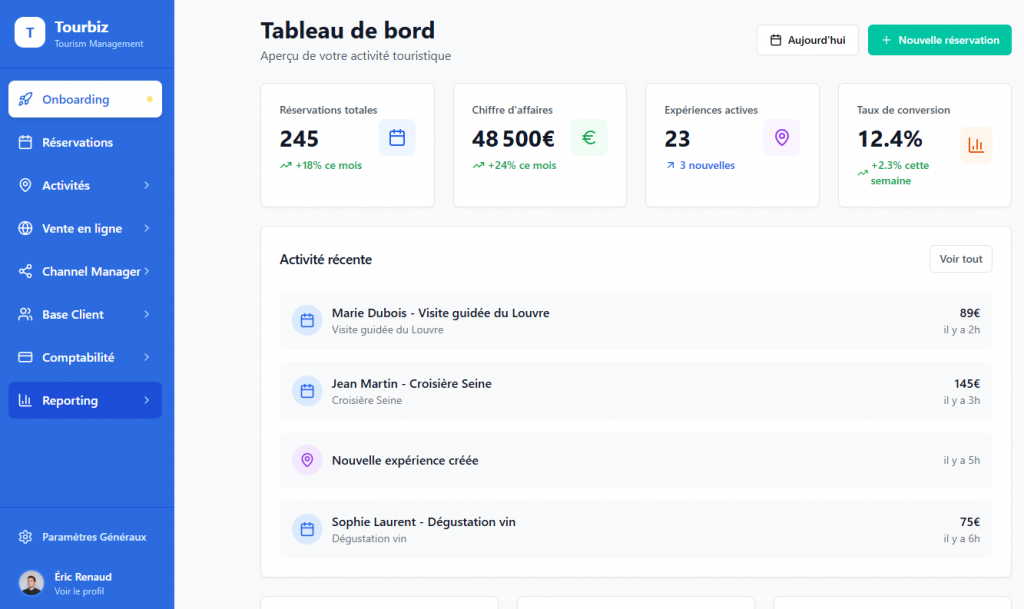
The promise of Tourbiz is simple: to centralize your bookings, your partners, and your sales in a single smooth interface. No more scattered tools, Excel sheets, and duplicate emails. The SaaS aligns your entire tourism value chain on the same dashboard.
Features designed for online booking
Tourbiz brings together the essential building blocks that an agency, tour operator, or local guide needs to manage its activity:
- Multichannel connection: real-time synchronization with your platforms (Viator, GetYourGuide, Google Things To Do, TripAdvisor…).
- Unified availability management: one inventory, automatically updated across all channels.
- Integrated payment and invoicing: no need for external tools or additional gateways.
- Statistics and reporting: track your sales, margins, and partners at a glance.
- Review management: Tourbiz allows you to collect customer reviews and integrate them on comparison sites like Tripadvisor or Google My Business.
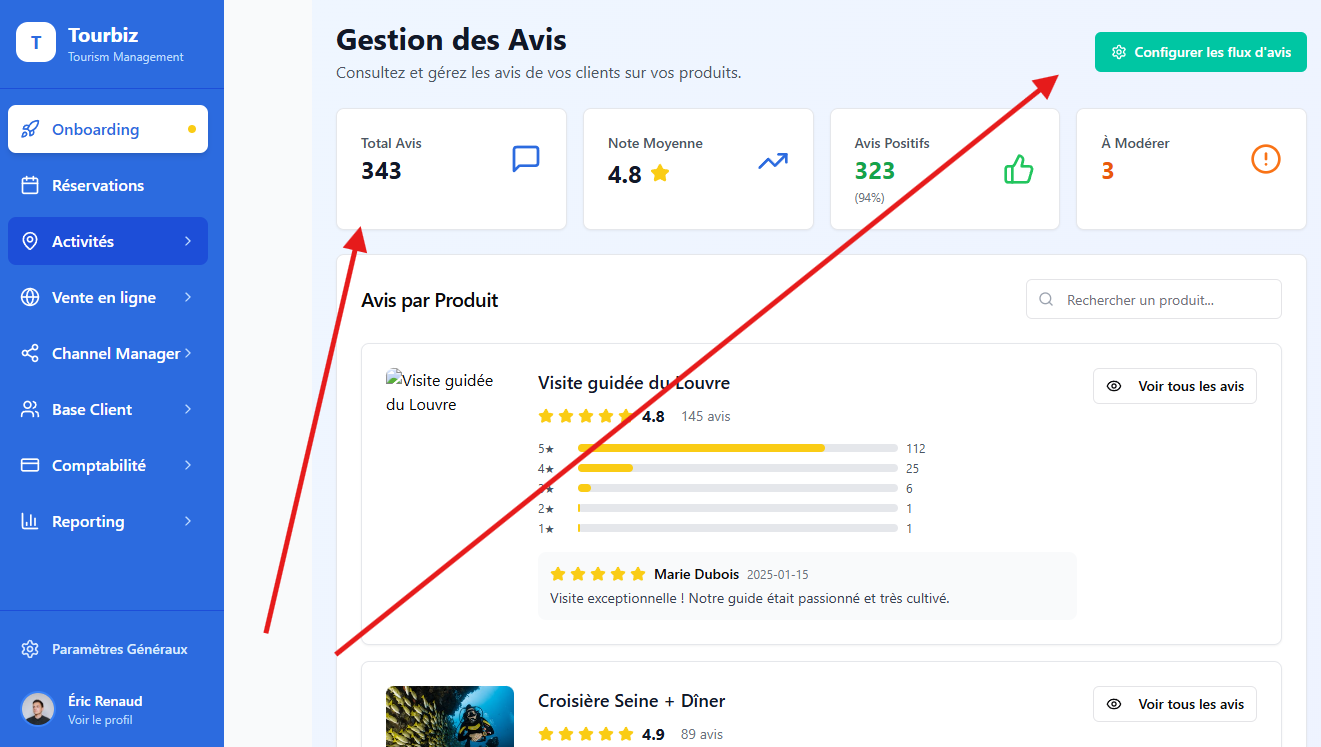
Thus, you save time, reduce errors, and increase your online visibility. Each booking becomes traceable and manageable, from the initial click to payment.
Concrete example of a Tourbiz use case: connect GetYourGuide or Viator in one click
Thanks to Tourbiz’s native connectors, integrating your OTA accounts takes less than five minutes. You no longer have to juggle between different platforms or manually update your products.
In practice:
- You connect your Viator or GetYourGuide account from the dashboard;
- Your products and availability synchronize automatically;
- Each booking made on a platform instantly appears in Tourbiz.
This process is detailed step by step in our GetYourGuide & Viator guide.
The concrete benefits for agencies and operators
Beyond time savings, the benefits of Tourbiz directly translate into your results:
- Fewer manual tasks: everything is automated, from stock updates to invoice issuance – Tourbiz handles electronic invoicing to new standards for tourism;
- Fewer overloads and errors: no more double bookings or scheduling inconsistencies;
- More profitability: total control over your channels, prices, and performance.
Tourbiz thus becomes your daily cockpit to manage your partner network and maximize your sales. One platform, zero friction, 100% connected.