
What is a CRM for tourism and what is it used for in 2025?
A CRM (Customer Relationship Management) is much more than just a contact management tool. In tourism, it centralizes all interactions between your business and your travelers: quote requests, bookings, payments, feedback… The goal is clear: to provide a seamless experience for every customer, from the first click to the return from their trip.
In 2025, the tourism CRM becomes a hub of strategic data, powered by artificial intelligence and marketing automation. These technologies allow for the personalization of every communication, automate abandoned cart follow-ups, and anticipate customer needs.
- Automation: automatic follow-ups for quotes, payment reminders, post-stay notifications.
- Integrated AI: intelligent segmentation of travelers based on their purchasing behavior.
- Personalization: emails and offers tailored to the customer’s preferences (type of trip, season, budget).
Who are the stakeholders? Everyone: from travel agencies to tour operators, including DMCs, travel planners, and independent guides. A well-configured CRM allows everyone to save time and transform a simple customer data point into a lasting relationship.
Why do tourism professionals need a specialized CRM?
The tourism sector has its own challenges: seasonality, the multiplicity of channels (website, marketplaces, social networks, WhatsApp), and above all, an ever-increasing customer demand for responsiveness.
A specialized CRM offers a tailored response.
- Data centralization: every customer interaction is recorded and accessible to the entire team.
- Sales optimization: tracking bookings, automatic cross-selling, simplified campaign management.
- Customer loyalty: personalized programs, proactive communication, post-stay follow-up.
Let’s take a concrete example. A travel agency using a CRM can automatically follow up with past travelers as soon as a new offer matches their preferences. It can also track the performance of its salespeople in real-time thanks to a unique dashboard.
Result: fewer lost emails, more sales, and a better customer relationship. Coupled with a good tourism reservation management tool, the CRM becomes the cornerstone of your commercial performance.
What are the best CRM software for tourism in 2025?
In 2025, competition among CRM solutions dedicated to tourism intensifies. The tools no longer just manage contacts: they automate sales, synchronize bookings, and integrate AIs capable of anticipating traveler behavior.
Here is a comparison of the CRMs that stand out the most for their adaptability, user experience, and native integrations with industry tools.
- Tourwriter: Flexible CRM designed for tour operators, with a dynamic itinerary module.
- Travefy: Ideal for travel planners, with a collaborative itinerary editor and real-time client tracking.
- HubSpot CRM (tourism version): Complete free version, rich in marketing automations and quote forms.
- Lemax: All-in-one solution tailored for high-volume agencies, integrated with OTA and GDS APIs.
- Zoho CRM Plus: Good value for money, multiplatform, customizable, and adaptable to your team’s size.
- Salesforce Travel Edition: The reference for large structures, powered by AI and compatible with most OTA platforms.
To help you in your choice, here is a comparison table of these tourism CRM solutions with their advantages and disadvantages:
| CRM Software | Positioning | Strengths | Limitations | Indicative pricing | Key integrations |
|---|---|---|---|---|---|
| Tourwriter | CRM & dynamic itinerary for tour operators | Modern and visual interface Custom itinerary construction Comprehensive client and sales tracking Good support for DMCs and receptive agencies | No advanced marketing automation Less suitable for small structures | From €120/month/user | Gmail, Outlook, Xero, Traveltek, Salesforce |
| Travefy | Collaborative CRM for travel planners and custom agencies | Very visual itinerary editor Real-time collaboration Integrated mobile app Sending interactive itineraries to clients | No accounting management Limited automations | From €40/month/user | Zapier, Gmail, Google Drive, Outlook |
| HubSpot CRM (tourism version) | Generalist CRM with marketing automation | Complete free version Native quote forms and sales funnel Powerful emailing tools Simple automations to set up | Limited tourism features High cost of advanced modules | Free then from €45/month | Booking.com, WordPress, Mailchimp, Zapier |
| Lemax | Complete CRM & ERP for agencies and tour operators | All-in-one solution: sales, production, invoicing Integrated OTA & GDS APIs Automation of booking flows Powerful analytical dashboards | Technical interface Long implementation | On request (average +€500/month) | Amadeus, Sabre, Expedia TAAP, Salesforce |
| Zoho CRM Plus | Versatile CRM for TPE & SMEs in tourism | Excellent value for money Emailing, support, and analytics modules included Clear and customizable interface High-performing mobile integration | Average learning curve Fewer native tourism connectors | From €57/month/user | Mailchimp, Zapier, Facebook Ads, WhatsApp |
| Salesforce Travel Edition | Premium CRM for large tourism structures | Very advanced automation Integrated AI for sales prediction High customization and security Modules specific to travel (Travel Cloud) | High price Complexity of deployment | From €300/month/user | GDS, OTA, SAP, HubSpot, Zendesk |
Before making your choice, focus on three essential criteria:
- Integrations: your CRM must be able to easily connect to your management and distribution tools.
- Customer support: fast, multilingual, available across multiple time zones.
- The interface: clear, mobile-friendly, with customizable dashboards.
To go further, discover our complete guide on OTAs and their CRM integration to boost visibility and online sales.
How to choose the most suitable tourism CRM for your activity?
Choosing a CRM is primarily about choosing a growth lever. But before comparing tools, you need to analyze your concrete needs: how many travelers do you manage? Which channels generate the most sales? What exchanges do you want to automate?
Start by prioritizing your objectives. For a small agency, ease of use and contact personalization are paramount. For a DMC, it’s the integration with sales platforms and suppliers that will make the difference.
- Identify your needs: rely on your data, your internal processes, and the volume of your bookings.
- Set up your dashboards: track your leads, performance, and margins in real-time.
- Automate without overloading: follow-ups, quotes, post-trip reminders… but without losing the human touch.
Beware of common mistakes:
- Underestimating customer service: a CRM without effective support quickly becomes a burden.
- Neglecting personalization: a generic message does not foster loyalty. Each customer segment must have its tone.
- Ignoring third-party integrations: the right CRM connects to your tourist guide planning management or accounting tools.
In short, the best CRM is not the most expensive, but the one that integrates naturally into your professional daily life.
How does Tourbiz integrate with your favorite CRM to boost your activity?
Tourbiz is not intended to replace your CRM. It aims to enhance it. The goal is simple: to allow you to centrally manage bookings, payments, and communications while keeping your customer data up to date in your usual CRM environment.
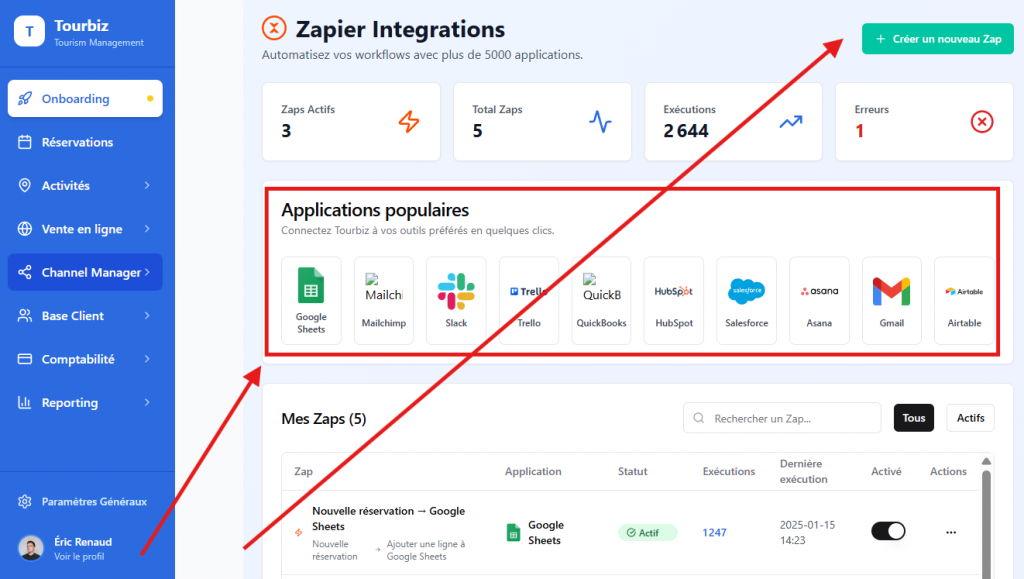
Thanks to its webhooks, Zapier, and open APIs, Tourbiz integrates in minutes with most tourism CRMs on the market: HubSpot, Lemax, Zoho, or Salesforce Travel. You can thus automate data transfer without going through manual exports.
- Direct connection: synchronize bookings and client records in real-time between Tourbiz and your CRM.
- Automation: new leads generated on Tourbiz are automatically added to your marketing campaigns in HubSpot or Zoho.
- Complete tracking: every customer interaction (quote, payment, message) is recorded for 360° management.
Combining Tourbiz and your CRM also ensures a more precise view of sales and better tracking of your operations. For example, payments recorded on Tourbiz can trigger personalized marketing automations in your CRM or launch an automatic follow-up after the trip.
The right tools change everything: our roundup of booking software for tourism compares what the market offers.
Want to go further? Discover how the Tourbiz-CRM integration simplifies the management and tracking of tourism sales on a daily basis.