
📌 Key takeaways
- Funbooker is a French online booking platform that lists more than 8,000 leisure activities across France.
- Signing up and listing activities are free: Funbooker only earns a commission of around 20% (incl. VAT) on confirmed bookings.
- The prices shown are the same as yours: the provider bears the commission in exchange for the visibility.
- Becoming a partner (funpro) goes through a form, profile validation, then creating your activity listings.
- A connected booking software like Tourbiz syncs availability with Funbooker and avoids double bookings.
- Thanks to an exclusive partnership between Tourbiz and Funbooker, sales made through Funbooker carry no variable fee on the Tourbiz side, unlike other OTAs.
Do you run a leisure activity and are you looking to sell your activities on Funbooker to fill your slots without piling on marketing effort? This French platform lists more than 8,000 leisure activities bookable in a few clicks, powered by thousands of providers: sports clubs, leisure parks, workshops, guides. For a provider, becoming a funpro partner means leaning on the platform’s audience and marketing budget in exchange for a commission. What’s left is to understand how it really works: what it takes, how to open a funpro account, and how to sell without turning your calendar into a headache. This guide covers it all, from account creation to selling best practices, and shows how software like ours simplifies connecting to Funbooker.
What is Funbooker and which providers is this platform for?
Funbooker is a French leisure-activity booking platform, born from a startup, that connects consumers looking for experiences with the professionals who run them. You’ll find everything from outdoor sports to workshops, theme parks and unusual or cultural activities. In practice, Funbooker works like a marketplace: the platform brings visibility and audience, collects payment from the customer, then pays the provider the amount minus its commission. It is one of the players we detail in our guide to OTAs, the online booking platforms Tourbiz connects to. For an activity provider, becoming a funpro supplier therefore means adding a national distribution channel alongside direct sales.
What commission does Funbooker charge providers?
The question of cost always comes first. Good news: with Funbooker, signing up and listing your activities cost nothing. The platform earns only on performance, through a commission taken on each confirmed booking. That rate is around 20% (incl. VAT) of the sale price and varies by activity type. The commission is deducted at source: Funbooker collects payment from the customer, keeps its share, and pays you the rest. To protect your margins, it helps to frame your multi-channel pricing policy upfront.
| Item | With Funbooker |
|---|---|
| Sign-up and listing | Free |
| Commission | Around 20% (incl. VAT) per confirmed booking, depending on the activity |
| Deduction | At source, on the provider’s side |
| Payout | Weekly (Thursdays) or monthly, your choice |
This model has a direct consequence: the customer pays the same price as on your website, but your net margin is reduced by the commission.
One point is worth highlighting, because it is specific to us: thanks to an exclusive partnership between Tourbiz and Funbooker, we charge no variable fee on sales that go through Funbooker. You only pay the platform’s commission, with no extra cost on our side, whereas connecting to other OTAs comes with variable fees. Plugging Funbooker in through Tourbiz therefore does not increase your distribution cost.
💡 Good to know: Like every marketplace, Funbooker reports the amount of sales made through the platform to the tax authorities each year, and sends you a summary. This is the European DAC7 framework (impots.gouv.fr). Remember to reconcile these amounts with your accounting.
Why sell your activities on Funbooker as a provider?
The appeal of a platform like Funbooker comes down to one word: visibility. It is hard for a small provider to rank at the top of Google or to fund advertising all year round. By joining a catalogue of more than 8,000 activities, you lean on the platform’s audience and marketing budget. The concrete benefits are as follows:
- An audience already there: customers actively looking for an activity to book.
- Prices identical to yours: the customer pays no more, you fund the commission.
- Filling off-peak slots, with no extra marketing effort.
- A channel that complements your own website, so you don’t depend on a single source of bookings.
The idea is not to bet everything on Funbooker, but to make it one channel among several. The providers who do best keep control of their direct sales while capturing, through platforms like GetYourGuide (see our guide to becoming a GetYourGuide supplier), Viator or Tiqets, a clientele they would not have reached otherwise.
How do you become a Funbooker partner (funpro)?
Joining Funbooker as a professional, a status called “funpro”, takes three steps, with no entry fee. The logic is close to that of other platforms: it is more or less the same process as becoming a supplier on Viator.
Step 1: fill in the “Become a funpro” form
Go to Funbooker’s “Become a funpro” page and complete the application form. Registration is free: the platform only earns a commission. An advisor then gets back to you to kick off the account setup. Prepare a few things before you start:
- The name and type of your activity.
- Your geographic area and professional contact details.
- A sense of how many slots you can open each week.
Step 2: validate your profile and administrative details
Once contacted, you validate the information needed to activate the account. This step is still free and determines when your activities go live. Have the usual documents of a leisure professional ready:
- Your SIRET (French business registration) number and company details.
- A professional liability insurance certificate.
- Your bank details (RIB/IBAN) to receive your weekly or monthly payouts.
Step 3: create and publish your activities
You then edit your activity listings: title, description, photos, prices and availability calendar. Publishing is free and you are visible as soon as the first listing goes live. Some partners even get their first booking on publication day. For each activity, take particular care with:
- Bright photos that truly represent the real experience.
- A clear description: duration, required level, what’s included, meeting point.
- An up-to-date calendar, to avoid turning customers away or selling a slot that is already full.
💡 Want to sell on Funbooker without spending your days on it?
With Tourbiz, connect Funbooker to your back office, sync your availability and manage all your bookings, across every channel, from one place. And thanks to our exclusive partnership with Funbooker, zero variable fee on our side on your Funbooker sales.
Create my free accountHow do you sell well on Funbooker?
Being present is not enough: on a marketplace, visibility rewards listings that are complete, well rated and regularly updated. A few levers, useful here as well as when you sell on Tiqets, really make the difference.
- Fill in each listing 100%: the more detailed an activity, the better it stands out in results.
- Collect customer reviews: the average rating weighs heavily on ranking and on the booking decision.
- Adjust your prices and offer deals in off-peak periods to capture demand.
- Keep your calendar up to date, on Funbooker as on your other sales channels.
⚠️ Warning! Selling on Funbooker in addition to your own site and other OTAs multiplies your booking sources, but also the risk of a double booking if your calendars are not synced. Selling the same slot twice means a disappointed customer and often a negative review.
How does Tourbiz simplify connecting to Funbooker?
At Tourbiz, we see Funbooker as one channel among others, to plug in without complexity. Rather than managing a separate Funbooker calendar, we sync it with your back office through our OTA integration: an activity created once is distributed and kept up to date automatically.
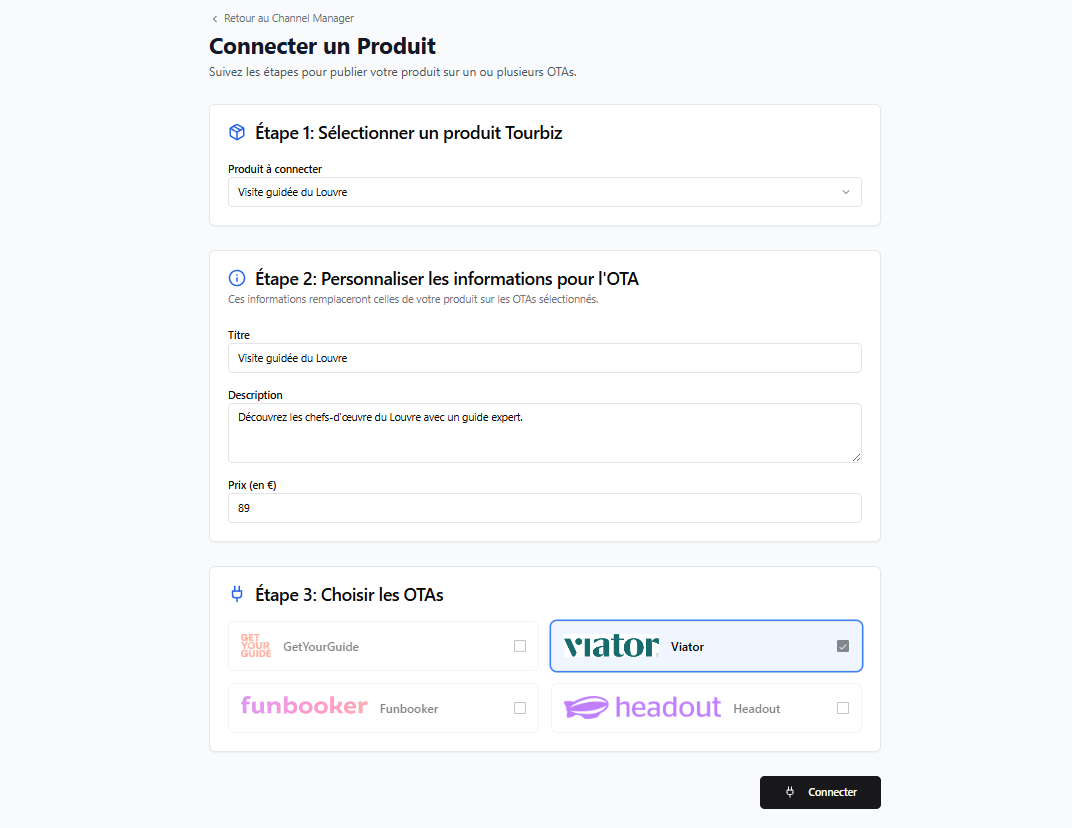
Concretely, here is what we automate for our clients present on Funbooker:
- The real-time synchronisation of availability, to avoid double bookings between Funbooker, your site and other platforms.
- The centralisation of Funbooker bookings in the same calendar as the rest of your business.
- The creation of products only once, then distributed to the connected channels.
- Sales tracking per channel, to measure what Funbooker really brings you.
The result: Funbooker becomes an additional source of bookings, with no double entry and no overbooking. The technical side stops being a hurdle and becomes a simple setting.
🎯 Our tip: Because we charge no variable fee on sales made through Funbooker, our clients use this channel without having to trade off visibility against profitability: each Funbooker booking costs them only the platform’s commission, not a cent more on our side. It’s an advantage specific to our exclusive partnership that other connected OTAs don’t offer.
FAQ: selling on Funbooker
What types of activities can you sell on Funbooker? ↓
How much does Funbooker cost for a professional? ↓
How do you become a Funbooker partner? ↓
What is Funbooker’s commission? ↓
Does Funbooker charge to sign up? ↓
Does connecting Funbooker to Tourbiz cost extra? ↓
Can you connect Funbooker to booking software? ↓
Selling on the other distribution platforms
To distribute your activities more widely, explore our other guides to selling on the major booking platforms:
![Sell on BilletRéduc: become an advertiser and list your events [2026]](https://tourbiz.fr/wp-content/uploads/2025/09/Reporting.png)
![Sell on Ceetiz: become a partner and list your activities [2026]](https://tourbiz.fr/wp-content/uploads/2026/07/Ouvrir-une-agence-de-voyage-conseiller-en-agence-de-tourisme-1-300x232.jpg)
![Sell on Cap Adrénaline: become a partner and list your activities [2026]](https://tourbiz.fr/wp-content/uploads/2026/07/EBITDA-tourisme-analyse-de-la-rentabilite-dune-activite-touristique-300x151.jpg)