
📌 Key takeaways
- Bokun is a booking and distribution software built by Tripadvisor, the parent company of Viator.
- Its B2B marketplace connects providers (suppliers) with more than 2,600 resellers and OTAs, at a negotiated commission.
- Bokun charges booking fees of 1% to 1.5%, dropped to 0% on sales made through Viator, on top of each reseller’s own commission.
- Becoming a supplier means creating an account, connecting your inventory, then joining the marketplace to set your distribution deals.
- Since Bokun is itself a booking software, a French alternative like Tourbiz covers the same needs (booking, calendar, OTA connections) with support in your language.
Are you an activity provider looking to sell on Bokun to distribute your experiences at scale? Acquired by Tripadvisor, Bokun is not a classic OTA: it is both a booking software and a B2B marketplace that connects providers to thousands of resellers. For a tourism professional, the challenge is twofold: understanding what Bokun really brings, and checking whether the tool suits a business run from Europe. This guide breaks down how Bokun works, its pricing, the steps to become a supplier, and then compares this solution with an alternative designed for the local market.
What is Bokun and which providers is this solution for?
Bokun is a booking and distribution solution built by Tripadvisor, the same group as the OTA Viator. It combines two parts: on one side, booking management software (products, availability, payments); on the other, a B2B marketplace that connects providers, known as suppliers, with resellers, travel agencies, hotels and other operators. Where a classic OTA sells directly to the traveller, Bokun mainly plays the role of a distribution hub: you list your activities there, then set up resale deals at a negotiated commission. It is a logic close to the one described in our channel manager guide, the tool that syncs a single inventory across several channels. For an activity provider, Bokun is therefore for those who want to industrialise their B2B distribution, provided they accept an environment designed first for the international market.
How much does Bokun cost and what commission does the platform charge?
Bokun does not charge a commission in the sense of an OTA, but booking fees. The model rests on a percentage taken on each booking processed, generally between 1% and 1.5%, plus, depending on the plan, a software subscription. A particularity tied to belonging to the Tripadvisor group: bookings that go through Viator carry no Bokun fee. On the other hand, as soon as a marketplace reseller sells one of your activities, the commission negotiated with that reseller applies, often within the sector’s usual range, on top of the Bokun fees. Before you start, frame your profitability channel by channel with rigorous sales tracking.
| Item | With Bokun |
|---|---|
| Booking fees | 1% to 1.5% per booking processed |
| Viator bookings | 0% Bokun fee (Viator commission applies) |
| B2B marketplace | Commission negotiated with each reseller |
| Subscription | Depending on the chosen plan (booking software) |
This possible stacking, booking fees plus reseller commission, makes a precise margin calculation essential before opening each new distribution deal.
💡 Good to know: Like every marketplace, Bokun reports the amount of sales made through the platform to the tax authorities each year, and sends you a summary. This is the European DAC7 framework (impots.gouv.fr). Remember to reconcile these amounts with your accounting.
Why use Bokun to distribute your activities?
Bokun’s appeal lies in its distribution power and its direct link to the Tripadvisor and Viator ecosystem. The concrete benefits are as follows:
- Access to a marketplace of more than 2,600 resellers and OTAs, hard to reach individually.
- A direct connection to Viator, with no Bokun fee on those bookings.
- The ability to resell or bundle other suppliers’ products to create combined offers.
- A single technical base to sync one inventory across several channels.
One major limit remains for a local player: the tool, its support and its documentation are designed first for the international market. This is one of the reasons many providers compare Bokun with local solutions before choosing, just as they do between the big OTAs in our comparison of the best OTAs.
How do you become a supplier and sell on Bokun?
Getting started on Bokun follows a three-step logic: equip your business with the software, join the marketplace, then activate your distribution channels. Here is the method.
Step 1: create your account and connect your inventory
The first step is to open a Bokun account and create your products there: titles, prices, availability and time slots. Creating the account is free to start with, through a plan with no subscription where you only pay a fee per booking. This is the foundation that will then feed all your channels, and its quality determines whether resellers pick up your activities. Prepare before you start:
- The catalogue of your activities with descriptions and photos.
- Your net rates and price categories (adult, child, group).
- Your availability calendar and booking rules.
Step 2: join the marketplace and set your distribution deals
Once your products are in place, you join the Bokun Marketplace to become visible to resellers. Joining the marketplace is free: you only pay when a sale is made. There you define the commission you grant each partner and the resale terms. It is a commercial negotiation as much as a technical setting, because each deal sets the net price you earn. For each channel, determine:
- The distribution commission granted to the reseller.
- The activities you make available for resale.
- Any exclusivities or geographic restrictions.
Step 3: connect to OTAs and publish
You can finally plug in your sales channels, starting with Viator: the connection is free and carries no Bokun fee on those bookings. As deals are signed, your activities become bookable through a network of partners. The process is reminiscent of the one in our guide to becoming a supplier on Viator. To publish smoothly, make sure to:
- Keep an availability calendar up to date at all times.
- Check the consistency of your prices across channels.
- Track the first bookings to fine-tune your deals.
💡 Looking for a European alternative to Bokun?
With Tourbiz, manage your bookings, your calendar and your payments, and connect to OTAs from a single interface, with support in your language.
Create my free accountHow do you distribute your activities well when you sell on Bokun?
Whether you go through Bokun or another solution, distribution success rests on the same fundamentals as when you sell on Headout or on any marketplace. A few levers really make the difference.
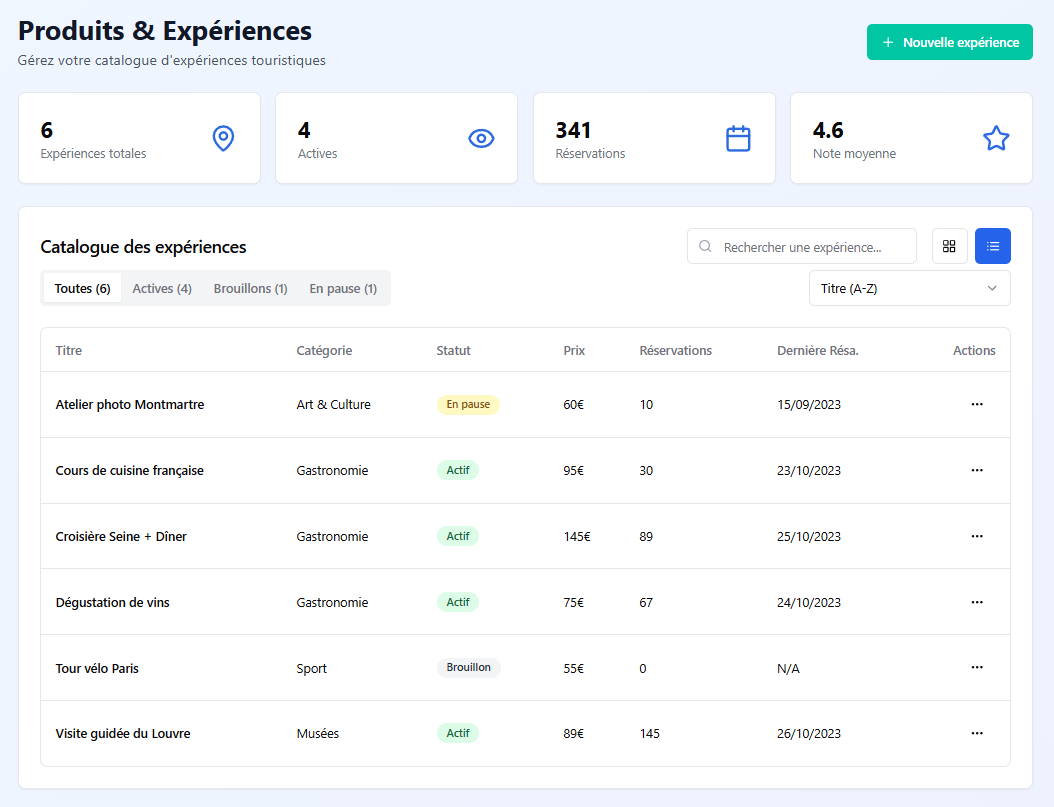
- Polish your product listings: complete descriptions, sharp photos, practical information visible.
- Keep a real-time calendar to avoid selling a slot that is already full.
- Frame your commissions reseller by reseller to protect your margin.
- Collect reviews: reputation weighs on how you are featured across all channels.
⚠️ Warning! Multiplying resellers through a marketplace multiplies points of sale, but also the risk of overselling if your calendars are not synced in real time. A booking confirmed on a slot that is already full means an unhappy customer and a negative review.
Bokun or Tourbiz: which solution to sell and manage your activities?
Let’s be clear: Bokun is above all a booking software, exactly like Tourbiz. The choice is therefore not about connecting to Bokun, but about the solution that will run your business day to day. At Tourbiz, we have built a European alternative that covers the same needs, booking, calendar, payments, while staying accessible and supported in your language.
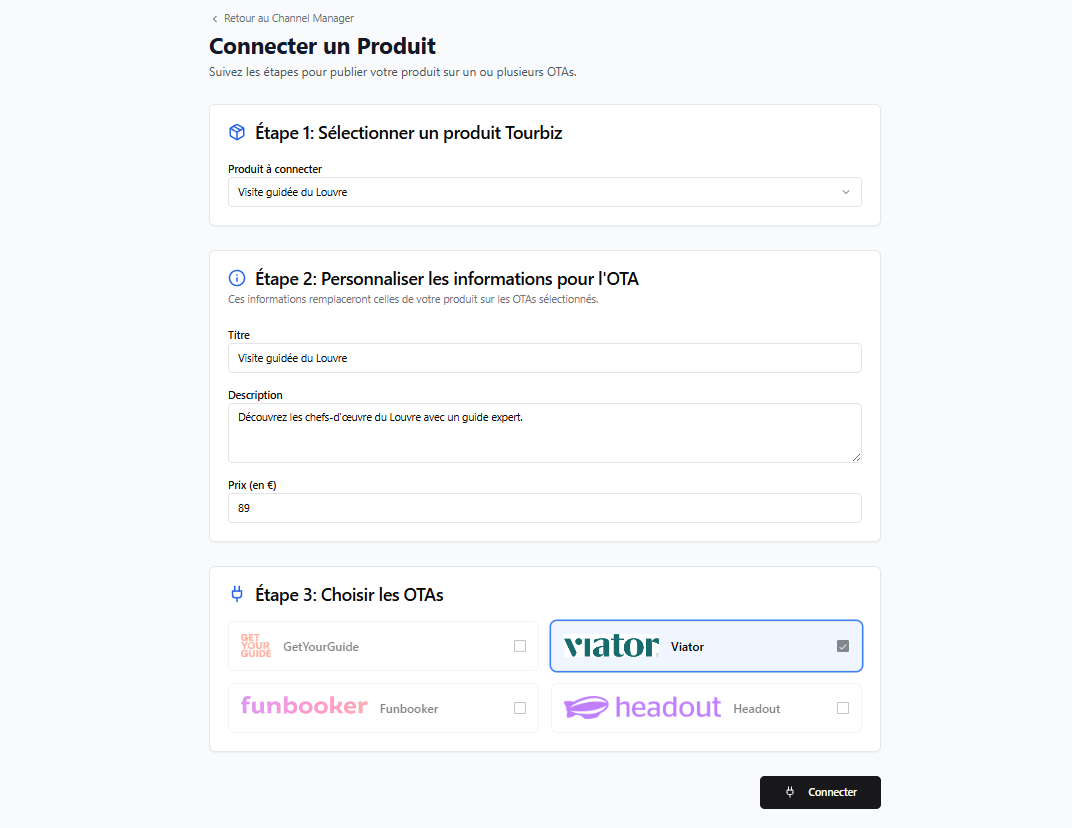
Concretely, we centralise your bookings and connect you directly to the major OTAs through our OTA integrations, without going through an extra distribution intermediary. You keep control of your prices and your calendar, with a contact who understands the specifics of your market. Here is what we simplify for our clients:
- The management of bookings and calendar from a single back office in your language.
- The direct connection to major OTAs, without a distribution layer on top.
- The real-time synchronisation of availability to avoid overselling.
- Local support, from setup to your first sales.
🎯 Our tip: At Tourbiz, our clients who hesitated with an international tool tell us the real gain is being able to talk to someone who knows their market when a setting gets stuck. The technical side can be caught up; the time lost deciphering a platform designed for elsewhere cannot.
The right reflex is not to systematically pit tools against each other, but to choose the one whose scope, support and model match your business. For a provider who sells mostly locally and wants to stay in charge of their distribution, a local solution often ticks more boxes.
FAQ: selling on Bokun
Is Bokun an OTA? ↓
How much does Bokun cost for a provider? ↓
How do you become a supplier on Bokun? ↓
Bokun and Viator: what’s the link? ↓
Is there a European alternative to Bokun? ↓
Do you need software to connect to OTAs? ↓
Selling on the other distribution platforms
To distribute your activities more widely, explore our other guides to selling on the major booking platforms:
![Sell on Funbooker: become a funpro partner and list your activities [2026]](https://tourbiz.fr/wp-content/uploads/2026/07/Prestataire-dactivites-de-loisirs-gerant-ses-reservations-en-ligne-300x225.jpg)
![Sell on BilletRéduc: become an advertiser and list your events [2026]](https://tourbiz.fr/wp-content/uploads/2025/09/Reporting.png)
![Sell on Ceetiz: become a partner and list your activities [2026]](https://tourbiz.fr/wp-content/uploads/2026/07/Ouvrir-une-agence-de-voyage-conseiller-en-agence-de-tourisme-1-300x232.jpg)