📌 Key takeaways
- Tiqets is a Dutch online ticketing platform specialised in museums, monuments and attractions, with more than 2,500 venues in its catalogue.
- Signing up as a supplier is free: Tiqets only earns a commission, on a shared-margin model.
- Tiqets’ strength is the instant mobile ticket and an international audience, with multilingual customer support available 24/7.
- Becoming a supplier goes through the “Become a Supplier” form, validation by an account manager, then submitting products to the supplier portal.
- Tiqets integrates with many connectivity partners (OCTO API): software like Tourbiz syncs availability and bookings in real time.
Do you run a museum, a monument or an attraction, and are you looking to sell your tickets on Tiqets to reach an international clientele? Founded in Amsterdam in 2014 and now backed by the giant Expedia, this OTA has become a benchmark in tourism ticketing, with more than 2,500 attractions in its catalogue. For a venue, becoming a supplier means reaching a global audience without building your own booking engine, with an instant mobile ticket to boot. This guide explains concretely how to become a Tiqets partner: the shared-margin commission model, the steps to open a supplier account, the best practices for selling your tickets, and finally how to connect the platform to your booking software.
What is Tiqets and which venues is this OTA for?
Tiqets is a Dutch platform for booking tickets to museums, monuments and attractions, founded in Amsterdam in 2014 and today part of the Expedia group. Its specialty: the single ticket, booked online and instantly available on mobile, often skip-the-line. Where other OTAs, which we review in our comparison of the best OTAs, cover a broad range, Tiqets has focused on cultural ticketing and attractions, with a catalogue of more than 2,500 venues worldwide. It is a curated marketplace: each product goes through a review before going live, which raises the quality of the listings. For a museum or an attraction, becoming a Tiqets supplier therefore means adding an international distribution channel alongside direct ticketing.
What commission does Tiqets charge its suppliers?
Like most OTAs, Tiqets charges neither a sign-up fee nor a subscription: the platform only earns money when you sell. Its model rests on a shared margin: Tiqets makes its money on the gap between the price paid by the customer and the net rate you set, once payment fees are deducted. In other words, you provide your net rates, and the platform builds its public sale price on top. Tiqets does not publish a single rate, as it varies by agreement and volume, but it sits within the usual range of the attractions sector. To avoid eroding your profitability, remember to optimise your margins by framing your multi-channel prices before you start.
| Item | With Tiqets |
|---|---|
| Sign-up | Free, no subscription |
| Model | Shared margin (commission on the gap between public price and net rate) |
| Rates | You provide your net rates, Tiqets sets the public price |
| Curation | Each product is reviewed before going live |
This net-rate model has one advantage: you control the amount you actually earn for each ticket sold.
💡 Good to know: Like every marketplace, Tiqets reports the amount of sales made through the platform to the tax authorities each year, and sends you a summary. This is the European DAC7 framework (impots.gouv.fr). Remember to reconcile these amounts with your accounting.
Why sell your tickets on Tiqets when you run an attraction?
For a cultural venue or an attraction, Tiqets’ strength is twofold: an international audience and a buying experience designed for mobile. The concrete benefits are as follows:
- Global visibility to travellers who book their visits before they even arrive.
- The instant ticket on smartphone, which limits queues and drop-offs.
- Multilingual customer support provided 24/7 by the platform.
- A curated marketplace, a quality signal that reassures buyers.
As with other marketplaces, the same logic applies as when you sell on Funbooker or on GetYourGuide: Tiqets brings you customers you would not have reached on your own, in exchange for a commission. It’s up to you to make it a channel that complements your direct ticketing.
How do you become a supplier on Tiqets?
Creating a supplier account on Tiqets takes three steps, with no fee or commitment. The process is reminiscent of the one described in our guide to becoming a GetYourGuide supplier, with an extra curation step.
Step 1: fill in the “Become a Supplier” form
From the “Tiqets for venues” area, click “Become a Supplier” and enter your venue’s details. Registration is free: Tiqets only earns a commission. A dedicated account manager then reviews your request and confirms the opening of the account. Prepare before you start:
- The name, type and address of your venue or attraction.
- Your company details (business registration, professional contact).
- The languages offered and the capacity per time slot.
Step 2: access the supplier portal and create your products
After validation, you get access to Tiqets’ Supplier Portal. There you create your first products, entering net rates and the calendar. This step is still free and prepares your listing for sale. For each ticket, provide:
- The ticket type (standard entry, skip-the-line, guided tour).
- Your net rates and any categories (adult, child, group).
- The availability calendar and time slots.
Step 3: pass curation and publish
Each submitted product goes through Tiqets’ curation rules before going live. Once approved, your ticket is available for sale, often within a few days. Publishing is free: you only pay the commission on sales made. To pass curation without back-and-forth, take care with:
- Quality photos, representative of the venue and the experience.
- A clear description: what’s included, the duration, access conditions.
- Practical information (address, opening hours, accessibility).
💡 Want to sell on Tiqets without the extra hassle?
With Tourbiz, connect Tiqets to your back office, sync your availability in real time and manage all your bookings, across every channel, from a single screen.
Create my free accountHow do you sell your tickets well on Tiqets?
On a curated marketplace like Tiqets, visibility rewards listings that are complete, up to date and well rated. These best practices also apply when you sell on Headout and on most attraction platforms. A few levers really make the difference.
- Fill in each listing 100%: the more detailed a ticket, the better it stands out and converts.
- Keep a real-time calendar: nothing is worse than a ticket sold for a slot that is already full.
- Collect reviews: the rating weighs on ranking and reassures travellers.
- Set up the instant ticket to offer the immediate access Tiqets is known for.
⚠️ Warning! Selling on Tiqets in addition to your own ticketing and other OTAs multiplies channels, but also the risk of overselling if your calendars are not synced. A ticket sold twice for the same slot means an unhappy visitor at the door and a negative review.
How does Tourbiz simplify connecting to Tiqets?
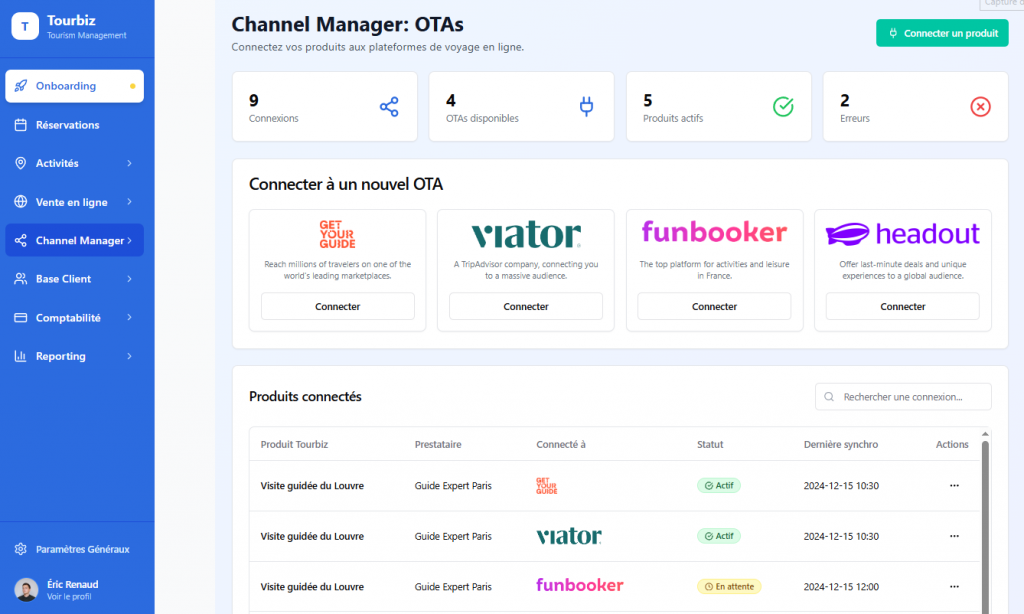
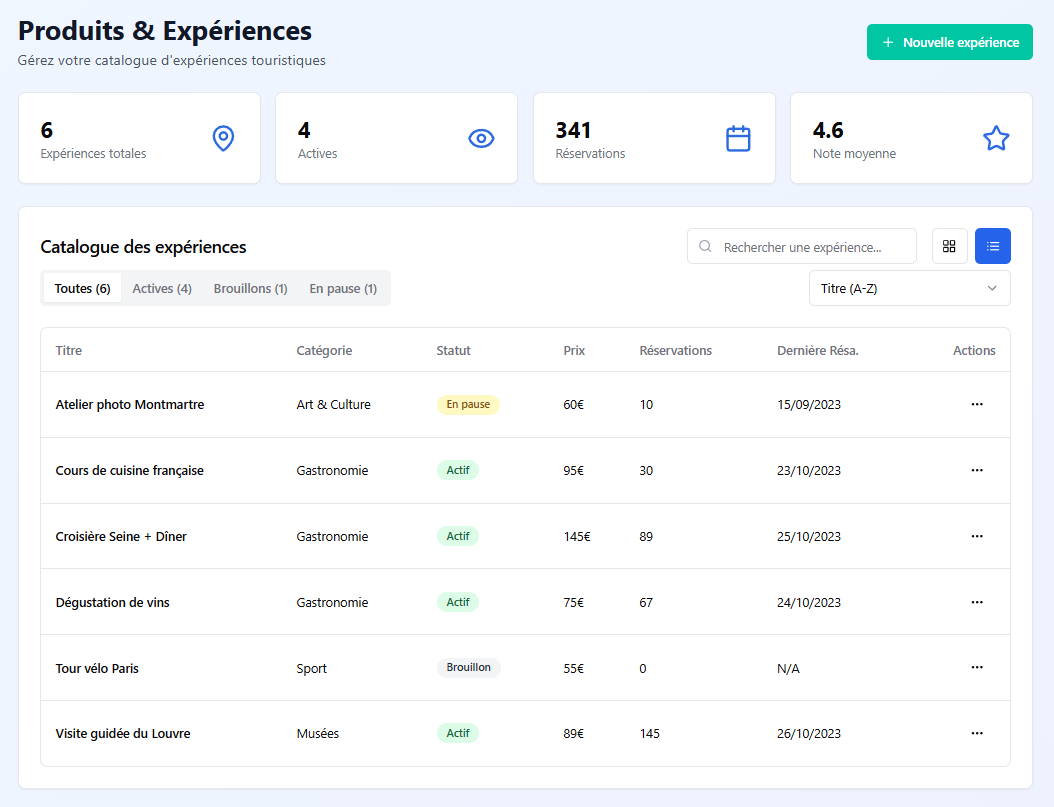
At Tourbiz, we connect Tiqets to your back office through our OTA integrations and an API compatible with the sector’s connectivity standards (OCTO). An activity or ticket created once is pushed to Tiqets and kept up to date automatically, with no double entry.
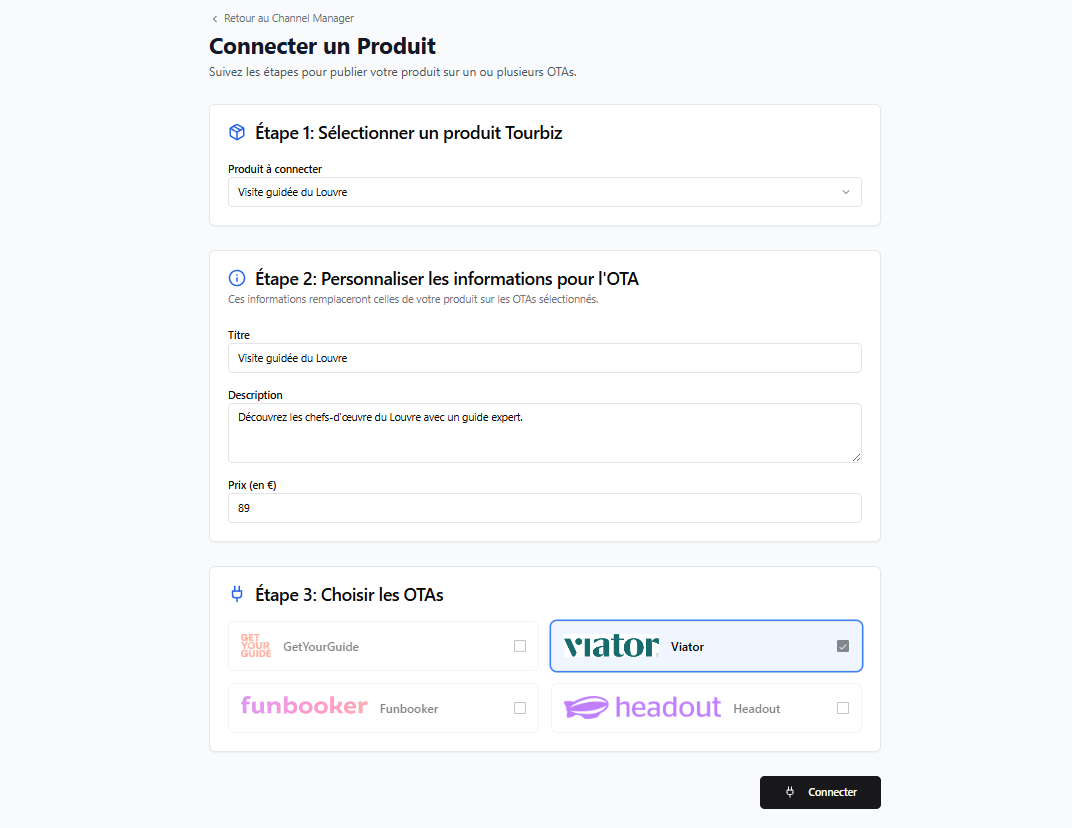
Concretely, here is what we automate for our clients present on Tiqets:
- The real-time synchronisation of availability, to avoid overselling between Tiqets, your site and other platforms.
- The centralisation of Tiqets bookings in the same calendar as the rest of your business.
- The creation of products only once, then distributed to the connected channels.
- Sales tracking per channel, to measure precisely what Tiqets brings you.
🎯 Our tip: At Tourbiz, our clients who manage ticketing often start by syncing their calendar before anything else. It’s the setting that immediately removes the risk of overselling, the first worry when you add a channel like Tiqets.
By connecting Tiqets to Tourbiz, you turn a demanding marketplace into a simple sales channel: you keep control of your net rates and your calendar, and online ticketing stops being a technical constraint and becomes a genuine lever for filling your venue.
FAQ: selling on Tiqets
Which venues can sell on Tiqets? ↓
How much does Tiqets cost for a supplier? ↓
How do you become a supplier on Tiqets? ↓
What is Tiqets’ commission? ↓
Is Tiqets a good fit for a European venue? ↓
Can you connect Tiqets to booking software? ↓
Selling on the other distribution platforms
To distribute your activities more widely, explore our other guides to selling on the major booking platforms:
![Sell on Funbooker: become a funpro partner and list your activities [2026]](https://tourbiz.fr/wp-content/uploads/2026/07/Prestataire-dactivites-de-loisirs-gerant-ses-reservations-en-ligne-300x225.jpg)
![Sell on BilletRéduc: become an advertiser and list your events [2026]](https://tourbiz.fr/wp-content/uploads/2025/09/Reporting.png)
![Sell on Ceetiz: become a partner and list your activities [2026]](https://tourbiz.fr/wp-content/uploads/2026/07/Ouvrir-une-agence-de-voyage-conseiller-en-agence-de-tourisme-1-300x232.jpg)