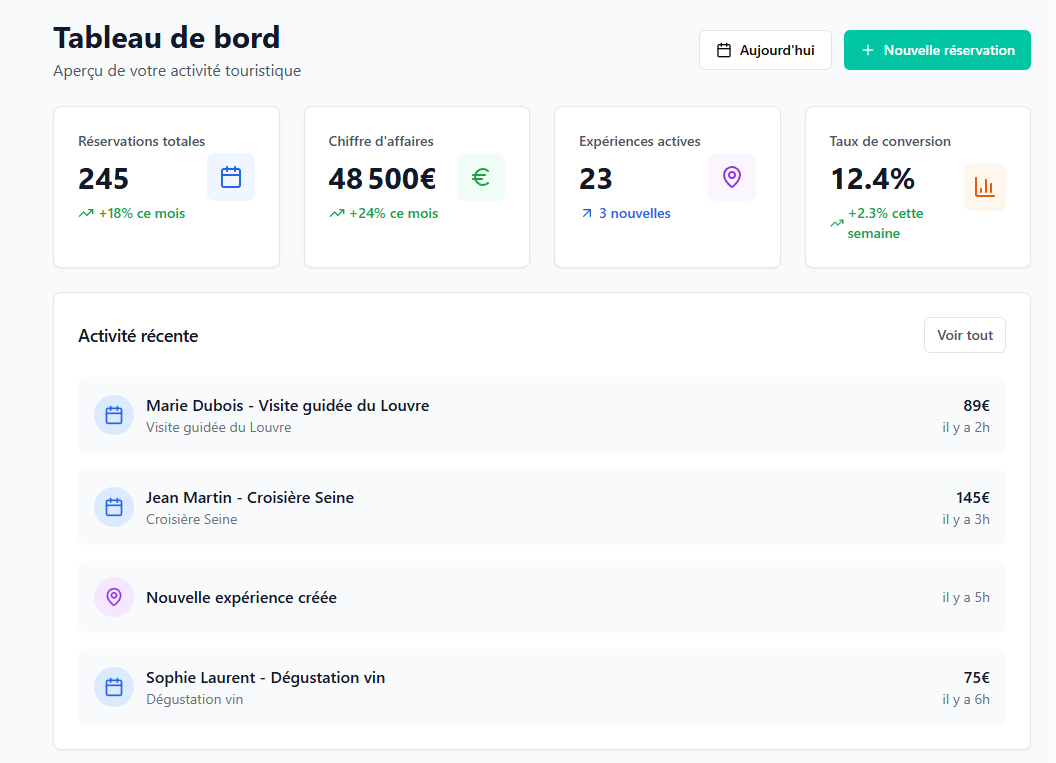

What is a travel agency in 2025 and how does it work?
In 2025, the travel agency is no longer that office with posters of tropical islands and stacked brochures. It is an agile, connected structure that combines human expertise and technological power. Its role: to design authentic experiences and simplify booking in a market where travelers compare, customize, and book in just a few clicks.
The concept of agency has profoundly evolved since the digitalization of tourism. The boundary between physical agency, online booking site, and custom travel creator is blurring. What matters today is the ability to support the client throughout their journey, from inspiration to loyalty.
New agency models
- Modernized physical agencies: they focus on human advice, local partnerships, and reassurance to attract a clientele attached to direct contact.
- Hybrid agencies: they combine point of sale and digital platform, streamlining the customer relationship across all channels.
- 100% digital agencies: operated in the cloud, automated and without a storefront, they reduce their costs and optimize online distribution.
Key trends in the tourism market 2025
The major dynamics redefining agency strategies are clear:
- Sustainability: travelers are looking for low environmental and social impact stays.
- Personalization: focusing on offers tailored to the profiles and preferences of each client.
- Artificial intelligence: improves itinerary recommendations, request management, and customer support.
- Customer experience: storytelling and emotion replace simple rates or destinations.
With the added bonus of an ecosystem that opens up to technology with online visibility solutions that did not exist 10 or 15 years ago.
This is particularly the case for OTAs or Google Things To Do.
To understand how agencies integrate into large digital ecosystems, check out our guide on the connection to Google Things to Do.
Why create a travel agency in 2025?
Creating a travel agency in 2025 means taking advantage of a rethought market, more conscious, more connected, and paradoxically, more human. After the crisis of 2020-2022, travelers have changed: they want meaning, contact, and security. Agencies capable of meeting these expectations are experiencing continuous growth.
A market rich in opportunities
The margins in the sector are recovering. The rebound in leisure, hybrid business travel, and custom tours open new perspectives. European destinations, more sustainable and accessible, attract a clientele seeking quality rather than volume.
New expectations of travelers
- Authenticity: local experiences, charming accommodations, cultural immersion.
- Security: guarantees, assistance, cancellation flexibility.
- Custom-made: personalized journeys from the inspiration phase.
The advantages of a modern agency model
- Automation: centralized bookings, invoicing, and customer follow-up.
- Multichannel distribution: presence on OTAs, social networks, and tourist search engines.
- Customer loyalty: data and CRM enable smarter relationship marketing.
To go further, discover how to find clients in tourism and develop your presence without relying on major distributors.
What are the steps to follow to create a profitable travel agency?
Creating a profitable travel agency is not just about selling trips. It is a structured, strategic project based on a deep understanding of the market and travelers. Here are the key steps to build a solid model from the start.
Step 1: Market study and positioning definition
First of all, identify your niche. Tourism is vast: ecotourism, business travel, premium stays, sports adventures… Each segment has its codes and clients. A good market study helps understand demand, competition, and the most profitable channels.
- Analyze trends and emerging destinations.
- Test your value proposition with a small group of travelers.
- Adapt your offers to specific personas rather than overly general audiences.
Step 2: Choice of status, licenses, and insurance
To operate legally, registration with a commercial register and obtaining professional civil liability insurance are essential. In France, the Atout France registration remains the key to operate legally.
- Choose a status: auto-entrepreneur, SASU, or SARL depending on your growth ambitions.
- Obtain the mandatory financial guarantee from an accredited organization.
- Ensure coverage against risks related to cancellations and booking errors.
Step 3: Brand strategy and client acquisition
Your brand must inspire trust and a desire for escape. A clear name, a fast website, and consistent visuals are integral to the strategy. To attract the first clients, invest in natural referencing (SEO), social networks, and strong local partnerships.
Discover how to improve your visibility on Tripadvisor and boost your reputation with travelers in 2025.
Step 4: Technology and essential tools
A profitable agency relies on a smooth technological infrastructure: booking management, CRM, accounting automation. Cloud solutions allow centralizing clients, suppliers, and payments on a single platform.
- Use a connected booking management software.
- Automate the sending of client documents and follow-ups.
- Connect your partners via API to limit data entry errors.
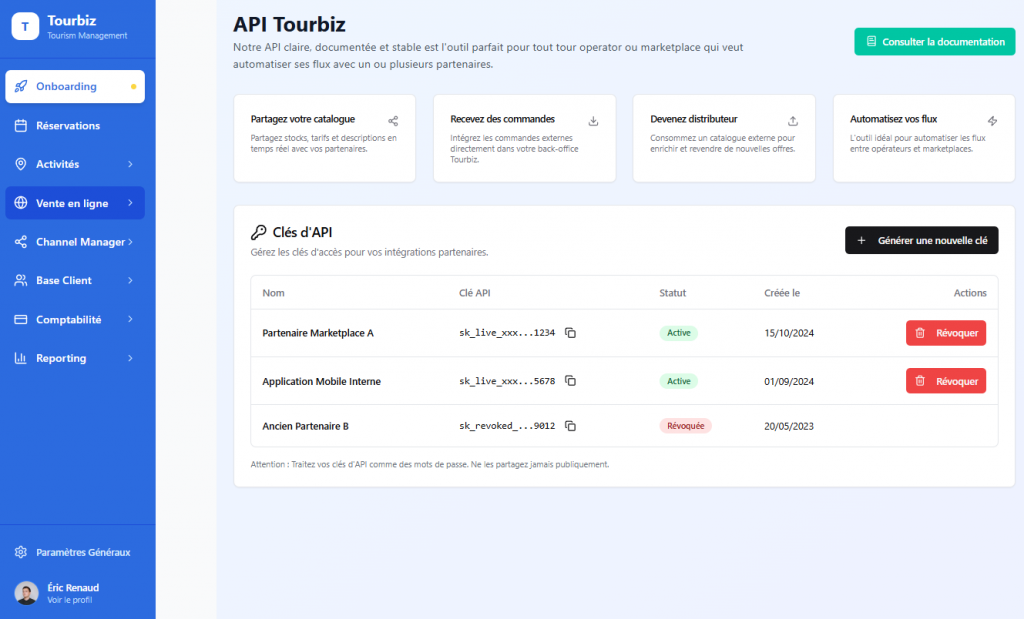
Step 5: Management, analysis, and development
Once the activity is launched, profitability comes from rigor. Monitor your performance indicators: conversion rate, average basket, customer acquisition cost. Adjust your pricing policy according to the seasons to remain competitive.
To delve deeper, check out our tips to optimize your pricing policy and maintain your margin each season.
What tools and software to use to manage your agency effectively?
The right technology transforms a craft agency into a smooth booking machine. In 2025, the difference lies in automation, synchronization, and data quality. Here are the pillars to integrate into your digital stack.
The best agency management software in 2025
The most effective solutions centralize the catalog, sales, accounting, and customer relations. The goal: to reduce manual tasks and maximize customer satisfaction.
- Booking tools: availability and payment management platforms.
- Integrated CRM: tracking interactions, segmentation, and automatic follow-ups.
- Accounting software: automatic synchronization of invoices and payments.
Automation and smart connectors
APIs and AI connectors save valuable time: automatically respond to requests, synchronize stocks, or generate clear dashboards. Integration between tools is becoming the norm to reduce operational burden.
- Direct connection with sales platforms (Viator, GetYourGuide, Booking, etc.).
- Centralized dashboards on the cloud to monitor performance.
- Integration of chatbots and messaging solutions like WhatsApp Business.
For a concrete overview of the best client communication practices, check out our guide on managing bookings via WhatsApp for tourism and improve your real-time follow-up.
How to manage and connect your agency to Tourbiz to simplify your activity?
Tourbiz has become the essential ally for agencies that want to switch to autopilot mode. The platform centralizes all the essential bricks to manage your activity: bookings, CRM, payments, reporting, OTA integrations… without juggling between ten interfaces.
The goal? To offer a smooth experience for both agencies and travelers, while reducing repetitive tasks and human errors.
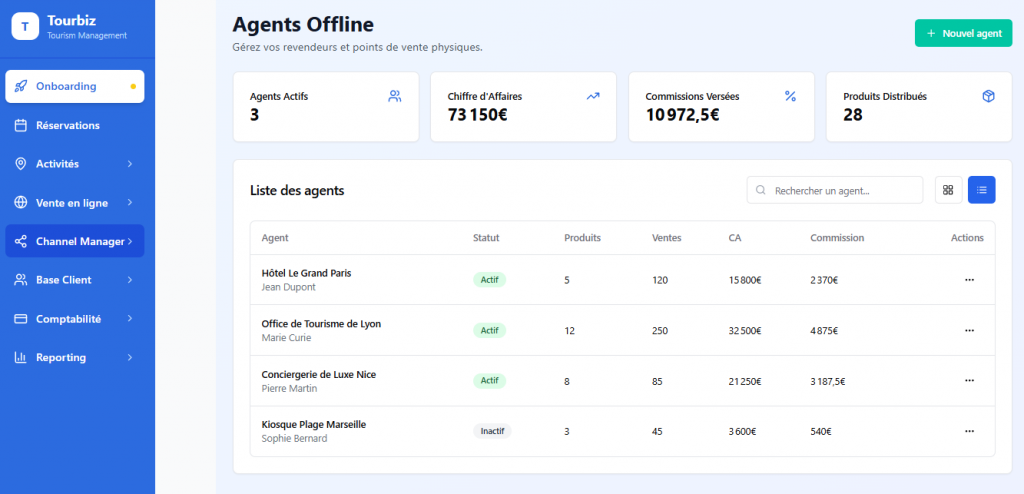
The key features of Tourbiz
Tourbiz is not just a management tool; it is a true all-in-one dashboard for travel professionals. Among the most used features:
- Centralized booking management: all your sales, whether from your site, an OTA, or a local partner, are automatically synchronized.
- Integrated CRM: history of each client, automatic follow-ups, segmentation by profile and travel preferences.
- Intelligent reporting: real-time indicators to track revenue, product performance, or distribution channels.
Thanks to this unified approach, agencies gain clarity and responsiveness across the entire value chain.
Integration with major partner platforms
Tourbiz connects directly to market leaders like GetYourGuide, Viator, Booking, or Expedia. This allows for inventory sharing, real-time price adjustments, and avoiding overbookings.
These integrations offer a huge competitive advantage: you remain visible where travelers book, without losing control over your margins or your data.
To learn more about choosing partner platforms, read our complete guide on the comparison of Viator VS GetYourGuide.
Steps to connect your account and automate your management
Getting started on Tourbiz is done in a few simple steps:
- 1 – Account creation: enter your agency name, your contact details, and choose your subscription plan.
- 2 – Importing the product catalog: transfer your circuits, experiences, and availability. The system automatically categorizes them.
- 3 – Connecting to OTAs and providers: activate the connectors with one click to synchronize your inventories.
- 4 – Automating tasks: set up your client reminders, payment confirmations, and post-trip follow-ups.
In just a few days, Tourbiz transforms your back office into a smart agency cockpit. All without technical development or heavy investments.
With Tourbiz, every agency retains control over its data, accelerates its activity, and finally focuses on what creates value: the customer experience.