

What is a travel API and how does it work?
A travel API (Application Programming Interface) is a digital connector that allows two tourism platforms to exchange data in real-time.
In tourism, it connects, for example, your booking solution to suppliers of flights, hotels, or activities. As a result: you access an inventory that is continuously updated without ever leaving your own interface.
Specifically, an API acts as a translator between systems that do not “speak” the same language. It receives a request (example: “show available hotels in Lisbon for May 10, 2025”) and returns a structured response with the corresponding results.
There are several major families of APIs in the tourism sector:
- Transport API: to query flights, trains, airport transfers, bus routes.
- Accommodation API: to access hotel and vacation rental stocks.
- Activity API: to catalog museums, excursions, visits, and local experiences.
- Payment API: to secure and automate customer transactions.
On the technical side, the operation is based on a few simple principles:
- Requests and responses: sending a request (GET/POST) to a specific “endpoint”.
- Standardized formats: data is structured in JSON or XML, easily readable by developers.
- Authentication: with an API key, each partner identifies its requests and ensures the security of exchanges.
To learn more about integrating tourism partners, check out our dedicated guide to connecting GetYourGuide.
Why have travel APIs become essential for tourism professionals?
Travel APIs are no longer just a technological asset. They are now a pillar for companies in the sector that want to remain competitive in a rapidly evolving market.
Optimize internal management and reduce manual tasks
Updates on availability, real-time rates, and synchronization of bookings are automated. Less double entry, fewer errors, and immediate visibility on stocks. This automation lightens your teams and streamlines the customer journey. To enhance this efficiency, check out our article on managing tourist reservations.
Instant access to a global inventory
Thanks to APIs, even a small local agency can offer a catalog worthy of a large group: flights, hotels, cruises, tours, or tailor-made experiences. Everything updates instantly based on supplier data.
An enriched customer experience
The seamless integration of multiple services into a single interface improves the user journey. The API allows you to personalize offers according to your travelers’ preferences and behaviors: type of activities, seasonality, budget.
A competitive advantage and new sources of revenue
APIs also open the door to data monetization and the creation of unique experiences. By connecting multiple sources, you can recommend dynamic stays, relevant local activities, or personalized upgrades.
As a result: better-controlled margins, a higher conversion rate, and loyal customers.
The best travel APIs to know today
The market for tourism APIs has professionalized. Gone are the makeshift integrations: big names in travel now offer solid, secure, and documented connectors. The choice will depend on your use – bookings, content, or payment – but also on your technical level.
Booking APIs
Amadeus, Skyscanner, and Booking.com remain the pillars. They offer global catalogs, complete access to rates, and proven reliability. Skyscanner, for example, exposes multi-carrier flight data that can be used to inspire and convert.
- Amadeus Travel API: ideal for B2B and OTA distribution.
- Skyscanner API: quick access to the most competitive prices on the market.
- Booking.com API: management of hotel availability in real-time.
Activity and experience APIs
Whether you are a receptive agency or a tour operator, these interfaces allow you to offer local activities in real-time. TripAdvisor, GetYourGuide, and Viator each have their own specifics in terms of catalog and business model. For a complete comparison, check out the comparison on getyourguide and viator.
- TripAdvisor API: reviews, ratings, and rankings to inspire trust.
- GetYourGuide API: thousands of local experiences ready to integrate.
- Viator API: ideal for marketplaces selling day excursions.
Payment and management APIs
Stripe and PayPal Travel simplify cross-border transactions and reduce the risk of fraud. Duffel Payments, newer, targets tourism startups with advanced automation needs.
- Stripe API: flexible payment processing, multi-currency management.
- PayPal Travel: simple integration, maximum customer trust.
- Duffel Payments: designed for air transport players.
Before choosing, carefully compare documentation, developer support, costs, and response time (latency). These elements will weigh heavily in your long-term performance.
How to concretely integrate a travel API into your solution or platform?
Integrating a travel API is not just a matter of code. It is a structured process that goes from obtaining the access key to production deployment through the testing phase. When executed well, this step brings you stability and scalability.
1. Integration steps
- Obtain the API key: sign up on the developer portal of the provider (Amadeus, Skyscanner, etc.).
- Test in a “sandbox” environment: simulate requests without impacting the real system.
- Go live: secure your exchanges via HTTPS and authentication tokens.
2. Best practices for data management
Handle real-time flows with caution: cache non-critical data (like photos or descriptions of activities), while updating itinerant information several times a day: prices, availability, schedules.
3. Pitfalls to avoid
- Dependence on a single provider: always keep an alternative API ready to be activated.
- Excessive latency: monitor response times to avoid hindering your conversions.
- Compatibility: check data formats and encodings before interfacing multiple APIs.
4. Tools and resources to facilitate interconnection
Platforms like Postman or RapidAPI allow you to visualize and test exchanges before integration. For the tourism part, our guide on channel managers can help you understand how to effectively synchronize your accommodation or activity stocks.
Finally, document each connection: this simplifies internal support and reduces the risk of errors in the next update.
How to connect a travel API, like GetYourGuide, to your Tourbiz account
Tourbiz was designed to streamline the connection between your booking systems and the largest platforms on the market. In just a few clicks, you can link suppliers like GetYourGuide, Viator, or Booking Experiences directly from your Tourbiz dashboard, without writing a single line of code.
Native connectors available on Tourbiz
Tourbiz offers several ready-to-use connectors for the APIs of the main players in tourism. These connectors are already configured to interpret activity, rate, and availability flows. The goal: to save you the technical steps of manual integration and ensure total compatibility with your inventory.
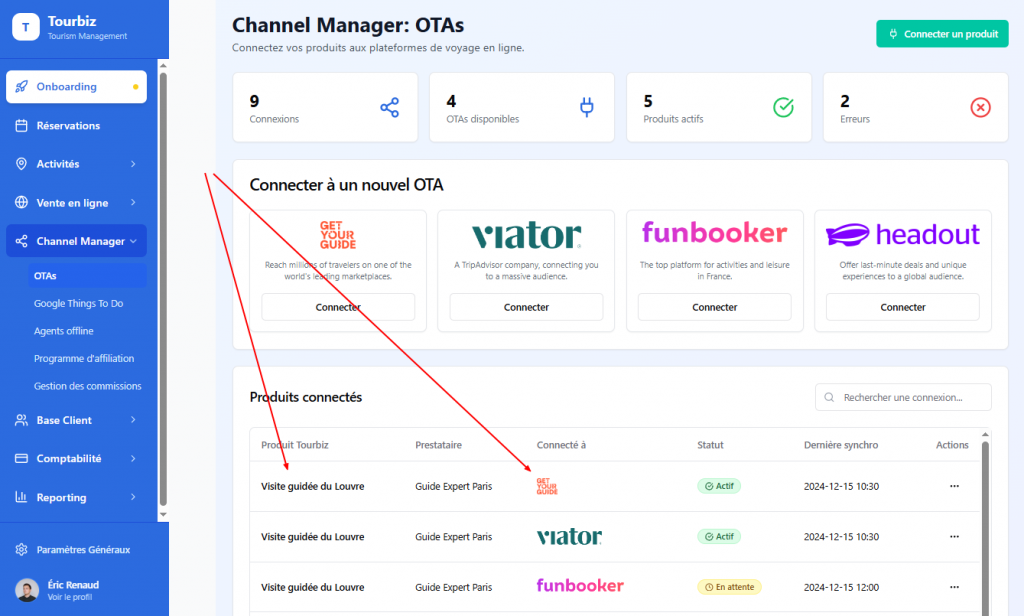
- GetYourGuide: to automatically retrieve your catalog of activities and excursions.
- TripAdvisor or Truspilot: to synchronize your reviews and local offers.
- Viator: to update your stocks across all connected platforms.
Learn more about how it works on the supplier side: how to find activities as a tour operator.
Configuration steps in the Tourbiz dashboard
Once in your Tourbiz environment, connecting to an external API takes just a few minutes:
- 1. Open the Integrations section in your admin space.
- 2. Add your API key obtained from the provider.
- 3. Activate synchronization and set the update parameters (real-time, scheduled, manual).
Tourbiz automatically validates the credentials and runs a connection test before publishing your offers.
Bonus: if you do not want to go through the API, you can also connect applications and create automated workflows thanks to our Zapier integration.
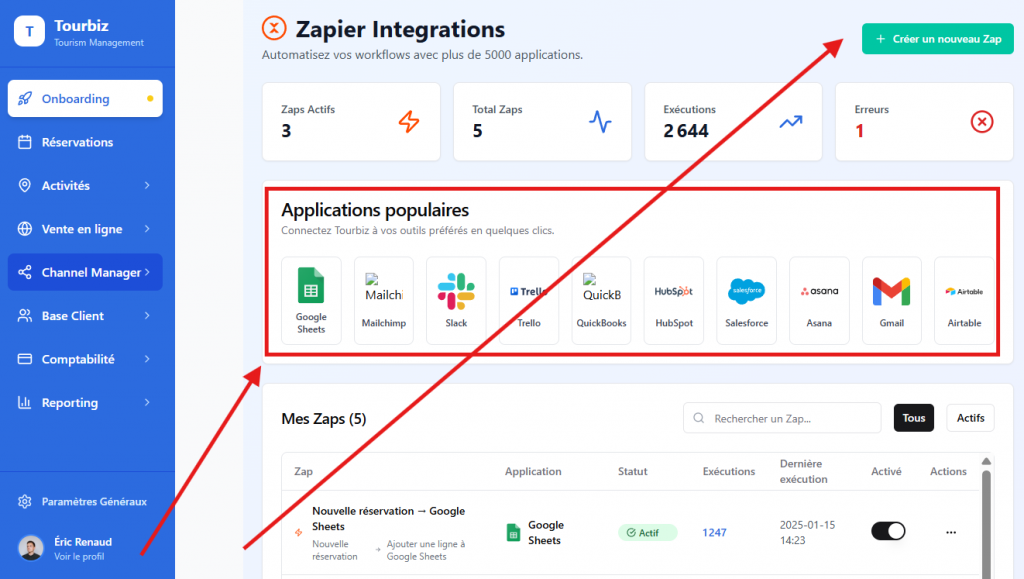
Automatic synchronization of catalogs and bookings
Once the link is established, the flows between Tourbiz and your supplier update without intervention. When an activity is booked via GetYourGuide, it is immediately recorded in your Tourbiz interface. Conversely, if you update a rate or availability on the Tourbiz side, the change is reflected in the partner API.
- Bidirectional synchronization: no more double entries, no more forgetfulness.
- Centralized management of stocks and availability in real-time.
- Unified reporting: your sales, commissions, and performances visible on a single interface.
Benefits for agents, agencies, and operators
For tourism professionals, this automation changes everything:
- Time savings: 80% fewer administrative tasks on bookings.
- Reduction of error risk: each operation is verified at the source.
- Increased visibility: your offers are available on multiple channels, without manual management.
- Better customer experience: availability is always accurate, confirmations are instant.
Surrounding yourself helps too: tourism associations bring professionals together and open networking opportunities.
By connecting your APIs directly to Tourbiz, you align your back office with market expectations: speed, reliability, and interoperability. And if you haven’t yet explored all the possibilities offered by GetYourGuide or Viator, start here: google things to do guide.