
What is a business plan for guided tours and what is it for?
A business plan for a guided tour activity is much more than just a financial document: it is the map that drives your tourism business. It outlines your concept, your objectives, and the strategy to achieve them. In a sector as competitive as that of local tours and experiences, it serves to convince investors, partners, and institutions of the solidity of your project.
In tourism, a good business plan is not just a spreadsheet. It must also reflect the reality on the ground: seasonality, guide management, equipment, partnerships with cultural venues or tourist offices.
The specifics of a guided tour activity:
- Seasonality: anticipate the variations in flow according to periods, particularly by anticipating how to manage clients in the low season.
- Human resources: juggle between permanent and seasonal guides.
- Logistics: plan transport, ticketing, audioguide equipment, necessary for smooth experiences.
- Local partnerships: work hand in hand with hotels, restaurants, museums, or artisans to create collective value.
The most common mistakes to avoid from the start:
- Not sufficiently estimating logistical costs (transport, insurance, licenses).
- Minimizing the marketing efforts necessary to exist against local competition.
- Underestimating the daily operational management of bookings and customer communication.
- Forgetting to analyze the profitability of each tour in relation to the human and material burden it imposes.
A well-designed business plan will help you avoid these pitfalls and structure solid foundations for your tourism project.
Why is a solid business plan essential for successfully conducting guided tours?
Creating a guided tour offer is exciting. But to last, intuition is not enough. The business plan is the tool that transforms an appealing idea into a credible model, aligned with your growth objectives and your actual resources.
- Securing funding or partnerships: banks, incubators, or tourist offices require a clear document to assess the viability of the project.
- Structuring your marketing and operational strategy: define your distribution channels, your prices, and your promotion strategies, relying for example on the optimal pricing policy according to demand and season.
- Anticipating material and human needs: the business plan helps you forecast these costs according to your ambitions — additional guides, vehicles, or digital tools.
- Measuring profitability: by linking sales objectives, margins, and marketing budgets, you define a dashboard of your performance.
Thus, a solid business plan becomes a daily management tool, capable of guiding your tactical choices as well as your strategic decisions. It is this compass that will make the difference between a fleeting guided tour activity and a sustainable tourism business.
How to build your guided tour business plan step by step?
Writing a business plan may seem intimidating, but by moving forward step by step, you will build a concrete document centered on your ground reality. Here are the essential points to integrate, in the logical order of construction.
Step 1: Define the concept and identity of your tours
Start by clarifying your concept. What story do you want to tell? What type of visitor are you targeting? Families, individual travelers, school groups, or companies in team building?
Your positioning should be felt immediately: tone of the tour, duration, type of experience (cultural, gastronomic, immersive…), but also the values that your tourism brand will embody.
Step 2: Study the local tourism market and competition
Market research is the foundation of your plan. It allows you to understand demand, seasonality, and the actors already present. Analyze local trends, booking platforms, and visitor volumes by season.
- Identify the strengths and weaknesses of competing tours.
- Map your priority targets and their booking channels.
- Leverage data published by tourist offices or chambers of commerce.
Step 3: Develop your offer, routes, and pricing
Your offer is the heart of your business plan. Detail your routes, duration, points of interest, and unique experiences. On the pricing side, set your prices based on your costs and the market. The idea is to be consistent, not necessarily the cheapest.
To go further on this point, read our guide on dynamic pricing.
Step 4: Implement a communication and sales strategy
Do not leave your communication to chance. Your strategy should combine online visibility and local partnerships:
- Create a strong presence on Google and tourist booking platforms.
- Work on your storytelling and visual identity.
- Maintain relationships with hotels, tourist offices, influencers, or partner agencies.
Step 5: Write the financial forecast
A good forecast summarizes your expected expenses and revenues: fixed costs (salaries, equipment, insurance), variable costs per tour, and revenue projections based on expected attendance. Be realistic, and also plan for a safety margin for low periods.
Each step should be documented, quantitative when possible, and linked to a concrete action to transform your idea into a profitable activity.
What tools and resources to use to create an effective guided tour business plan?
A good business plan relies on a reliable method and well-chosen tools. Today, the digital tourism ecosystem offers many resources accessible to independent guides as well as local agencies.
Business plan software suitable for tourism
Platforms like LivePlan or The Business Plan Shop offer financial plan templates and dashboards tailored to service and leisure activities. They save time on formatting and automatic margin calculations.
Specialized models and templates
Using a model dedicated to tourism is an asset. You will find examples of precise budgets: guide remuneration, transport, platform commissions, digital marketing costs, etc. You can customize them according to your type of activity (walking tour, biking, boating…).
Client data and insights
Local data is crucial: annual attendance, customer pools, online reviews. This information will help you adjust your routes and communication. Also analyze customer feedback from review platforms to better understand unmet expectations.
Solutions for managing bookings and scheduling
Your business plan must integrate the operational dimension. A smooth management of bookings and scheduling optimizes cash flow and improves the customer experience. If you do not yet have a centralized tool, discover our tips on managing tourist bookings.
Combining these tools allows you to structure your plan on solid foundations: concrete data, realistic projections, and a clear operational vision. This is the key to a business plan that does not remain a static document, but becomes a true strategic dashboard on a daily basis.
How to structure and manage your guided tour activity with Tourbiz?
Once your business plan is finalized, the key step is to link it to the daily reality of your activity. This is where Tourbiz becomes your best ally. This all-in-one platform transforms your financial and organizational forecasts into a real-time management system.
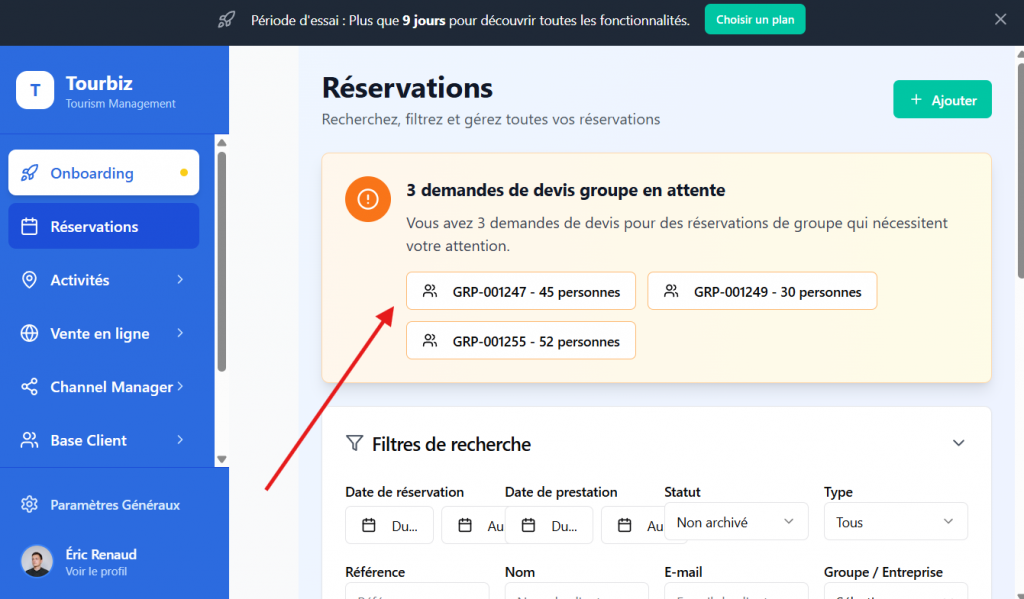
Integrate your business plan into Tourbiz
Your business plan is only valuable if it translates into operational indicators. With Tourbiz, you can connect your booking data, costs, and margins to obtain a clear view of your profitability. The tool helps you:
- Compare your forecasts with actual performance (revenue per tour, occupancy rates, operational expenses);
- Identify the most profitable tours and high-potential periods;
- Test different growth scenarios without wasting time on spreadsheets.
Track revenue, costs, and profitability in real-time
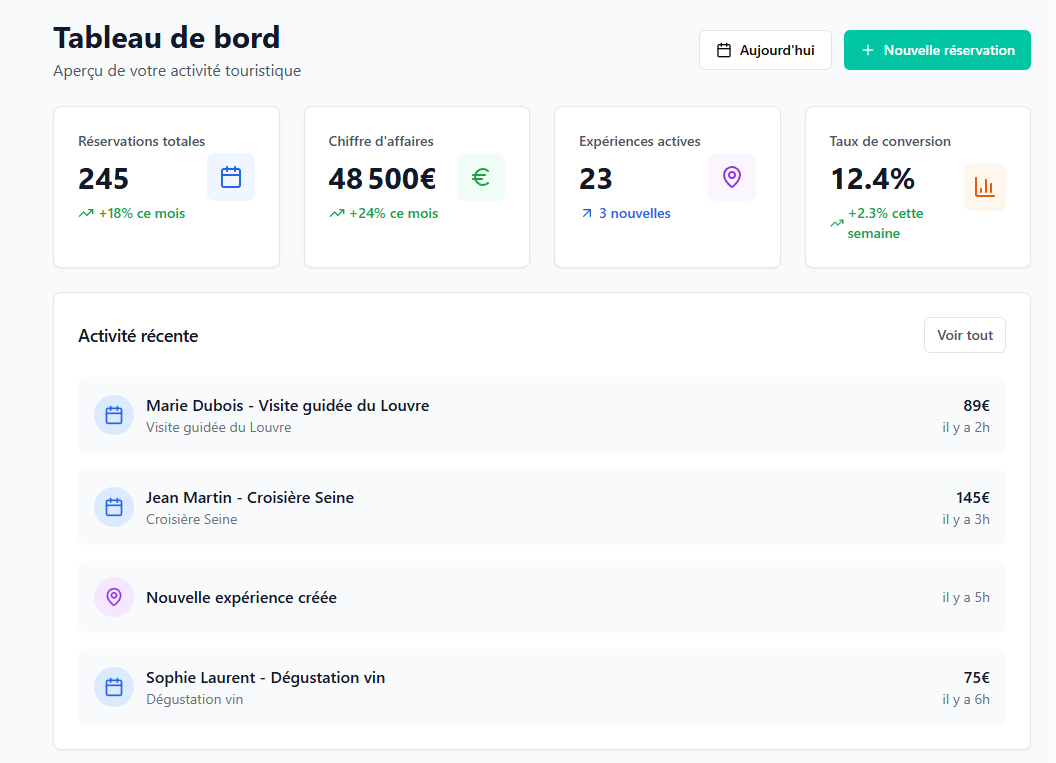
Thanks to its intuitive dashboards, Tourbiz centralizes the key figures of your business: turnover, commissions paid, margins per guide or per tour. You can instantly adjust your prices and resources according to the seasons and demand.
This dynamic tracking helps you better plan your activity and anticipate material or human needs, without waiting for the end of the season to correct course.
Connection to partner platforms
Tourbiz easily integrates with major tourist marketplaces. With one click, you can synchronize your availability, prices, and offers with Viator and GetYourGuide, two essential channels to boost your visibility and sales.
This interconnection reduces double entries and planning errors, while optimizing the distribution of your tours where travelers really book.
Optimize the customer experience and daily operations
Tourbiz is not limited to internal management: it improves every step of the customer journey. Automatic confirmations, reminders before visits, or post-experience reviews enhance satisfaction and loyalty.
- Fluid communication with your visitors and guides;
- Integrated tools for payments and invoicing;
- Centralization of reviews and customer feedback to refine your offers.
Coordinating people on the ground calls for proper tourist guide management, with schedules and assignments centralized.
In a word, Tourbiz transforms your business plan into a living tool. Every day, you move from a simple strategic vision to a concrete, smooth, and profitable management of your guided tours. Tourism is no longer managed by intuition — but with data, automation, and intelligent support.