
What is an independent travel agent?
The independent travel agent is a tourism professional who operates without being attached to a physical agency. They often work from home, online, or in coworking spaces, and manage their own portfolio of clients and partners.
How does it differ from a traditional agency?
Unlike a traditional travel agency, they do not have a storefront or fixed costs related to a commercial premises. Their model relies on flexibility, personalization, and a strong digital positioning. Many of these professionals use booking platforms and automation tools to effectively manage their business — like those presented in our guide on managing tourist bookings.
Definition and legal status
As an independent, the travel agent engages in a commercial activity governed by the Tourism Code. They must be registered with Atout France, provide proof of financial guarantee, and have professional liability insurance.
Depending on their model, they can work alone, be a franchisee, or join a network of independent travel agents. Each of these options influences their pricing freedom, commissions, and reputation.
Main activities and missions
- Travel planner: Designing personalized stays and tours
- Advising and supporting travelers
- Negotiating with providers: hoteliers, transporters, guides
- Selling and following up on bookings
- Administrative, marketing, and customer service management
Advantages and constraints of independence
Becoming an independent agent offers total freedom in choosing clients, partners, and strategy. It’s a flexible model, ideal for those seeking autonomy and innovation. But this freedom also comes with responsibilities:
- The need for strict cash flow management
- Constant prospecting for new clients
- A significant administrative burden
Possible statuses: self-employed, franchise, or network of independents
Several options are available for those who wish to create their independent travel agency:
- Self-employed: simplified regime, ideal for starting out
- Franchise: offers a framework, a brand, and ready-to-use tools
- Network of independents: pooling of services (back-office, training, support)
The choice of legal status depends on your level of experience, budget, and growth ambitions.
Why become an independent travel agent in 2024?
Tourism has evolved significantly since digitalization. In 2025, the market continues to explode in the personalization and unique experiences segment. Travelers want tailor-made solutions, and that’s precisely what the independent travel agent can offer them.
The rise of digital tools has also facilitated the daily management of tourism professionals. Connecting to activity, accommodation, and excursion platforms – like those detailed in our article on GetYourGuide and Viator – has made the profession more accessible and profitable.
Sector trends after digitalization
Booking behaviors have changed: the client researches online, compares offers, and seeks authentic reviews. The independent agent becomes an expert advisor, capable of filtering, adapting, and building a coherent experience around the client.
Freedom, flexibility, and opportunities for specialization
One of the great attractions of the independent status is the possibility to specialize:
- Sustainable adventure travel
- Luxury tourism
- Slow travel
- Group or incentive travel
- Authentic and local experiences
This specialization enhances perceived value and fosters client loyalty.
Profitability and growth prospects
An independent travel agent can achieve interesting profitability as early as the second year if they combine good expertise, a niche strategy, and optimized management. Digitalization and SaaS tools allow for reduced fixed costs and increased margin per client.
Testimonials and examples of successes
Since 2024, many independent agents have reported solid growth thanks to a clear strategy: specialization, controlled digital presence, and automation of repetitive tasks. This model inspires a new generation of travel professionals, more free, connected, and resilient.
What training should you follow to become an independent travel agent?
In a sector as competitive as tourism, training is a strategic lever. It provides the regulatory, commercial, and digital foundations necessary to launch with legitimacy and efficiency. Today, training programs are diversifying and adapting to all profiles, from recent graduates to professionals in transition.
To choose well, you need to consider three criteria: the desired level of autonomy, the speed of learning, and the ability to integrate modern digital tools. The evolutions of the profession, particularly related to online management and automation, are detailed in our channel manager guide.
Diploma courses (BTS, professional licenses, specialized masters)
Traditional programs provide solid foundations:
- BTS Tourism: focused on sales, designing tourism products, and customer relations.
- Professional license in tourism professions: deepens project management, marketing, and partnerships.
- Specialized master: aimed at targeting a managerial position or developing managerial skills before launching.
Short courses and distance certifications
Independents often prefer short and flexible formats: MOOCs, certifying courses, distance programs. These paths allow learning the basics of digital, regulation, and travel marketing directly from home.
Many organizations also offer specific modules on managing a freelance activity or online sales.
Essential skills
Becoming an effective agent does not solely depend on the diploma, but mainly on the concrete skills acquired over time:
- Sales techniques and customer relations
- Mastery of booking tools and inventory systems
- Skills in digital marketing and SEO
- Management of satisfaction and after-sales service
Available aids, grants, and support
Chambers of commerce, Pôle Emploi, and certain professional networks offer training and business creation aids. Independents can also benefit from funding through the CPF or regional support programs for business recovery.
The initial investment in training is quickly recouped: it conditions the credibility, effectiveness, and future growth of the activity.
How much does an independent travel agent earn and what are their prospects?
The income of an independent travel agent varies greatly depending on their business model, specialization, and the size of their client portfolio. In 2025, the majority of independents report a notable increase in their profitability, thanks to the digitalization of sales and diversification of services.
Average income by business model
- Self-employed or freelance: between €1,500 and €3,000 net per month, depending on seasonality and positioning.
- Affiliated with a network: between €2,000 and €4,500 net, with commissions shared with the structure.
- Online agency creator: up to €6,000 net monthly for well-established profiles, with a team or automated tools.
Factors influencing salary
- Experience and reputation with clients
- Level of specialization (high-end travel, MICE, cruises…)
- Monthly sales volume and signed partnerships
- Ability to retain and generate repeat business
Possible evolutions
The status of independent agent is a gateway to many opportunities:
- Create your own travel agency with a specific specialty
- Become a tour operator and design your own circuits
- Position yourself in premium segments: luxury, adventure, responsible tourism, or business travel.
Some agents also take advantage of the rise of travel design to transform into creators of tailor-made experiences.
Job market and prospects in 3–5 years
Forecasts for 2025–2030 indicate an increased demand for independent profiles capable of managing local and international clientele. Travelers seek a human, expert, and flexible service, where standardized agencies struggle to reinvent themselves.
In this context, a well-trained, agile agent connected to modern tools remains a safe bet in the digital tourism market.
How to optimize the management of your travel agent activity with Tourbiz?
The key to success for an independent travel agent is their ability to effectively manage their time, clients, and bookings. This is where Tourbiz changes the game. This SaaS platform brings together all the necessary tools to simplify the lives of tourism professionals: booking, reporting, automation, and connectivity to major market players.
The goal? To free you from time-consuming tasks while allowing you to focus on what matters most: creating memorable travel experiences.
Centralization of bookings and task automation
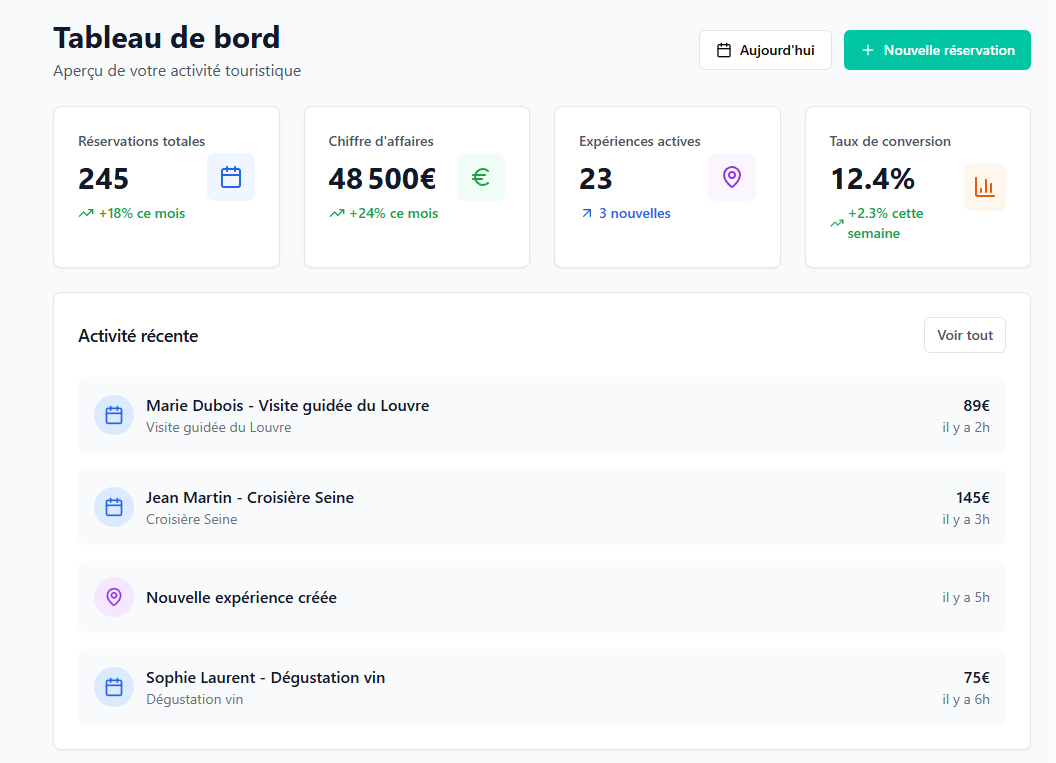
Tourbiz centralizes all your bookings in one dashboard. No more hours spent juggling between different platforms or manually checking each confirmation.
- Real-time synchronization of availability and statuses
- Automatic notifications for new bookings and changes
- Simplified export of data to Excel or your accounting
Thanks to its automations, you significantly reduce duplicates and the risk of errors, while gaining up to 30% productivity on a daily basis.
Connection to partner platforms
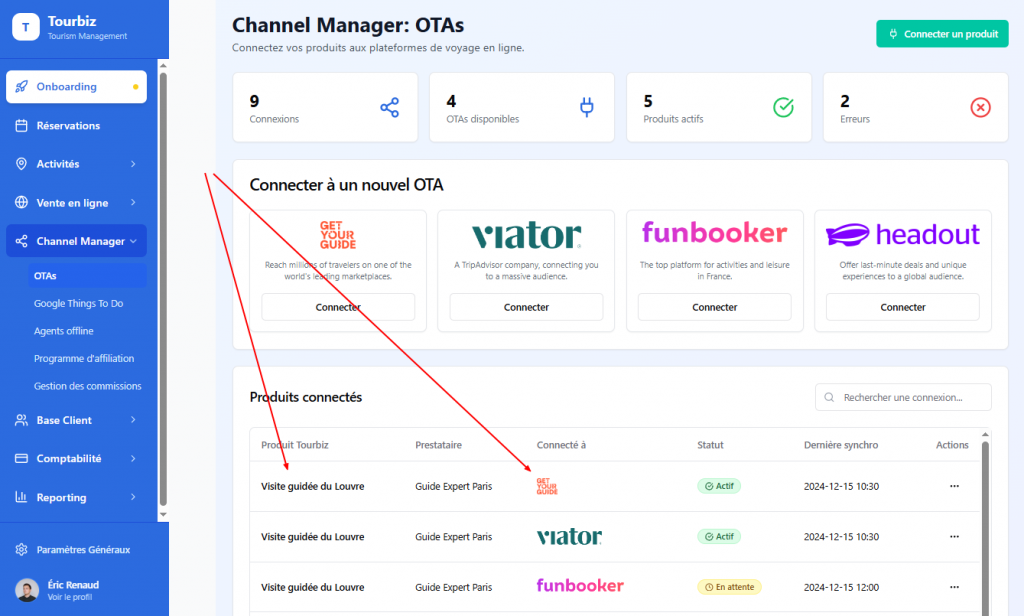
Tourbiz acts as a true hub to connect your catalog to tourism giants – the famous OTAs – such as Viator, Funbooker , or GetYourGuide. This bidirectional connection allows you to broadcast your offers with one click across multiple channels while maintaining control over your prices and availability.
- Increased visibility on OTAs
- Automatic synchronization of inventories
- Instant update of rates and promotions
This interoperability is essential to maximize visibility and sales without multiplying manual tasks.
Simplified client management and reporting
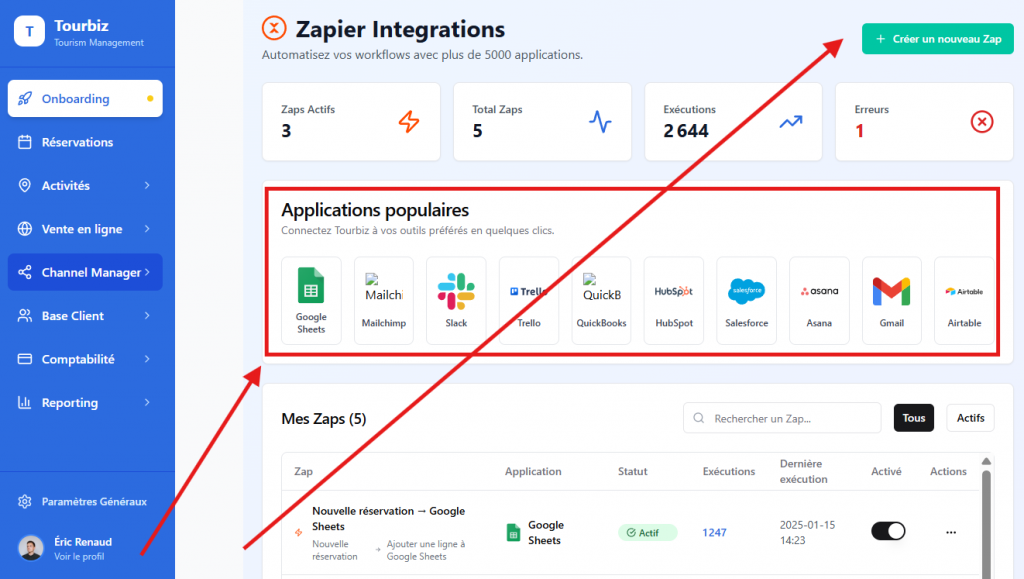
Tourbiz is not a CRM, but it connects perfectly: thanks to its Zapier integrations and its open API, you can link your existing tourism CRM (HubSpot, Zoho, Trekksoft, or any other business tool) and automatically synchronize your booking data: clients, sales, products, distribution channels, etc.
Your CRM thus remains your relational space, while Tourbiz becomes your single source of truth on commercial performance. You centralize your booking flows, feed your dashboards without manual entry, and access a unified reporting to track in real-time:
- the best-performing offers;
- the most profitable periods;
- client lifetime value;
- average basket per client;
- number of purchases per client;
- and the evolution of your revenue by channel or market.
By connecting Tourbiz to your CRM, you have a perfect view of your sales flow, your data, and your client relationship in a single fluid and automated ecosystem.
Example: how to connect to GetYourGuide via Tourbiz?
Connecting to GetYourGuide via Tourbiz is simple, with no lines of code:
- Go to your Tourbiz space > ‘Partner Integrations’
- Select GetYourGuide and authorize the API connection
- Your products and availability synchronize instantly
Once the link is established, your bookings are automatically imported into your Tourbiz dashboard, with all associated client details and payments — a considerable time and reliability gain.
We have written a complete guide on the subject accessible via this link: guide to connecting to GetYourGuide.
Tourbiz is a strategic lever for any travel agent who wants to delegate the technical aspects to refocus on advice and personalization.