Tourism has particularities that make invoicing more complex than elsewhere: a multitude of providers involved in a single service, OTA commissions to deduct, specific VAT depending on the scheme, and payment flows that are sometimes delayed. This guide aims to give you the keys to see clearly, and to show you how tools like Tourbiz can turn this constraint into a smooth routine.
What is provider invoicing?
Provider invoicing refers to all the financial documents issued between a service provider — you — and your customers or business partners. In tourism, this term covers two distinct realities:
- B2C invoicing: you invoice the end traveller directly for an activity, a tour, transport or accommodation.
- B2B invoicing: you invoice a travel agency, a tour operator, an OTA or a reseller that sold your service to its own customers.
In both cases, a valid invoice must include a number of mandatory details: invoice number, date of issue, full identification of both parties (name, address, business registration number or equivalent), a precise description of the service, the pre-tax amount, the applicable VAT rate and the total amount including tax.
But beyond the legal framework, a good provider invoice is also a management tool: it tracks every sale, makes it easier to monitor payments and constitutes an essential accounting record in the event of an audit.
What makes provider invoicing specific to tourism?
Tourism is a sector in its own right when it comes to invoicing. Several elements set it apart from a conventional commercial activity.
VAT on the margin and the TOMS scheme
Travel agencies and tour operators are subject to the TOMS scheme (in France, the special VAT scheme for travel agencies and tour organisers — the equivalent of the EU Tour Operators’ Margin Scheme). In practice, VAT does not apply to the total sale price, but to the margin made between the purchase cost of the services and the price invoiced to the customer. This derogatory scheme complicates invoicing and requires particular accounting rigour.
OTA commissions and net rates
When you sell through online travel agencies (OTAs) like Viator, GetYourGuide or Funbooker, the platform takes a commission — generally between 15 and 30% — before paying you the balance. This mechanism implies net invoicing: you issue an invoice for the amount paid to you, not the public price. It is therefore crucial to distinguish between the displayed sale price, the OTA’s commission and the amount actually collected. Without a dedicated tool, this reconciliation quickly becomes time-consuming.
The multiplicity of stakeholders
A single tourism service can involve several players: an independent guide, a transport company, an accommodation provider, a caterer. Each must issue its own invoice, within the legal deadlines, and ensure that the amounts match the contractual agreements. This fragmentation creates risks of errors and discrepancies, especially in high season.
How can you be sure you’re invoicing correctly?
Invoicing well is above all a matter of organisation and rigour. Here are the best practices that make the difference in the field.
Standardise your invoice templates
Always use the same invoice template for each type of service. One template for groups, one for individual sales, one for resellers. This standardisation reduces oversights and speeds up issuing.
Automate numbering and archiving
Chronological, unbroken numbering is a legal obligation. If you handle several dozen bookings a week, automation becomes essential. Management software connected to your booking system guarantees effortless continuity.
Distinguish quotes, purchase orders and invoices
These three documents do not have the same legal value. The quote is a commercial proposal, the purchase order validates it, and the invoice records the reality of the transaction. In tourism, particularly for groups and B2B, these steps are often confused — which creates disputes at payment time.
Manage cancellations and credit notes
Cancellations are part of everyday life in tourism, and some can even lead to double booking situations when stock is not properly updated. Every invoiced cancellation must be offset by a credit note that cancels or reduces the original invoice. Without this document, your accounts remain unbalanced and your VAT return will be incorrect. Anticipate this scenario from the moment you design your invoicing process.
Respect legal payment deadlines and anticipate electronic invoicing
In France, the legal payment deadline between businesses is 30 days after the invoice issue date (60 days maximum by contractual agreement). In tourism, OTAs have their own payout schedules — often weekly or monthly. Identify these rhythms to anticipate your cash flow and avoid liquidity strains in the low season. Also note: the electronic invoicing reform in tourism is being phased in from 2026 for B2B transactions — an additional constraint to factor into your process today.
Tourbiz: the solution to better manage your provider flows
At Tourbiz, we designed our software from a simple observation: provider invoicing is one of the most frequent pain points for small and medium-sized tourism operators. Between commissions to deduct, OTA payouts to reconcile and credit notes to issue in the event of cancellation, the risk of error is high — and the consequences can be costly.
Our approach rests on three pillars:
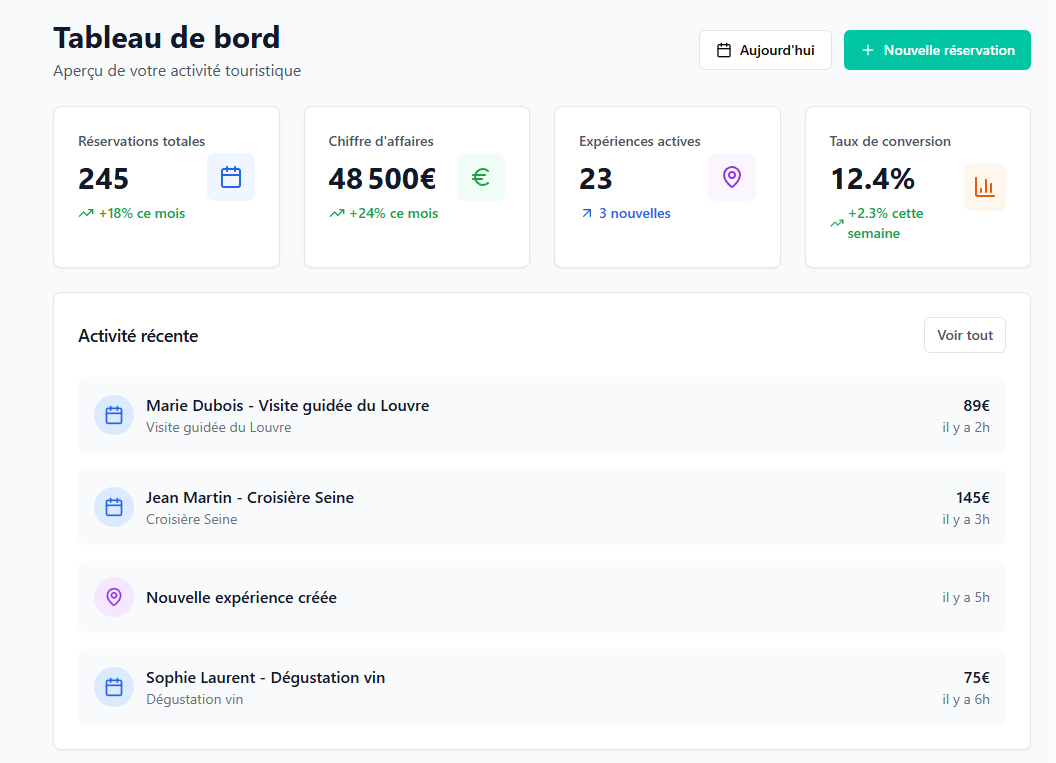
- Centralising bookings: all your sales — website, OTAs, phone, front desk — arrive in a single dashboard. Every transaction is tracked, time-stamped and linked to an identified sales channel. No more Excel spreadsheets to cross-check manually.
- Automatic reconciliation of OTA flows: thanks to our integrated channel manager, Tourbiz is connected in real time to Viator, GetYourGuide, Headout and Funbooker. The amounts paid out are automatically matched to your bookings, which considerably simplifies your accounting and the preparation of your returns.
- Managing cancellations and credit notes: when a booking is cancelled via an OTA or directly, Tourbiz updates your inventory in real time and generates the elements needed to issue a credit note. Your accounts always stay in sync with the reality of your business.
In practice, operators who use Tourbiz save on average several hours a week on the administrative tasks related to invoicing. That freed-up time is energy available to improve the customer experience, develop new offers or strengthen your presence on distribution channels.
To start simply, keeping your Excel accounting is an option before moving to a dedicated tool.
Provider invoicing doesn’t have to be a headache. With the right tools and the right practices, it becomes a smooth, reliable and transparent process — for you and for your partners.