📌 Key takeaways
- Kayak providers can access several levels of funding: federal (FFCK, the French canoe-kayak federation / ANS, the National Sports Agency), territorial (region, department, municipality), environmental (ADEME, the French ecological transition agency) and European (LEADER).
- A commercial provider (SAS, EURL, SARL — French company forms) is not excluded from public grants, but the eligibility conditions differ from those for non-profit associations.
- 43% of local authorities cut their sports budget in 2025, which makes diversifying your funding sources more strategic than ever (Source: ANDES, 2025).
- Putting together a solid application means presenting a structured project, up-to-date financial documents and consistency with the priorities of the scheme you’re targeting.
- Up-to-date management software is often required or valued in applications: it proves your ability to run the business professionally.
What a kayak provider means in the eyes of funding bodies
Before looking for grants, you need to understand which box funding bodies place you in, because that box determines your rights.
A kayak provider can operate under several legal forms: a non-profit association (French “loi 1901”), a commercial company (SAS, EURL, SARL), or a local-authority operation. Each status opens different rights and closes other doors.
Association vs commercial structure: the rules of the game aren’t the same
An association affiliated with the FFCK naturally accesses federal grant schemes (PSF — Federal Sports Projects, FFCK/EDF calls for projects), ANS funding via the DRAJES (regional sports authorities), and local-authority aid under local sports policy. It also benefits from FDVA 2, the fund for the development of associative life, which primarily targets small structures with few or no employees.
A commercial structure, on the other hand, has more access to investment and ecological-transition aid: the ADEME Sustainable Tourism Fund, BPI France, and regional schemes for very small and medium-sized tourism businesses. It is not eligible for federal sports grants, but it can benefit from significant aid if it is positioned around sustainable tourism or service innovation.
To go further on the financial management of your structure: how to optimize the margins of your tourism business.
What “kayak provider” really covers
A kayak provider can be a nautical base that rents out craft and offers guided outings, an organiser of multi-activity stays with kayaking as the main activity, or a club that develops a commercial offer alongside its non-profit mission. This diversity often implies a dual reading of funding applications: you have to identify which “hat” to wear depending on the scheme you’re targeting.
Why seek grants rather than self-finance everything
The answer is simple: margins in the outdoor business are structurally under pressure.
Equipment is expensive, it’s renewed frequently, and short seasons concentrate costs into a few months. A professional-quality kayak costs between €800 and €1,500, so a fleet of 20 craft represents an investment of €15,000 to €30,000 renewed every 5 to 8 years, not counting safety equipment, vehicles and reception facilities.
In this context, a well-targeted grant doesn’t just change your cash flow: it changes your capacity to invest.
The leverage effect of public aid
Aid of 30% on a €20,000 investment frees up €6,000 in cash, often the equivalent of several months of fixed costs. Schemes like the ADEME Sustainable Tourism Fund finance up to 50% of eligible costs, with a ceiling of €200,000 per project. On ecological-transition projects (replacing combustion engines, solar installation, soft mobility), this leverage is particularly strong for outdoor providers.
A 2025-2026 context that pushes for diversification
43% of French local authorities cut their sports budget in 2025 (Source: ANDES, 2025). Directly “sports” grants are therefore more competitive. The right strategy is to cross the angles: positioning your project around sustainable tourism or accessibility, which benefit from other budget envelopes, can offset the pressure on conventional sports budgets.
The schemes available depending on your profile
There is no single “kayak” grant: funding sources overlap and complement each other depending on your status, your territory and your project.
Federal Sports Projects (PSF) – for FFCK-affiliated associations
PSF are grants from the National Sports Agency (ANS) redistributed by the federations to their clubs. The FFCK manages its own PSF envelope, which funds projects to develop the sport: paddling school, accessibility, para-kayak, instructor training. Applications are filed via Le Compte Asso (the French association portal), and open between March and April each year. If you received a PSF grant in 2025, the financial report is mandatory to access the 2026 aid.
The ADEME Sustainable Tourism Fund – for small and medium tourism businesses
This scheme is aimed at commercial structures carrying out a tourism activity, in rural or peri-urban areas. It funds investments linked to the ecological transition: energy performance, sustainable mobility, waste management, less-polluting equipment. For a kayak provider, this can cover replacing shuttle engines, installing solar panels on a reception building, or acquiring eco-designed craft. The process starts with an environmental assessment carried out by an approved ADEME partner, before any application for financial aid.
Discover how Tourbiz supports nautical bases in structuring their business.
Regional and departmental schemes
Each region has its own budget lines for tourism and sport. Some departments have specific plans for canoe-kayak, such as the Departmental Canoe-Kayak Plan which funds nautical facilities with a minimum public contribution of 20 to 30% from the project owner. Regions also co-fund via LEADER funds (Europe), sustainable-tourism programmes, or aid schemes for rural small businesses. This aid varies greatly from one territory to another: the contact to reach is always your Chamber of Commerce (CCI) or the tourism department of the Regional Council.
FFCK and EDF calls for projects – for inclusion
Since 2014, the FFCK and EDF have jointly run the “Clubs and Territories” call for projects, aimed at developing canoe-kayak for people with disabilities. If your structure develops a para-kayak offer or wants to get started, this call for projects is a direct entry point to dedicated funding, with rules updated every year.
How Tourbiz helps kayak businesses secure grants
A grant application isn’t just a form: it tells the story of your structure’s financial and organisational health.
Public funding bodies – whether the ANS, ADEME or a regional council – systematically examine your balance sheets, income statements, forecasts and sometimes your activity reports. A structure that can’t produce these documents quickly and cleanly weakens its application, even if the project is fundamentally solid.
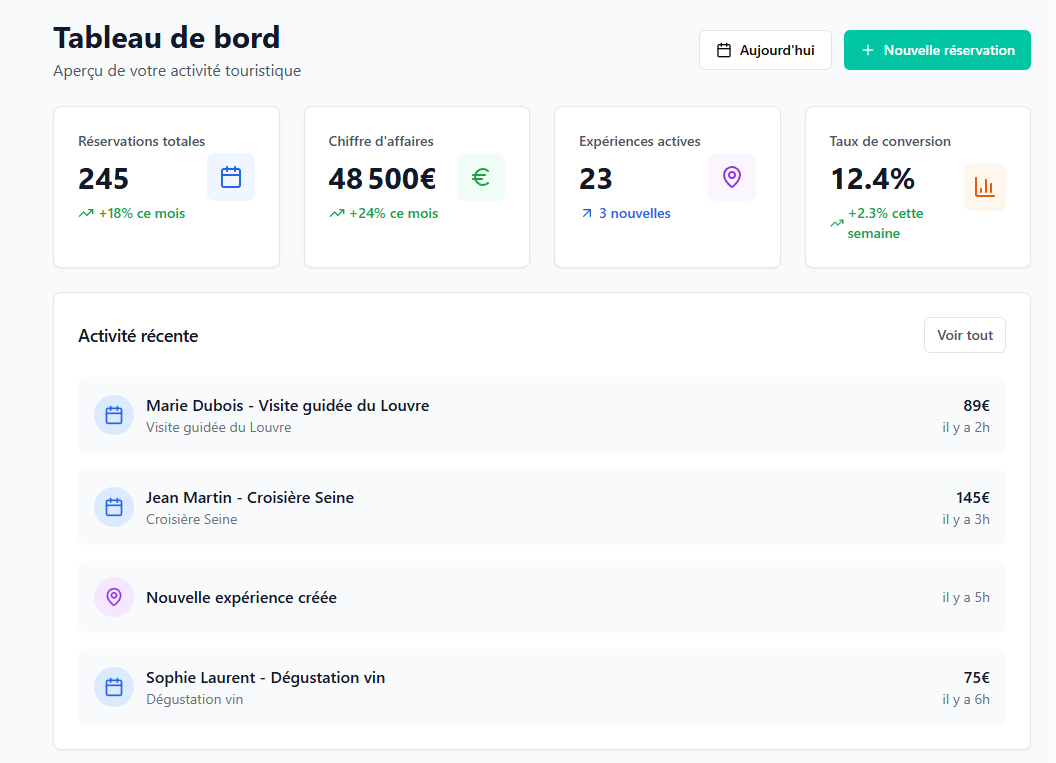
This is where Tourbiz plays a concrete role. By centralising your bookings, payments and accounting in a single tool, it lets you extract in a few clicks the financial data that application assessors need: revenue by activity, occupancy rate, season history, sales summary. These structured exports form a solid basis to support an application and demonstrate that your business is run professionally.
Check the Tourbiz pricing to assess the investment, which is itself often eligible for certain schemes supporting the digitalisation of small businesses.
How to structure a grant application that succeeds
The majority of rejected applications are turned down for reasons of form, not substance.
Identify the right scheme before applying
Each aid has its eligibility criteria, its ceilings and its timelines. Filing an application after the deadline or for a scheme you’re not eligible for is a waste of time. The site aides-territoires.beta.gouv.fr lists most of the public schemes accessible to sport and tourism players, with filters by legal status, territory and project type.
Build a project, not just a request
A good application describes a precise need, a costed investment, a measurable expected impact and an ability to report back. It’s not enough to write “we want to buy 5 new kayaks”: you have to explain why these craft will let you welcome more people, develop an accessible offer, or reduce the environmental impact of the activity. The Tourbiz blog regularly publishes resources on managing and running profitable tourism activities that can help structure this kind of argument.
Anticipate deadlines and supporting documents
PSF schemes open in March-April. ADEME calls have their own timelines, often published at the end of the previous year. The golden rule: never start an investment before receiving an aid notification, or you risk being declared ineligible. Prepare in advance your balance sheets for the last two financial years, your up-to-date statutes, your business registration number (SIRET), and if you’re an association, your prefecture declaration receipt.
❓ FAQ
Which grant scheme for a commercial kayak provider?
Commercial structures (SAS, EURL, SARL) mainly access tourism and ecological-transition schemes: the ADEME Sustainable Tourism Fund, regional aid for small and medium businesses, BPI France schemes. Federal sports grants (PSF, ANS) are reserved for associations affiliated with a federation.
How do I know if my project is eligible for the ADEME Sustainable Tourism Fund?
The first step is an environmental assessment carried out by an approved ADEME partner in your region. Only at the end of this assessment is an eligible action plan established. You can’t apply directly: the process must go through this local partner.
Can you combine several grants on the same project?
Yes, combining is possible but regulated. European rules impose an overall ceiling on public aid per project (the “de minimis” rule: €200,000 over 3 financial years for a commercial structure). Each scheme specifies its combination conditions in its rules.
When should I apply for a PSF grant for my kayak club?
PSF applications generally open between March and April each year on Le Compte Asso. If you received PSF aid the previous year, the financial report is mandatory before any new application.
Can a grant application fund management software?
Some small-business digitalisation schemes (notably BPI France and regional digital-transformation aid) can cover the purchase of tourism management software. Check with your Chamber of Commerce (CCI) or Regional Council about the schemes in force in your territory.
What documents are generally required in a grant application?
The documents systematically required are: your statutes or company registration extract (Kbis), the balance sheets for the last two financial years, bank details, a project description with a provisional budget, and a financing plan. Some schemes add quotes, photos of the site or an activity report from the previous season.
Can the LEADER Fund finance a kayak activity?
Keeping the accounting of your tourism activity under control avoids nasty surprises at year-end.
Yes, if your business is located in an eligible rural area and your project fits the priorities of your territory’s Local Action Group (LAG). LEADER funds projects with strong territorial roots, often on the themes of sustainable tourism, accessibility or the enhancement of a natural heritage.