
What exactly do we mean by “travel industry marketing” in 2025?
In 2025, travel industry marketing has little in common with that of before 2020. It is now a set of digital strategies, personalized content, and technological tools designed to inspire, convert, and retain the connected traveler. Agencies, tour operators, and experience providers rely on fine data to tailor their offerings to each customer segment.
In short: tourism marketing is no longer just about selling a destination, but about creating an emotional and seamless journey before, during, and after the trip.
The major post-pandemic changes: from recovery to personalization
The shock of the pandemic has profoundly reshaped traveler behavior. After the total halt of tourism, recovery has been marked by caution and then personalization. Travelers want unique experiences tailored to their desires and seek to minimize friction in the booking process.
- Digital channels have become the heart of the purchasing decision.
- Tourism players are investing heavily in automation and direct communication.
- Activity platforms like GetYourGuide or Viator have accelerated the standardization of good marketing practices.
To understand how to centralize your actions on this type of platform, check out our article guide on connecting with getyourguide.
The growing role of data and artificial intelligence
The major challenge in 2025 is data. AI-based tools now allow for real-time analysis of traveler behavior, anticipating their needs and offering ultra-targeted campaigns. The goal: to capture attention even before the trip is planned.
Data is becoming a strategic asset of tourism marketing, enabling the optimization of advertising campaigns, dynamic price adjustments, and enhanced loyalty.
Why is travel marketing evolving so quickly?
The tourism sector is one of the most sensitive to changes in behavior and technology. In just a few years, consumers have profoundly redefined their expectations: to travel better, not necessarily more, and to share experiences rather than possessions.
The impact of new consumption habits
Travelers in 2025 are seeking more authenticity, sustainability, and experience. Mass tourism is giving way to tourism of emotions and meaning. Professionals are adapting by offering local, ethical, and immersive experiences.
- Rise of “slow travel” and nearby stays.
- Highlighting engaged players for the environment.
- Seeking coherence between marketing discourse and concrete actions.
The influence of social platforms and user-generated content
Social networks have definitively taken control of storytelling. TikTok, Instagram, and YouTube shape travel desires, and user-generated content becomes more powerful than any traditional advertisement. For tourism brands, the key lies in authenticity and co-creating narratives with their community.
Want to know how to increase your visibility on this type of platform? Discover our tips in the guide: tourism and social networks.
Economic and ecological pressures
Between inflation, rising energy costs, and increasing expectations around responsible travel, professionals must rethink their business model. Travel marketing is transforming to integrate sustainability at every stage of communication and commercialization.
In other words: brands that adapt quickly gain credibility and foster longer-lasting loyalty. Tourism marketing is now a lever for engagement – not just sales.
What are the major marketing trends to follow in tourism in 2025?
Tourism marketing in 2025 is played out on a field of continuous innovation. Travelers are more demanding, more aware, and above all, more connected. To attract these new profiles, brands must adopt a data-driven, emotional, and transparent approach.
Hyper-personalization through AI and machine learning
AI tools now offer tourism players the ability to segment their audiences at an unprecedented level. Gone are the “one size fits all” campaigns: each internet user sees an offer tailored to their behavior, location, or interests.
- Predictive analysis of bookings.
- Automated messages but contextualized according to the customer journey phase.
- Price optimization via dynamic pricing.
In 2025, this personalization extends to the overall experience: from activity search to post-stay recommendations.
Experiential and immersive storytelling
Travelers want to live stories, not just book a service. Immersive storytelling relies on audio, video, and interactive formats to evoke an emotion even before departure. Agencies are betting on 360° visuals, podcasts, or filmed testimonials to recreate the feeling of “being already there.”
The rise of sustainable marketing and brand transparency
Travelers place a central focus on the ecological impact of their stay. Tourism companies must now prove the authenticity of their commitments, or risk losing public trust.
- Highlighting local and responsible initiatives.
- Clear communication on CO₂ emissions.
- Certification and storytelling around brand values.
The growing importance of loyalty and community travel
The new generation travels to belong to a community. Private clubs, exclusive newsletters, WhatsApp groups for travelers: relationship marketing is becoming a priority. Loyalty is now about creating a tribe around one’s brand universe.
Players who manage to maintain dialogue between two stays see their repurchase rate double. Tourism in 2025 is based on relationships, not transactions.
How can tourism professionals adapt their marketing strategy?
Adapting your marketing strategy means aligning your tools, data, and messaging with contemporary traveler expectations. The key: a seamless omnichannel approach, where every contact becomes an opportunity for conversion – or loyalty.
Integrate the right digital tools for each stage of the customer journey
From discovery to booking, every interaction must be mastered. Modern management solutions now allow for the unification of CRM, availability management, and direct communication.
- Centralize your bookings with a (see our channel manager guide).
- Automate customer exchanges via professional WhatsApp.
- Synchronize your listings on major OTAs and activity platforms.
Measure performance: indicators to track and mistakes to avoid
Effective marketing relies on reliable data. Rather than focusing solely on clicks or traffic, one must observe conversion and post-stay satisfaction indicators.
- Conversion rate on each channel.
- Revenue per visitor (RPS) and acquisition cost.
- Post-stay engagement rate (reviews, shares, recommendations).
The most common mistake? Neglecting coherence across all channels. A contradictory message between an email and an advertisement can undermine a customer’s trust.
Draw inspiration from the best successful campaigns in 2025
Recent successes in the sector show that innovation comes through simplicity: clear offers, authentic messages, and perfect digital execution. Some local agencies have tripled their conversion rates simply by adjusting their booking forms or CRM strategy.
How does Tourbiz help tourism players innovate in their marketing?
Faced with the growing complexity of tourism marketing in 2025, professionals need a platform capable of centralizing their operations, automating repetitive actions, and connecting all their channels. This is exactly what Tourbiz offers: an ecosystem designed to streamline management, boost visibility, and improve conversion.
Tourbiz features to centralize marketing actions
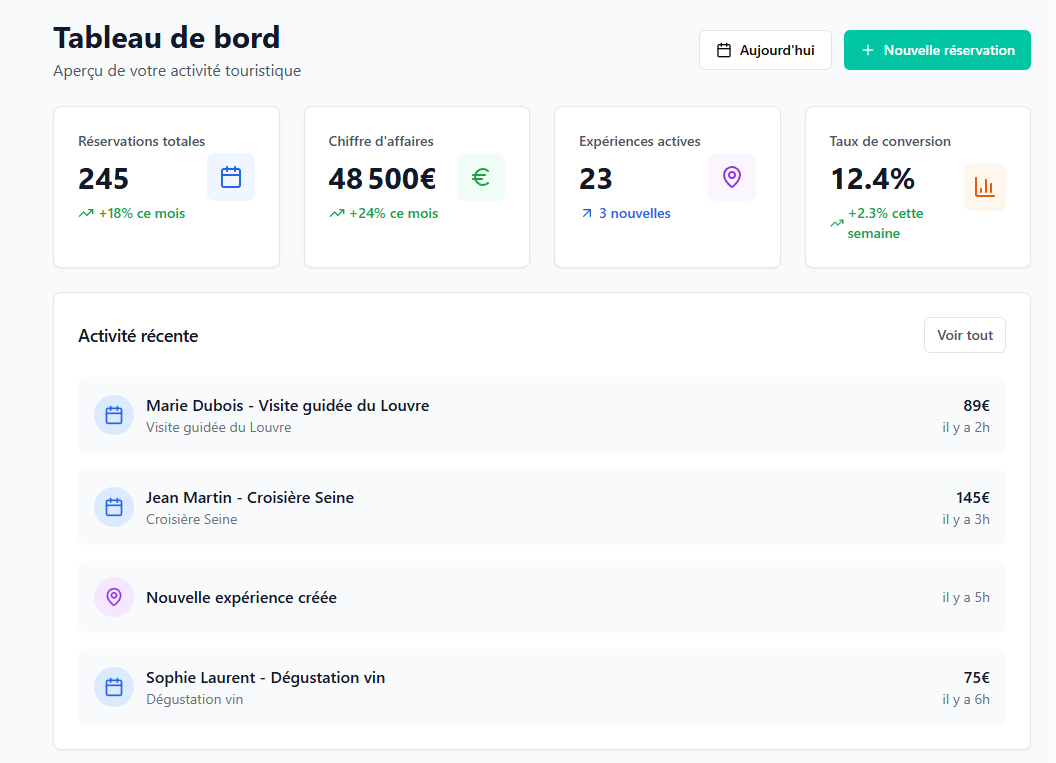
Tourbiz allows you to manage a lot of things in one place: automated emails, review management, distribution channels (channel manager), connection to google things to do, direct sales, and real-time performance. For example, you can:
- plan and track campaigns on a unified dashboard.
- automatically segment based on purchase history and customer preferences.
- access intelligent reporting to measure the effectiveness and profitability of each marketing action.
Result: a marketing team that gains agility, coherence, and precision – without multiplying external tools.
Connection with key platforms (GetYourGuide, Viator, etc.)
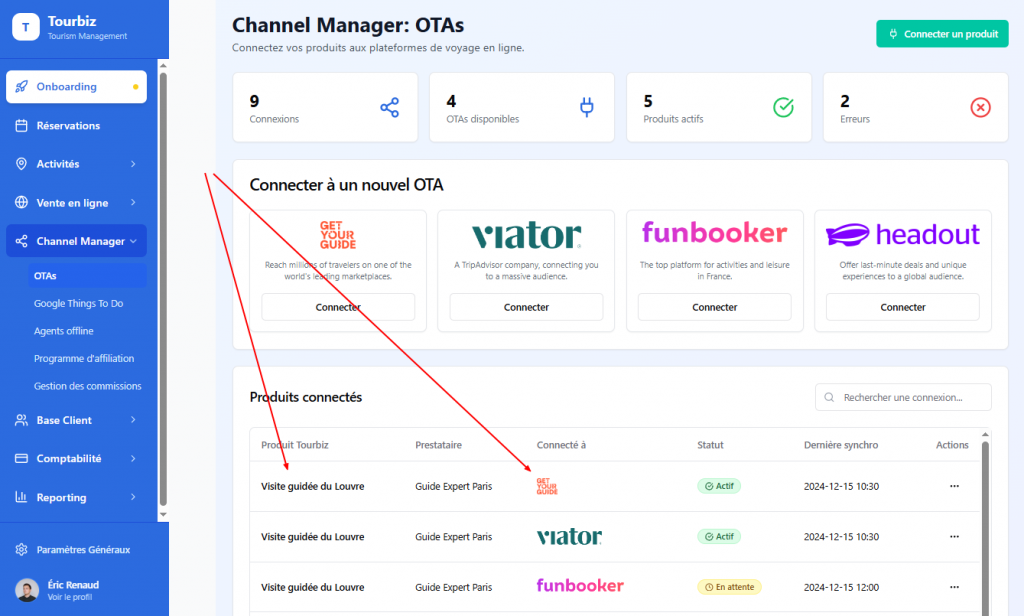
One of Tourbiz’s great strengths lies in its connected ecosystem. In just a few clicks, it is possible to synchronize offers on the main global experience sales platforms like GetYourGuide or Viator.
- Simultaneous distribution of availability on multiple OTAs.
- Elimination of overbooking risk thanks to real-time updates.
- Sales analysis by channel to continuously adjust distribution.
Use case: optimize visibility and bookings via Tourbiz
To present you with a concrete use case, let’s imagine a local hiking agency. By connecting its website, its tourism CRM, and its booking platforms to Tourbiz, it can:
- Track the performance of its advertising campaigns in real-time.
- Automatically launch personalized emails after each activity.
- Analyze the most profitable channels and adjust its marketing budget.
Benefits: fewer manual tasks, more direct bookings, and a 360° view of marketing performance.