
What is SEO in the travel sector and why is it so specific?
SEO (Search Engine Optimization) in tourism is the art of making a website or travel offer visible on Google, at the right time and for the right search intent. It is one of the fundamentals of tourism marketing, if you are looking to find new clients.
But unlike other sectors, “travel SEO” follows very specific codes — at the intersection of emotion, seasonality, and ultra-competition.
Specifically, optimizing the natural referencing of a tourism player means understanding three realities:
- A cyclical market: searches explode at certain times, then drop sharply. An agency must anticipate these peaks and adapt its content to the season.
- Fierce competition: OTAs (Booking, Expedia, GetYourGuide…) dominate the top results. Local players must then compete on relevance and niche.
- A technological dependency: Google Maps, TripAdvisor, and third-party platforms now guide customer journeys, often before the traveler even arrives on a site.
In 2025, three trends are redefining this landscape:
- Mobile search has become the norm: 80% of travelers prepare and book via their smartphone.
- Voice search imposes more conversational content (“What to do in Lisbon in April?”).
- Micro-moments — these short searches for inspiration — and UGC content (reviews, experience photos) directly influence visibility and trust.
To survive in this environment, each operator must rethink their digital strategy, combining storytelling, SEO techniques, and user experience. A useful read: how to improve your marketing in the travel sector.
Why is natural referencing essential for tourism players?
In a sector where Google captures more than 90% of travel searches, SEO is not a “bonus”: it is a lever for visibility, notoriety, and trust. For agencies and independent operators, it allows them to compete with market giants on hyper-targeted queries.
Organic visibility : the defense against OTAs
Platforms like Booking or Viator invest heavily in paid advertising. Against them, good SEO positioning is the only way to exist sustainably without relying on a constant advertising budget. Each well-optimized piece of content acts as a permanent asset, attracting qualified visitors month after month.
Notoriety, conversion, loyalty
A well-referenced site inspires trust. A client who discovers an agency through an inspiring article will be more inclined to book, then to return. SEO builds a long-term relationship, well beyond the simple click.
In short:
- Visibility: attract the right travelers at the right time.
- Credibility: be perceived as a local reference.
- Profitability: reduce customer acquisition costs.
Practical case: the local agency that surpasses the big brand
Imagine a small adventure agency based in Chamonix. It targets the queries ” Mont Blanc glacier hike ” with detailed content, an optimized Google Business listing, and customer testimonials. Result: it positions itself ahead of generalist OTAs on this ultra-specific query — and captures traffic ready to convert.
To go further, explore our complete guide on OTAs and their impact on agency visibility.
How to build an effective SEO strategy for the travel sector?
An SEO strategy in tourism is not improvised. It must articulate keyword research, inspiring storytelling, technical optimization, and local anchoring. All with a logic of measurable performance over time.
1. Find the right keywords related to destinations and experiences
It all starts with understanding how travelers search. We no longer simply type ” travel Greece ” but ” 5-day all-inclusive Cyclades cruise “. Analyzing these queries allows for building useful and realistic content.
- Use tools like Google Keyword Planner or Ahrefs to identify search volumes by season.
- Combine transactional keywords (e.g. “book Santorini cruise”) and inspirational keywords (e.g. “best Greek islands to visit”).
- Create content clusters around strong themes (gastronomy, hikes, cultural getaways…).
2. Optimize your structure and on-page content
A high-performing travel site has a clear hierarchy: destination pages, activity categories, inspirational articles. Each page must meet a specific intent.
- Care for titles, metas, and Hn tags.
- Insert internal links between destinations, guides, and offers.
- Publish “living” content: recent photos, testimonials, customer reviews.
3. Focus on local SEO
Local referencing is the cornerstone of travel SEO. A well-informed Google Business listing (address, phone, hours, photos, reviews) can generate free and qualified traffic.
- Optimize NAP (Name, Address, Phone) signals consistently across all platforms.
- Encourage customers to leave authentic reviews after each activity.
- Link listings to dynamic maps and integrated itineraries on the site.
4. Develop a network of smart backlinks
Inbound links remain one of the most powerful trust signals for Google. In tourism, they are earned by sharing emotionally valuable content and collaborating with credible players.
- Create partnerships with travel blogs or regional media.
- Participate in interviews or collaborative guides on destinations.
- Highlight local expertise in press publications.
5. Measure, adjust, restart
An SEO strategy is never fixed. Search trends evolve quickly — especially in such a volatile sector as tourism. Tracking your KPIs (organic traffic, click-through rates, conversions) allows you to prioritize the next actions.
If you are looking to deploy your marketing, also check out our article on the Google Things To Do guide, a powerful lever to work alongside your SEO to boost the local visibility of tourist activities.
What tools and best practices to use to boost your travel SEO?
Implementing a high-performing SEO strategy requires good tools and clear routines. In 2025, most travel players combine automation, analysis, and competitive monitoring.
Keyword research tools
Tools like SEMrush, Ahrefs, or Google Keyword Planner allow you to:
- Identify seasonal queries with high potential.
- Track search volume changes by region or language.
- Spot opportunities related to search intent (inspiration, planning, booking).
Analysis and tracking tools
Google Analytics and Search Console remain essential for understanding where traffic comes from and which pages convert best. Screaming Frog, for its part, helps audit the structure and detect 404 errors, missing tags, or unnecessary redirects.
Automation and competitive monitoring
With tools like SurferSEO, SimilarWeb, or AnswerThePublic, you can automate your reports, monitor competitors, and adjust your content without wasting time. This “data-driven” approach allows you to remain agile in a constantly changing market.
Best practices and sustainable strategies
Travel SEO is won over the long term. A few simple reflexes :
- Publish regularly, even off-season.
- Reuse your content in other formats: videos, stories, newsletters.
- Analyze your customer reviews to identify new keywords.
Want to see how these best practices translate concretely into your sales ? Read our article on sales tracking and tourism management to link your SEO actions to measurable results.
How to connect your SEO strategy to your offers via Tourbiz?
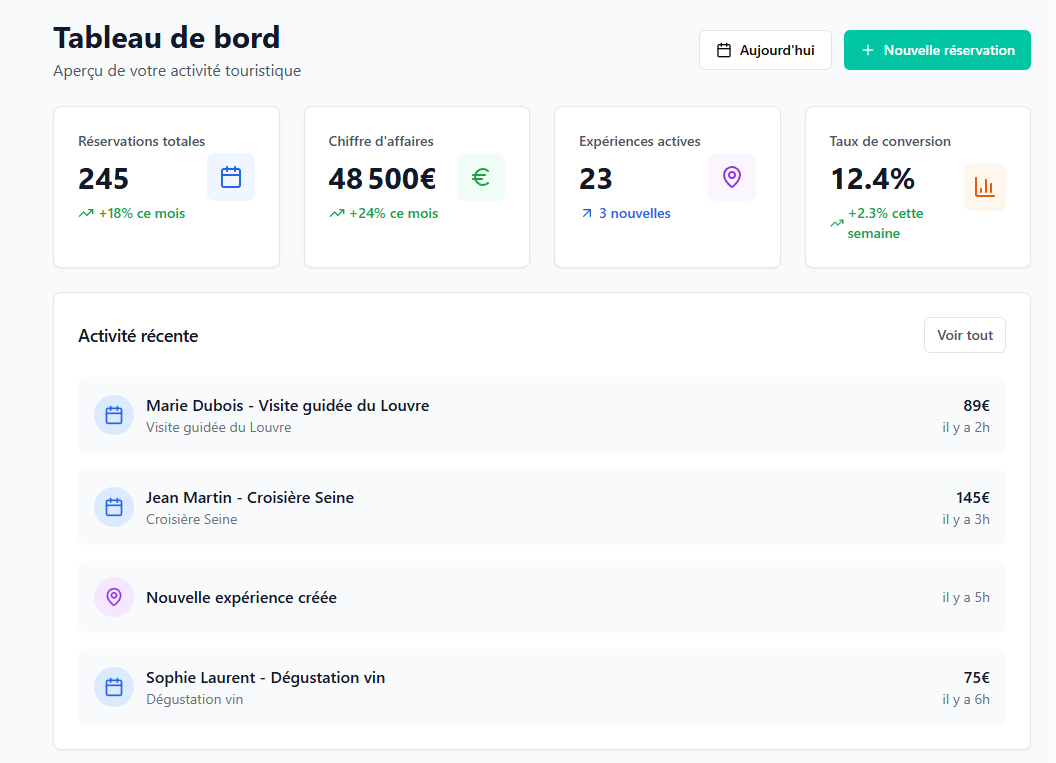
SEO is visibility. But without well-structured offers, this visibility does not convert. And that’s where Tourbiz makes the difference. The platform acts as a bridge between your marketing efforts and your tourism products: it centralizes, automates, and enhances every experience you offer.
Centralize product data for coherent SEO
Too often, agency or operator websites are a patchwork of poorly linked product pages. Tourbiz solves this problem by centralizing your activities, tours, and accommodations data in one space. You thus obtain a clear structure that is 100% compatible with modern SEO requirements.
Integrate activity sheets optimized for Google
Each sheet in Tourbiz is not just a simple presentation of an activity. It is a page designed for SEO : fields “meta title”, “description”, “customer reviews”, and “dynamic prices” are directly integrated into the editor.
- Titles and metadata generated according to your priority keywords.
- Reviews and ratings structured in the form of Schema.org tags to enrich results on Google.
- Dynamic prices and availability connected to your booking engine.
In short, Tourbiz transforms your product sheets into true SEO-ready pages, capable of competing with major platforms.
Connect Tourbiz to marketplaces to amplify visibility
One of Tourbiz’s major competitive advantages is its compatibility with platforms like GetYourGuide, Viator, or Expedia. By linking your product sheets to these marketplaces, you multiply your reach while keeping control of your data.
- Automatic synchronization of availability and rates to avoid double bookings.
- Omnichannel SEO consistency: your offers remain identical on your site and on partner platforms.
- Performance tracking: measure the returns of your sales from organic traffic on these channels.
It’s the best way to align your natural referencing efforts with your distribution strategy. To deepen this connectivity, consult our guide on the supplier GetYourGuide guide.
Staying current pays off, and our overview of tourism trends helps you anticipate demand.
By connecting Tourbiz to your SEO strategy, you no longer just attract traffic. You build a complete ecosystem — unified, measurable, and ready to convert every visitor into a customer.