
What is meant by “legal status” for a tourism activity?
The legal status is the legal framework that defines the existence of a business and how it conducts its activity. For a tourism professional, this choice structures everything: it conditions your tax obligations, your level of personal protection, and the credibility of your brand with your partners.
In other words, it’s your “professional identity card.” Each status determines who you are in the eyes of the administration, but also how you collaborate with platforms, hosts, or suppliers.
Individual structure vs company: understanding the difference
The simplest mode of operation remains the individual structure (EI, micro-enterprise): you operate in your own name. In a company (EURL, SARL, SAS…), the activity becomes an independent legal entity.
- Individual structure: simple procedures, reduced taxation, but unlimited liability.
- Company: protected assets, more credible structure, but heavier administrative obligations.
Specific obligations in the tourism sector
Tourism being a regulated sector, certain activities require specific authorizations: travel agent license, registration in the travel operators register, professional civil liability insurance, etc. This framework aims to protect the end customer—and to strengthen trust in the services.
Before creating your structure, also think about operational management: the status impacts invoicing, contracts, and even the daily management of bookings. To frame this part well, discover our guide on managing tourist bookings.
Why is the choice of legal status crucial for your tourism business?
Choosing your status is not a simple administrative formality: it’s a strategic decision that influences the financial health, market perception, and growth capacity of your tourism activity.
Immediate fiscal and social impacts
Each status leads to a different taxation mode and a distinct social regime. A micro-entrepreneur declares their turnover simply, while a company manager must deal with taxation on profits and contributions from directors.
- Micro-enterprise: taxes proportional to turnover, simplified contributions.
- SARL, SAS: higher social charges but better coverage and increased credibility.
Liability and asset protection
The status defines the level of personal risk: in individual activity, your assets can be at stake; in a company, your liability is limited to the invested capital. An essential distinction if you manage multiple partners or large volumes of bookings.
Credibility and partnerships
A company often inspires more confidence among investors, OTAs, or service providers. Platforms like GetYourGuide or Viator actually prefer legally well-identified structures to reference their partners.
To enhance your visibility with these actors, consult our article on GetYourGuide and Viator in the tourism sector.
What are the possible legal statuses to launch a tourism activity?
The range of possibilities is vast for tourism project holders. Your status will determine both the simplicity of your procedures, your tax regime, and how you can collaborate with platforms or local partners.
The auto-entrepreneur or micro-enterprise: simplicity and limits
This status is ideal for testing an activity as a guide, travel photographer, or independent companion. You benefit from simplified formalities and a tax regime suited to small volumes.
- Advantages: quick creation, micro-social regime, simplified accounting.
- Limits: turnover ceilings, no deduction of expenses, limited credibility with OTAs.
The individual enterprise (EI) and EIRL: autonomy and risks
You operate personally but can protect your assets since the recent reform of statuses. It’s a flexible solution for seasonal activities or guides working alone.
The SARL and EURL: regulation and security
The limited liability company status inspires confidence and offers a rigorous framework. It is often preferred for small agencies or rental structures. You thus separate your personal assets from those of the company.
- EURL: unipersonal version, perfect for starting alone with a structured project.
- SARL: better for family projects or lasting partnerships.
The SAS and SASU: flexibility and growth potential
The preferred status for tourism startups and digital agencies. Very modular, it attracts investors and simplifies the entry of new partners. The only downside: heavier formalities and higher management costs.
Cooperatives and associations: collaborative models for local actors
Finally, some projects place local impact or solidarity at the heart of their model. Cooperatives allow for pooling resources and defending a collective brand (independent guides, slow tourism actors…).
To go further on structuring your offer and your distribution channels, consult our OTA guide.
🧾 Summary table: Choosing the right legal status for a tourism activity
| Legal status | Description | Advantages | Disadvantages | Ideal for… | Main obligations |
|---|---|---|---|---|---|
| Auto-entrepreneur (micro-enterprise) | Simplified status to start an individual activity with few administrative burdens. | ✅ Quick and free creation ✅ Simplified accounting ✅ Low social contributions | ❌ Limited turnover ceiling (around €77,700) ❌ No deduction of actual expenses ❌ Unlimited liability | Independent guides, small tourism activities, local auto-entrepreneurs | – Monthly/quarterly turnover declaration – Professional liability insurance – Registration in the register (if commercial activity) |
| Individual Enterprise (EI) | Status to operate alone, without creating a company. Since 2022, personal assets are protected. | ✅ Simplicity of management ✅ Protection of personal assets ✅ Taxation at IR | ❌ Social contributions on profit ❌ Extended liability (outside professional assets) | Seasonal activities, guides, tourism artisans | – Activity declaration – Keeping simplified accounts – Professional liability insurance mandatory |
| EURL (Single Member Limited Liability Company) | Variant of the SARL with a single partner. Separates personal and professional assets. | ✅ Limited liability ✅ Credible structure with partners ✅ Possibility to deduct expenses | ❌ Heavier accounting ❌ Minimum contributions even without turnover | Individual entrepreneurs wanting to develop | – Filing of statutes – Keeping complete accounts – Annual declaration |
| SARL (Limited Liability Company) | Company with several partners, suitable for collaborative tourism projects. | ✅ Clear distribution of shares ✅ Limited liability ✅ Good professional image | ❌ Heavy administrative management ❌ Limited flexibility | Travel agencies, family structures, tourist accommodations | – Statutes, registration, meetings – Complete accounting – Professional liability insurance |
| SAS / SASU (Simplified Joint Stock Company) | Very flexible status, ideal for innovative projects or fundraising. | ✅ Great freedom of operation ✅ Good image for partners/investors ✅ Social protection for the manager (employee regime) | ❌ Higher social charges ❌ More expensive creation | Tourism startups, platforms, digital agencies | – Drafting of statutes – Rigorous accounting – President = assimilated employee |
| Association law 1901 | Non-profit structure, suitable for social, cultural, or local tourism. | ✅ Simplicity and flexibility ✅ Tax exemption if non-profit ✅ Possibility of subsidies | ❌ No distributable profits ❌ Strict regulation in case of commercial activity | Tourist offices, local structures, cultural projects | – Declaration at the prefecture – General assemblies – Simple accounting (or complete if subsidies) |
💡 Choice advice:
- Starting or testing activity: Auto-entrepreneur or EI
- Structured development: EURL or SARL
- Collaborative project or tourism startup: SAS / SASU
- Associative or social project: Association law 1901
How to choose the right legal status according to your project and business model?
Determining the most relevant status means aligning your ambition, resources, and acceptable level of risk. Before filing your statutes, ask yourself the right questions: what is the size of the project? What margin do you wish to achieve? Will you have partners?
Essential criteria to analyze
- Project size: the more ambitious your activity is (e.g., tour operator), the more a company status is recommended.
- Partners and service providers: frequent collaborations? Opt for a formal framework (SARL, SAS).
- Expected revenues and investments: simplified regimes quickly show their limits as turnover grows.
Practical cases
- Travel agency: company status (SARL, SASU) to obtain the license and collaborate with operators.
- Independent tourist guide: micro-enterprise or EIRL depending on the volume of activity.
- Rental of furnished properties: LMNP or SCI regime depending on the size of the portfolio.
- Activity platform: SAS recommended to welcome investors and manage complex flows.
Tools and resources to compare statuses
Before making a decision, use public simulators (INPI, Bpifrance) or consult with an accountant specialized in tourism. Some software, like Tourbiz, allows you to simulate the accounting implications based on the chosen status.
And to refine your model according to your growth strategy and commercial organization, discover our article on sales tracking and management in tourism.
How to manage your tourism activity on Tourbiz according to your legal status?
Once your status is chosen, the next step is to organize your internal processes to ensure they remain compliant and efficient. Tourbiz has been designed to adapt to the reality of each status—from micro-enterprise to SAS. The idea: unify operational management and legal compliance, without multiplying tools.
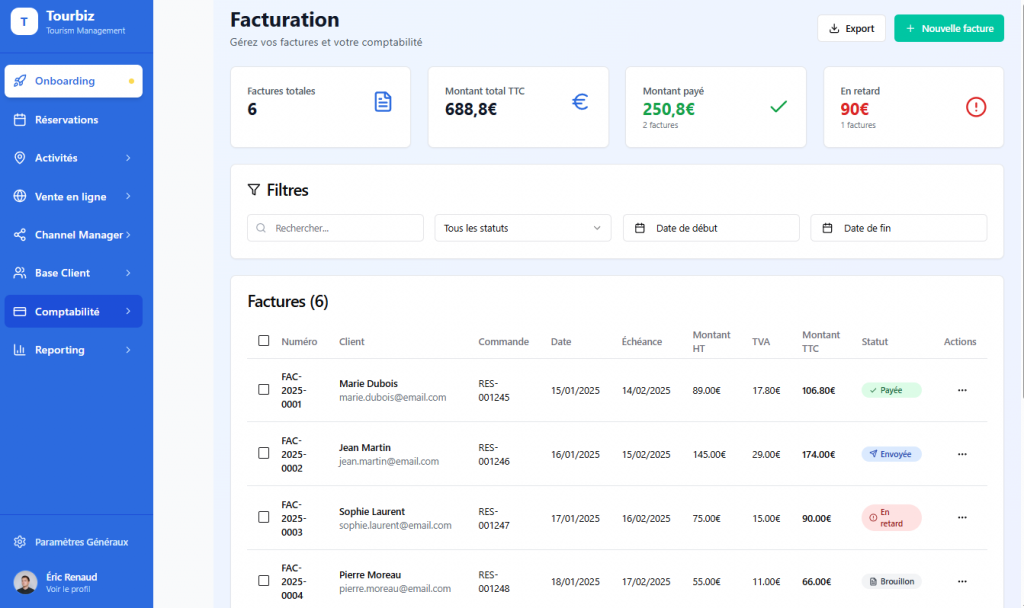
Synchronization of bookings and invoicing compliant with your status
Each status imposes its own rules regarding invoicing: invoice numbering, legal mentions, VAT… Tourbiz automatically integrates these variables according to your business profile:
- Micro-entrepreneur: issuing invoices without VAT and simplified tracking of turnover.
- Company (SARL, SAS, etc.): automatic generation of accounting documents and accounting exports ready to be sent to your expert.
Good to know: our platform is already compliant with electronic invoicing, which will be mandatory starting in 2026.
Integration of automated accounting flows via Tourbiz
Tourbiz connects your bookings, payments, and invoices to your accounting dashboard. You have a clear view of your margins, commissions, and collected taxes. This is a key advantage for companies subject to more complex tax obligations.
- Unified accounting export: all your sales consolidated by activity, ready to be sent.
- Automated VAT tracking: ideal for structures exceeding the thresholds for exemption.
These automations drastically reduce the risk of error and repetitive tasks, while maintaining control over financial flows, whether you are alone or leading a team.
Bonus: link your offer to GetYourGuide via Tourbiz
One of the standout features of Tourbiz lies in its OTA connectivity. You can directly connect your tourism experiences to platforms like GetYourGuide. This bidirectional integration synchronizes your availability, pricing, and bookings in real time.
In practice: you set up your products in Tourbiz, activate the GetYourGuide connector, and let the engine do the rest. No more double entries or unsynchronized calendars—you centralize everything from your dashboard.
To master this connection, consult our GetYourGuide supplier guide and discover how to optimize your presence on tourism marketplaces while remaining compliant with your legal status.