

What is a no-show or a cancellation in tourism?
In tourism, a “no-show” refers to a customer who does not show up for the booked activity or accommodation without notifying. A cancellation, on the other hand, corresponds to a customer’s decision to cancel their visit, with or without notice. The major difference: the no-show leaves no room for the operator to react.
Generally, three cases are distinguished:
- The no-show: absence of the customer without warning.
- Late cancellation: reported too close to the scheduled date, it prevents reselling the seat or room.
- Early cancellation: made within a reasonable timeframe, it can be managed more easily by the provider.
These situations, like double booking, have a direct impact on daily organization: a boat leaves half empty, a room remains unused, a guide waits in vain. The loss of earnings becomes evident… but the disorganization amplifies the problem.
To better understand the implications, let’s take some concrete examples:
- Accommodations: unoccupied rooms, loss of revenue, and unnecessary cleaning costs.
- Excursions: incurred logistical costs (fuel, equipment, guide) not amortized.
- Transfers: driver mobilized unnecessarily.
- Ticketing: lost seats, poorly anticipated flow.
A rigorous management of tourist reservations thus becomes essential to limit the economic and operational impact of these absences.
Why do no-shows and cancellations weigh so heavily on profitability?
Behind each no-show lies a double loss: that of direct revenue, and that – more insidious – of hidden costs. When an activity is not filled, fixed costs remain. Staff are paid, vehicles are prepared, licenses are amortized. But the revenue is missing.
- Direct loss: absence of revenue and sometimes partial refund.
- Hidden costs: personnel costs, maintenance, preparation.
Beyond the financial aspect, no-shows disrupt schedules. Guides reassigned at the last minute, stock adjustments, communication to resume with subsequent clients… It’s a loss of time and efficiency that accumulates over time.
The impact also extends to customer relations. An overwhelmed or uncertain provider in their confirmations can lose the trust of their visitors and harm the quality of the partnership with distributors (agencies, OTAs, hotels).
This is where optimizing the pricing policy becomes a strategic weapon: adapting pricing conditions according to flexibility or cancellation risk allows regaining margin while remaining competitive.
How to anticipate no-shows through prevention and communication?
Anticipating a no-show is primarily about building a smooth and reassuring customer journey. Most absences without notice stem from a lack of communication or a too rigid booking process. By focusing on prevention, operators can significantly reduce these situations.
Here are the most effective levers:
- Optimize the online booking process: a clear, intuitive, and mobile-friendly site limits errors and oversights. The user must know in real-time what they are booking and under what conditions.
- Automatically confirm and remind: automatic notifications before the activity (email, WhatsApp, SMS) reinforce customer engagement. It’s simple and remarkably effective.
- Establish a transparent cancellation policy: displaying the deadlines and conditions for refunds or rescheduling at the time of booking reduces last-minute misunderstandings.
- Analyze customer data: detecting risky behaviors (group bookings, peak periods, cancellation history) allows adjusting strategy in advance.
Digital advancements facilitate these practices. For example, WhatsApp tools for tourism simplify sending personalized reminders, automatic confirmations, or follow-up messages. The result: more fluidity, fewer surprises, and a more engaged clientele.
What strategies to adopt to effectively reduce cancellations?
Reducing cancellations does not rely solely on strict policies, but on the balance between perceived flexibility and actual customer commitment. The goal: secure revenue while maintaining satisfaction.
Here are the approaches that work:
- Offer non-refundable or semi-flexible rates: this encourages the customer to honor their reservation while leaving them some leeway.
- Provide rescheduling options or vouchers: when a cancellation is unavoidable, allowing rescheduling or converting the reservation into a gift voucher preserves the business relationship.
- Foster loyalty rather than penalize: a customer attached to your brand is more likely to maintain or reschedule their activity. Subscription programs or loyalty points can tip the balance.
- Manage via a centralized system: tracking reservations and anticipating cancellations becomes simpler with tools connected to your distribution channels.
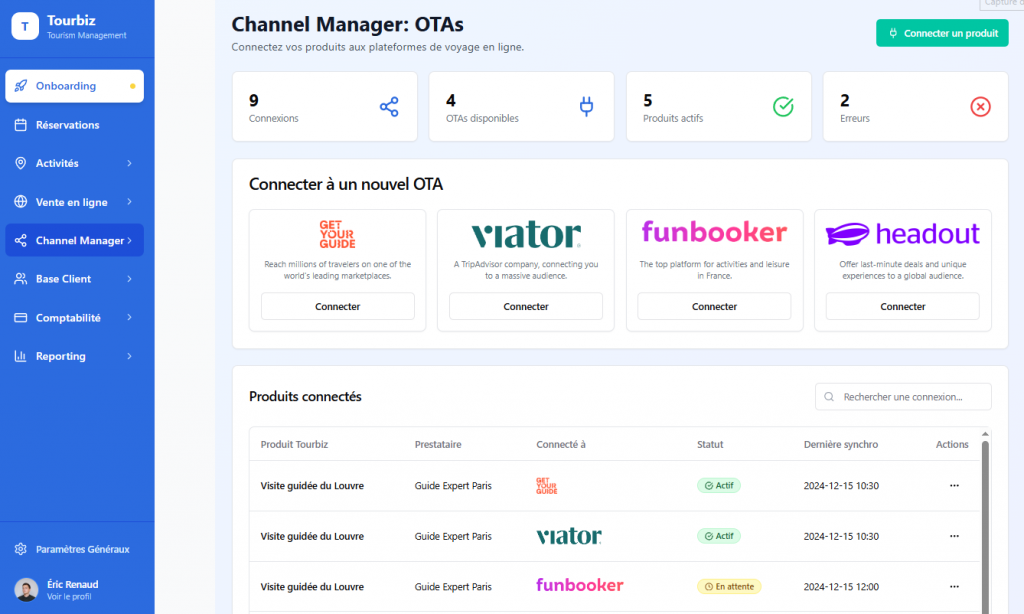
This global management relies on intelligent integrations. For example, connecting to GetYourGuide allows adjusting availability in real-time, harmonizing cancellation conditions, and re-engaging customers more effectively.
How does the Tourbiz platform help limit no-shows and better manage cancellations?
Tourbiz is not just a reservation management software. It is a true cockpit for tourism operators who want to master their flows, their customers, and their margins. By centralizing data and automating alerts, the platform significantly reduces the risks of no-show and losses related to cancellations.
Here’s how Tourbiz makes a difference:
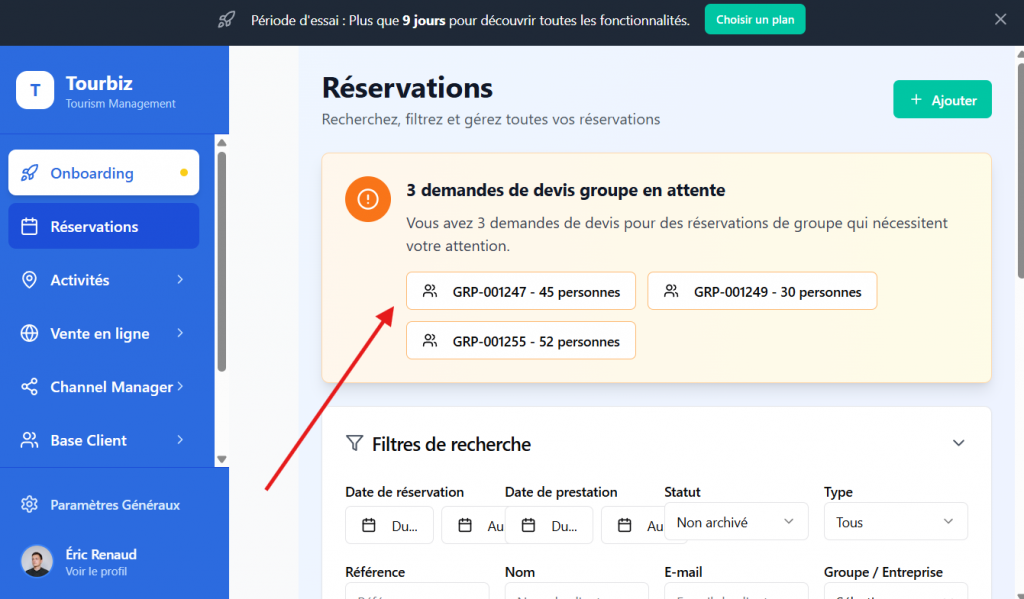
- Real-time tracking of reservations: each reservation is tracked from its creation to final confirmation. Automatic alerts prevent oversights and remind deadlines to both customers and teams.
- Direct integration with sales channels: thanks to native connections with platforms like GetYourGuide, Viator, or Google Things to Do, availability and conditions synchronize instantly. Fewer double bookings, fewer unexpected cancellations.
- Centralized customer communication: emails, SMS, or WhatsApp messages can be sent from the interface. Exchanges are recorded, and each customer remains informed about their reservation, timings, and cancellation rules.
- Intelligent dashboards: cancellation data, attendance rates, or performance by channel are presented in clear graphs. The operator can spot trends, anticipate risky periods, and adjust their strategy.
This global vision allows not only to react but especially to anticipate. The operator knows when a slot becomes fragile and can decide on a reminder message, an offer to reschedule, or an express resale through their partner channels.
For structures connected to players like Viator or GetYourGuide, integrated multi-channel sales management thus becomes a strategic lever: by simplifying coordination, Tourbiz helps secure reservations, optimize communication, and regain margin on each activity.
In a word: fewer hidden losses, more control, and a more serene operation on a daily basis.