
What is the accounting of a tourism activity and what are its specificities?
The accounting of a tourism activity is not just about adding up the sales of stays or tracking operating expenses. It is an essential tool for understanding activity cycles, anticipating cash flow needs, and managing an offer that is often fragmented across multiple distribution channels.
In the tourism sector, it integrates both revenues from direct bookings, online platforms, partners, and specific costs — guides, accommodations, transportation, OTA commissions, etc. A rigorous management of tourist reservations is therefore essential to provide reliable financial data.
The specificities of tourism accounting
Tourism professionals face a complex equation: a highly seasonal activity, often dependent on climatic, economic, or health-related uncertainties. As a result, cash flow is not linear, while fixed costs remain.
- Seasonality: concentration of revenues over a few months, necessity to amortize costs over the year.
- Diversity of revenues: ticketing, accommodation, activities, catering, partnerships.
- Contractual complexity: multiple intermediaries and booking channels.
Legal and tax obligations
A tourism business must comply with standard accounting obligations (balance sheet, income statement, journal), but certain specific taxes are added: tourist tax, VAT on travel services, or special regimes related to the sale of tourist packages.
Accounting readability is also a trust lever for partners, clients, and funding organizations. Accurate recording of revenues and expenses ensures impeccable legal compliance and better anticipation of tax obligations.
⚠️ Important: starting in 2026, professionals will need to comply with the new electronic invoicing standard. Don’t know how to do it? Discover the most comprehensive guide on the subject of electronic invoicing for tourism stakeholders!
Why is good accounting management essential for a tourism professional?
In a sector where every season counts, mastering accounting ensures resilience. Good financial management allows for anticipating low periods, investing at the right time, and optimizing margins without compromising the customer experience.
Cash flow management and anticipation of low periods
The ability to smooth seasonal financial flows makes the difference between a professional who suffers and one who manages. By tracking sales trends and fixed costs, it becomes possible to secure the necessary funds to get through the winter — and even to exploit new business opportunities, such as prospecting clients in the low season.
Financial readability and growth management
Clear accounting allows for understanding which offers generate the most profitability. This diagnosis feeds strategic decisions: increase the communication budget for a high-margin product, adjust prices, or eliminate overly costly activities.
- Immediate visibility on the profitability of each tourism product.
- Informed decision-making to effectively allocate marketing and human resources.
Compliance and tax control
Having a consolidated dashboard simplifies preparation for audits, justifies financial flows, and facilitates the validation of accounting documents. It is also a guarantee of peace of mind to respond quickly to requests from authorities.
Margin optimization and profitability
By finely analyzing variable costs and hidden expenses, a tourism professional can act on several levers: supplier negotiation, automation of administrative tasks, reduction of commissions through direct sales. Accounting then becomes a tool for continuous improvement, not just a regulatory constraint.
What tools and methods to use to simplify tourism accounting?
Managing the accounting of a tourism structure should not be a mountain. The right digital tools can save time, reduce human errors, and simplify collaboration with accountants.
General accounting software or tourism specialized?
Small and medium-sized enterprises in the sector can choose between general tools (QuickBooks, Sage, Pennylane…) or solutions dedicated to tourism. The latter integrate modules designed for bookings, OTA commissions, and multi-channel invoicing.
- General software: more flexible, but often require adjustments.
- Specialized solutions: optimized for tourism-specific flows (ticketing, partnerships, online agency commissions).
Why automate invoices and payments
Automation frees up time and enhances reliability. Repetitive tasks — invoices, bank reconciliations, reports — are handled by the software. And when your sales go through multiple booking channels, synchronization becomes vital. Good management via a channel manager facilitates the automatic retrieval of data for frictionless accounting tracking.
Some essential SaaS tools
For tourism providers, the winning trio consists of:
- An invoicing tool – to standardize multilingual quotes and receipts.
- A connected banking solution – to automatically track incoming/outgoing flows.
- A CRM linked to the booking system – to better understand client profitability by channel.
Working with an accountant
Digital does not replace human advice. By centralizing data via your SaaS tool, you provide your accountant with a clear and real-time view of your activity. The result: faster balance sheets and more relevant advice on the financial strategy to adopt.
How to effectively structure the accounting management of your tourism activity?
Fluid accounting relies on good internal architecture: categorization of revenues, centralization of data, and regular analysis of performance indicators. It is both a technical and strategic approach.
Establish an adapted accounting plan
Tourism activities do not always fit into standard boxes. Accommodation, excursions, partnerships, or commissions: each flow deserves a distinct line in your accounting plan. This will allow you to isolate the performance of each segment and identify growth levers.
Centralize management data
Linked to booking platforms and invoicing tools, your data becomes a true asset. It feeds both the accounting dashboard and operational analysis. The ideal: link your bookings, sales, and payments in one environment, as mentioned in our guide on sales tracking and tourism management.
Track the right indicators
Accounting is only useful if it informs your decisions. Focus on high-impact indicators:
- Occupancy rate: measures seasonal performance.
- Margin by activity: identifies high value-added services.
- Customer acquisition cost: evaluates the profitability of marketing campaigns.
Implement regular balance sheets
Do not limit your balance sheets to the end of the fiscal year. A monthly or quarterly report with visual dashboards allows for quick adjustments to your pricing decisions, budgets, and investment priorities.
Accounting structuring is not just an administrative constraint: it is a pillar of competitiveness for any modern tourism professional.
How to centralize accounting and bookings via Tourbiz?
For tourism professionals, juggling between multiple booking platforms, scattered invoices, and fragmented accounting is often a source of stress. Tourbiz has been designed to solve this puzzle — by connecting, automating, and securing the entire financial flow.
Direct connection to booking channels
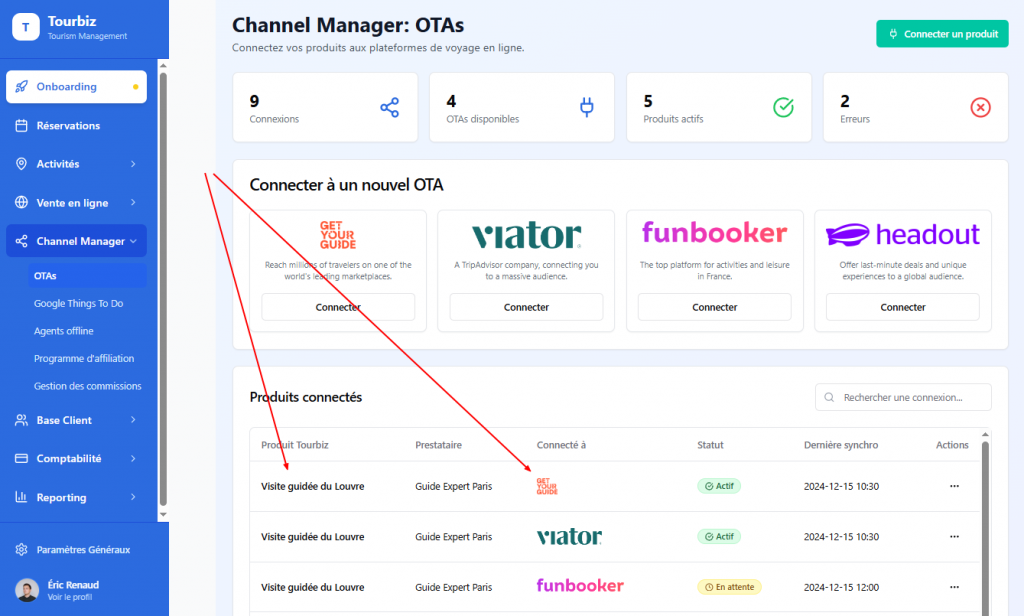
Tourbiz connects to your OTAs (Funbooker, Viator, GetYourGuide…) and to your online booking site. All transactions, price adjustments, and availability are synchronized in real time. No more manual imports or risks of “double booking“: your financial and booking data speak the same language.
- Multi-channel synchronization: all bookings enrich your accounting base.
- Elimination of duplicates: sales are automatically allocated by source channel.
Automatic synchronization of payments and invoices
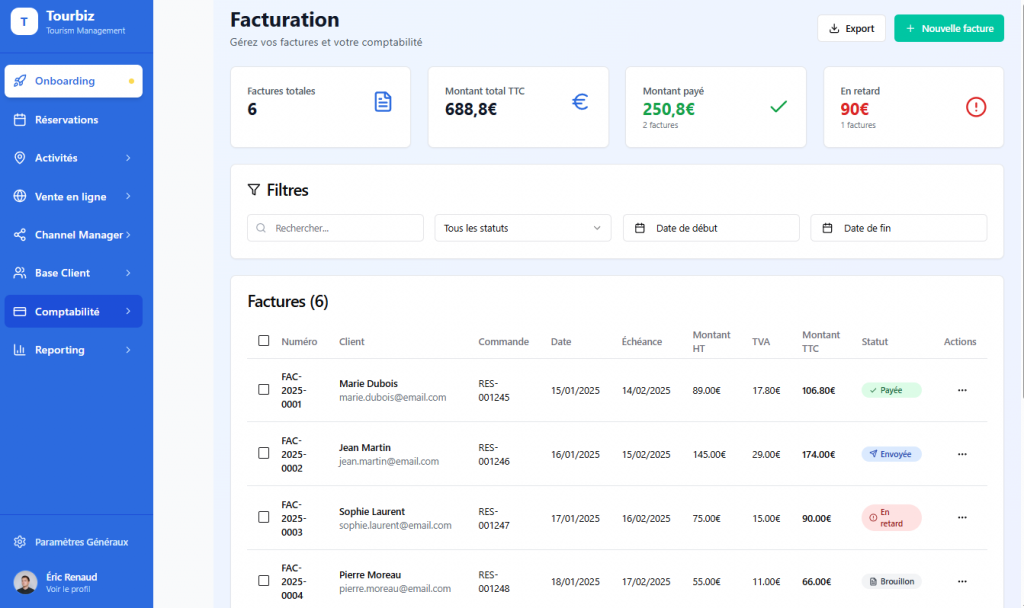
Each payment received or refund made is recorded and accounted for without manual action. Tourbiz automates the generation of client invoices and their classification in your accounting plan. Once set up, everything happens in the background.
- Automatic invoicing – invoices generated as soon as the booking is confirmed.
- Tracking of collections – bank reconciliation and automatic allocation of amounts including/excluding tax.
Real-time generation of accounting reports
With Tourbiz, your financial reports do not sit in a spreadsheet. You can visualize your revenues by sales channel, the VAT to be paid, or the net margin of each tourism offer with one click. These reports update instantly as bookings and payments are received.
Result: clear and immediate management, without waiting for your accountant’s monthly closure.
Centralizing your booking and accounting data on Tourbiz is a decisive step towards frictionless management. Fewer errors, more fluidity, and an overview of your entire tourism activity — from booking to financial balance.