

What is an OTA?
An OTA (Online Travel Agency) is an online travel agency that allows travelers to book tourist services directly: hotels, flight tickets, tours, activities, excursions, cruises… Unlike a traditional distributor, the OTA operates exclusively online and relies on giant databases, secure payment systems, and global visibility.
Historically, OTAs were born in the hospitality sector with players like Booking.com and Expedia. Their promise: to make booking simple, fast, and transparent for the traveler, while offering professionals an international showcase. Very quickly, the model spread to other segments: Airbnb transformed seasonal rentals, Viator and GetYourGuide established themselves in activities and excursions, Omio and Trainline in transportation.
In 2025, an OTA is no longer just a booking intermediary. It is a trusted player for travelers, centralizing thousands of offers, aggregating millions of customer reviews, and guaranteeing payment security. For professionals, it represents both a tremendous visibility opportunity… and a challenge in terms of margin and dependency.
The main OTAs in 2025
The landscape of OTAs is vast and constantly evolving. In 2025, some players still dominate their segment, while new entrants shake up the codes. To navigate this, here is a typology of the main OTAs according to their specialization.
Accommodation OTAs
- Booking.com: global leader, present in over 200 countries, it remains essential for independent hotels as well as large chains.
- Expedia: historical North American player, strong in air travel and hospitality, with a diversified portfolio.
- Airbnb: from seasonal rentals to experiences, the platform also establishes itself as a hybrid player between accommodation and local activities.
Activity and experience OTAs
- Viator (a subsidiary of Tripadvisor): one of the global heavyweights for excursions, guided tours, and local activities.
- GetYourGuide: very strong in Europe, the platform stands out for its polished UX and premium positioning.
- Headout: a newer OTA, but rapidly growing in major cities and events.
- Musement (acquired by TUI): mainly active in Europe, with a strong focus on museums and cultural attractions.
Transport and other segment OTAs
- Omio: specialist in trains, buses, and ferries in Europe, becoming essential for multimodal travel.
- Trainline: very strong in the UK and France, focused on rail ticketing.
- Flixbus / Flixtrain: at the intersection of operator and OTA, the platform captures a growing share of low-cost mobility.
A growing weight in distribution
In 2025, OTAs are no longer just showcases. They have become mandatory stopovers for millions of travelers:
- They concentrate the majority of online searches.
- They have colossal marketing power (SEO, international campaigns, digital advertising).
- They capitalize on customer reviews, which serve as a trust barometer.
For a tourism professional, choosing which OTAs to position on is therefore a strategic arbitration: maximum visibility vs. sometimes heavy commissions.
Why work with an OTA?
For many tourism professionals, the relationship with OTAs is ambivalent: gratitude for the visibility provided and frustration over the commissions charged. However, in 2025, it is difficult to ignore their structuring role in tourism distribution.
Working with an OTA is primarily about accessing global visibility. A small local operator offering boat rides or guided tours can instantly appear in the searches of an American or Asian traveler, without colossal marketing investment.
It is also about benefiting from a guarantee of trust. For a customer, booking through Booking, Viator, or GetYourGuide is reassuring: verified reviews, available customer service, secure payment. These guarantees weigh heavily in the purchasing decision, especially when it comes to a first booking abroad.
Finally, OTAs are a powerful tool for filling gaps in attendance. Outside of high season, they become valuable allies for maintaining a steady flow of bookings, particularly thanks to their promotional capabilities and algorithmic highlighting.
In summary:
- + more visibility in a global market.
- + more credibility thanks to the brand power of OTAs.
- + more volume by filling periods that would otherwise be empty.
The issue is not whether to work with an OTA, but rather how to intelligently integrate it into your distribution strategy.
The limits and risks of OTAs
If OTAs have become essential partners, they are not without trade-offs. Every professional must be aware of the risks associated with their use in order to anticipate and maintain a balanced strategy.
| Risk | Explanation | Concrete impact |
|---|---|---|
| High commissions | Between 15 and 30% of the sale price returned to the OTA. | An activity sold for €100 may only yield €70 to €80, which heavily impacts the margin. |
| Excessive dependence | Relying on a single OTA for the majority of sales. | An algorithmic visibility drop or a change in conditions can jeopardize the entire activity. |
| Standardization of the offer | Product sheets must follow standardized formats. | Less room for differentiation and brand storytelling. |
| Risk of double booking | Poor synchronization between platforms. | Unhappy customers, refunds, negative reviews — a real headache without a synchronization solution. |
Working with an OTA is therefore not a bad idea in itself, but it must always be accompanied by a control strategy. The right tools — particularly a Channel Manager — allow you to centralize and secure sales while benefiting from the power of OTAs.
In short: OTAs should not replace your direct channels, but rather intelligently complement them. And that is what Tourbiz does very well.
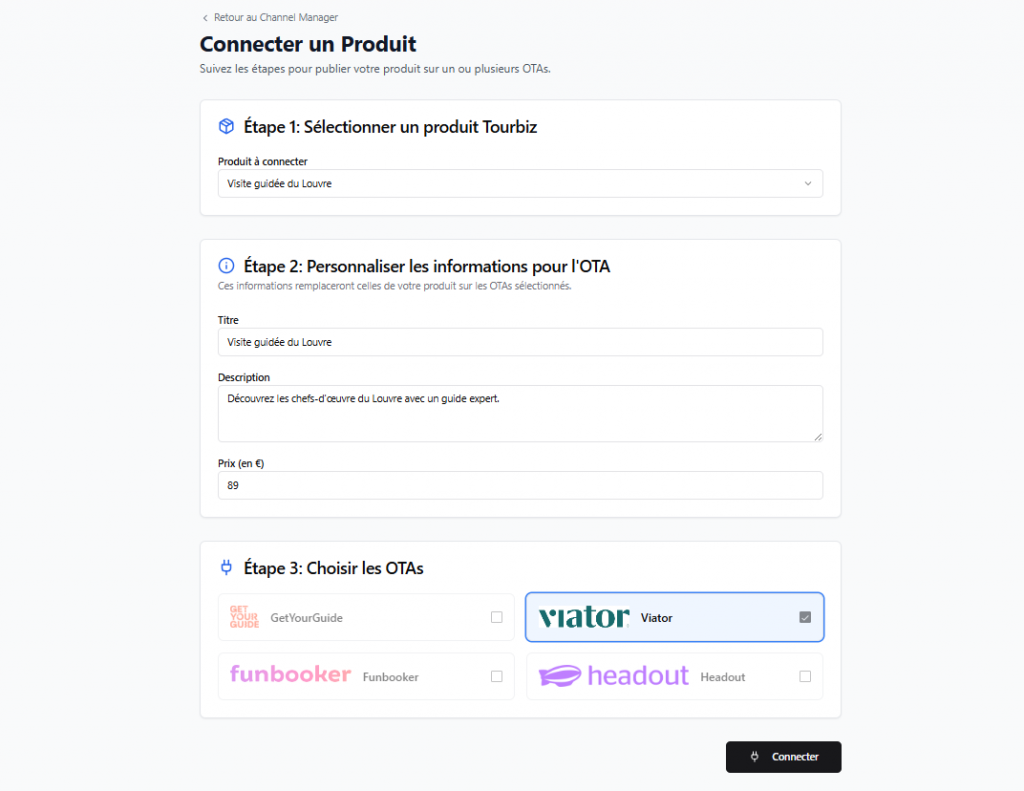
To discover the connections available today and choose your channels wisely, consult our list of OTA integrations at Tourbiz.
How to optimize your OTA strategy in 2025?
Working with an OTA is essential, but succeeding in your strategy requires a subtle balance between external visibility and internal control. In 2025, three axes are decisive.
First, select the right OTAs according to your target. There’s no need to be everywhere: a cultural activities operator will favor Viator or GetYourGuide, while a theme park may focus more on Funbooker or Musement. It’s better to concentrate efforts on the most relevant platforms than to scatter your stocks.
Next, optimize your product sheets. High-quality photos, clear storytelling, and transparent pricing directly influence the OTA algorithms and conversion rates. Many providers still underestimate this lever, even though it can double the visibility of an offer.
Finally, it is essential to maintain control over your availability. OTA sales must be synchronized with direct bookings (website, phone, counter) to avoid errors. This is precisely the role of a channel manager software, which centralizes all channels into a single calendar and secures stocks.
In summary, success on OTAs relies on three pillars: the right targeting, the quality of the sheets, and technical mastery. Those who find this balance transform OTAs into a growth accelerator, rather than a constraint.
The role of Channel Managers and SaaS tools
OTAs open doors, but they also add a layer of complexity to daily management. Each reservation coming from a different channel, every price or availability change must be reflected everywhere. Without automation, it’s a headache that quickly leads to costly errors.
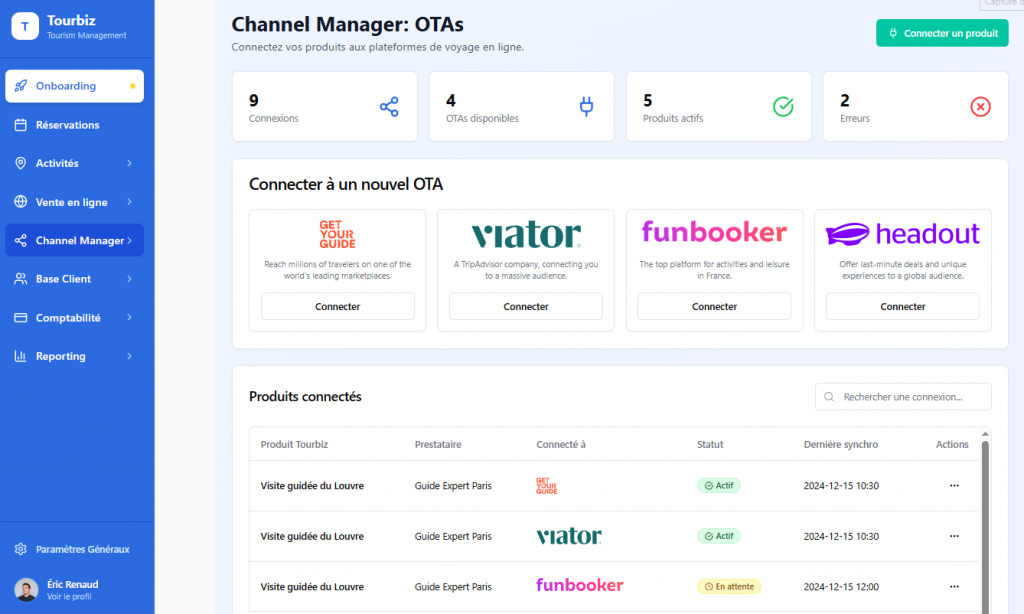
This is where Channel Managers come in. These SaaS solutions act as a conductor: they synchronize your direct sales and those from OTAs in real-time. A slot reserved on Viator immediately disappears from GetYourGuide and your own site, eliminating the risk of overbooking.
Beyond simple stock management, a modern Channel Manager goes further:
- it centralizes all bookings in a single calendar,
- it provides a global view of the performance of different channels,
- it helps adjust prices and offers based on demand.
In other words, it is the essential tool to transform your presence on OTAs into a true controlled growth lever. To delve deeper into the subject and explore best practices, discover our channel manager guide.
What OTAs are integrated by Tourbiz?
Tourbiz was designed so that tourism professionals can benefit from the power of OTAs, without technical complexity or unnecessary margin loss. In 2025, our Channel Manager natively integrates several essential platforms:
- GetYourGuide: European leader in activities and experiences, ideal for reaching an international clientele in search of guided tours, cruises, or excursions.
- Viator (a subsidiary of Tripadvisor): one of the global giants, particularly powerful in excursions and urban activities, widely used by North American travelers.
- Funbooker: the French reference platform for leisure, birthdays, and local activities. An important feature: Tourbiz takes no fees on Funbooker bookings, ensuring maximum profitability for professionals.
By directly integrating these OTAs into your dashboard, Tourbiz allows you to synchronize your availability in real-time, reduce the risk of overbooking, and manage your multichannel sales with ease.