

What is experiential tourism in 2025?
Experiential tourism is the natural evolution of travel: moving from simply “seeing” to “living”. Born in the 2000s and popularized in the 2010s, it places the traveler at the center of the action, no longer as a spectator, but as an actor in their adventure.
Initially, it was mainly about immersion: sleeping with locals, participating in a craft activity, discovering a culture differently. In 2025, this logic has transformed into a true process of co-creation of experience between visitors, guides, and local communities.
This mutation is explained by the new expectations of travelers:
- Authenticity: the search for a sincere human connection with locals.
- Meaning: understanding, learning, contributing — more than just accumulating Instagram clichés.
- Personalization: itineraries tailored to each person’s desires and values.
Experiential tourism is therefore no longer a niche, but a compass for rethinking the tourism offer. For agencies, guides, and hosts, this involves a new way to create a travel agency capable of integrating humanity and innovation at the heart of each stay.
Why is experiential tourism becoming essential for professionals in the sector?
Since the pandemic, travelers no longer just want to visit a place: they want to reconnect. With nature, with others, with themselves. This need for human connection has redefined the priorities of the sector. Collective, participatory, or immersive experiences have become a major lever for differentiation.
Generations Y and Z, now at the center of the travel market, have imposed their standards:
- Preference for “real” experiences rather than standardized tourist destinations.
- Massive use of social networks to share lived experiences, not brochures.
- Increased sensitivity to ethics, sustainability, and transparency.
For professionals, betting on experiential tourism is also investing in loyalty. A unique experience creates an emotion, and thus a lasting memory — much more powerful than a simple pricing offer.
In practice, tourism actors can rely on data and technology to track their sales and measure the impact of these experiences, thus optimizing their strategy to better personalize and evolve their offers.
The new trends in experiential tourism in 2025
In 2025, experiential tourism enters a new phase: that of awareness and innovation. Travelers no longer just want to live an adventure, but also to have a positive impact on the places they visit. As a result: four major trends are reshaping the travel landscape.
1. Regenerative and sustainable tourism
Beyond simple “green tourism”, we now talk about regenerative travel. The goal is no longer to limit one’s impact, but to improve the visited ecosystem. This involves local projects, participation in environmental actions, or collaboration with community initiatives.
2. The rise of local micro-experiences
Long stays give way to short formats, focused on a place and an emotion. A sensory walk, a cooking workshop, a night tour narrated by a resident: so many micro-experiences that create a strong perceived value.
3. Hybrid experiences: between real and digital
The boundary between the real world and the virtual is fading. Augmented reality and immersive tools enrich discoveries. Destinations now integrate connected pathways where storytelling unfolds via smartphone, headset, or QR code. This approach opens new perspectives for improving visibility on Google Things to Do and reaching digital travelers.
4. Gastronomy, nature, and well-being as pillars
The quest for meaning is also reflected in a refocusing on simple pleasures: local products, walking, meditation in nature. Travel becomes a pause to realign body and mind, far from mass tourism.
These trends offer professionals fertile ground for innovation: each experience can become a story, each destination, a shared emotion.
How can tourism actors adapt to these new expectations?
Adapting to experiential tourism is not just about rethinking an offer: it’s about rethinking the customer relationship, the design of the stay, and even the way to tell the story of one’s territory. Here are the concrete levers to activate right now.
Build local partnerships
Creating authentic circuits involves close collaboration with communities. Artisans, farmers, independent guides: each becomes an ambassador of the experience. These partnerships strengthen the legitimacy and coherence of the offer.
1. Exploit data and customer feedback
Digital tools allow for analyzing preferences, reviews, and behaviors. By using this data, professionals can design hyper-personalized offers adjusted in real-time. Data becomes an ally to better forecast demand and avoid revenue losses, particularly through dynamic pricing solutions.
2. Optimize presence on experiential platforms
Travelers now search for their activities on specialized platforms (GetYourGuide, Viator, Airbnb Experiences). Being visible on these channels multiplies booking opportunities and reaches global audiences.
3. Train your teams
The human element remains at the heart of the system. Training guides, agents, and partners in creating memorable experiences makes all the difference: storytelling, emotional management, positive interactions. Every detail counts to transform a simple moment into a lasting memory.
Experiential tourism is not improvised: it is built, step by step, around relationship, meaning, and creativity.
How does Tourbiz enable the integration of experiential tourism into its offer?
Offering authentic, immersive, and profitable experiences is often an operational headache. Tourbiz simplifies this equation. The platform allows agencies, tourist offices, and operators to integrate experiential tourism at the heart of their offer, without multiplying tools or wasting time on management.
Centralize all your offers on a single interface
With Tourbiz, you can gather your activities, circuits, and local experiences in one dashboard. This allows for better management of your sales, availability, and partners in real-time. No more need to switch between different back-offices: everything is centralized, from the catalog to the booking.
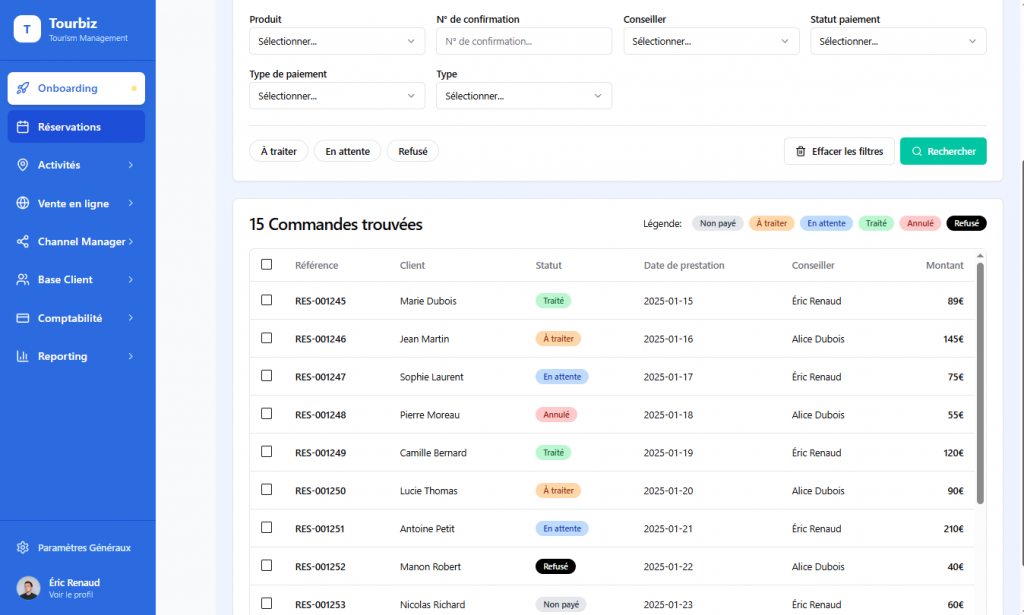
This approach helps you stay agile in the market and better manage your tourist reservations, a key issue when demand fluctuates according to seasons or travel trends.
A smooth connection with major experience platforms
Tourbiz integrates powerful connectors with giants like GetYourGuide, Viator, or Headout. Specifically, this means you can automatically distribute your offers across multiple platforms from a single space, without re-entry or stock errors.
A strategy that boosts the visibility and effectiveness of your campaigns while limiting double-booking risks.
A dashboard to measure your performance
Tracking the performance of your experiences becomes simple. The Tourbiz dashboard offers a consolidated view of your bookings, revenues, and distribution channels. You can thus adjust your prices, identify the most profitable activities, and anticipate slow periods.
Real-time analysis also allows you to identify what appeals to your customers and adapt your offers accordingly. It’s a powerful lever to improve your storytelling and enhance customer satisfaction.
Concrete examples of success
Several local agencies and independent guides have already boosted their activity thanks to Tourbiz. By connecting their experiences across different channels, our clients have increased their visibility by more than 40% on average and gained valuable management time.
Visibility also runs through search, and our guide to SEO in the travel sector covers the fundamentals.
Tourbiz thus establishes itself as a true growth partner for all those who want to integrate experience at the heart of their offer, without complicating their daily lives.