
What is a tourism grant and why is it essential for a local player in 2025?
A tourism grant refers to public financial aid intended to support players in the sector in creating, modernizing, or digitizing their offerings. It can come from the State, regions, Europe, or quasi-public structures. Its objective is clear: to accelerate the sustainable transition and enhance the attractiveness of local destinations.
Since the pandemic, tourism has undergone profound transformation. Visitors now seek authentic, sustainable experiences rooted in the territories. This evolution has put pressure on small local structures: tourist offices, independent guides, accommodation providers, travel artisans. To remain competitive, these players must rethink their models… and grants often constitute a vital lever.
Tourism grants therefore address several challenges:
- Local economic recovery: they allow players to maintain jobs and revive productive investment.
- Ecological transition: many schemes support low-carbon projects, eco-mobility, or responsible flow management.
- Digital transformation: the aids encourage the digitization of customer relations, from booking to online promotion.
- Attractiveness of territories: they contribute to enhancing cultural, environmental, and gastronomic heritage.
In 2025, public authorities amplify funding tools: France Relance plan, Sustainable Tourism Fund, regional programs aligned with the European strategy ‘Green Transition 2030’… The European Union also extends its flagship schemes through Horizon Europe and NextGenerationEU.
In the face of the French political debacle, obtaining a tourism grant has become a survival condition for many sector players eager to find new clients in tourism and to differentiate themselves sustainably.
What are the main funding programs available for local tourism players?
Good news: in 2025, the range of funding accessible to local tourism operators has diversified. The stated objective of public authorities? To support projects with a strong regional impact while promoting competitiveness.
National grants
At the national level, three players stand out:
- ADEME: supports sustainable tourism initiatives, soft mobility projects, or ecological renovations of accommodations.
- BPI France: finances digital innovation and modernization of tourism infrastructures.
- Atout France: targets innovative projects that enhance heritage and upgrade destinations.
Regional and departmental aids
Each region has dedicated programs, often managed in partnership with departments and tourist offices:
- Occitanie: ‘Tourism & Sustainable Territories’, to modernize reception and soft mobility.
- Provence-Alpes-Côte d’Azur: aids for the renovation of eco-responsible tourist establishments.
- Nouvelle-Aquitaine: support for short circuits and structuring local players.
European funding
Project leaders can also apply for:
- FEDER: energy renovation, responsible tourism infrastructures.
- Horizon Europe: innovation and digital transition projects in tourism.
- NextGenerationEU: support for employment and resilience of tourism SMEs.
Private funds and partnerships
Finally, private funds (impact banks, foundations) and public-private partnerships represent increasingly used co-financing levers. Tourism companies can find a strategic complement to their public aids.
For tourism entrepreneurs, the challenge is not limited to obtaining a grant: it also consists of effectively managing their tourism bookings to demonstrate their capacity for management and execution.
Summary table of aids & grants in France in 2025
Finding and creating your grant application is not always easy, given the number of possibilities but paradoxically the lack of information on the subject. To help you see more clearly, here is a summary table with links to the various platforms:
| Name of the aid / scheme | Beneficiaries | Objectives / uses | Amounts / conditions | Reference / link |
|---|---|---|---|---|
| Aid for investments in tourist sites | Tourism companies, visitor sites | Create or strengthen a visit offer, improve visitor reception, adapt to standards. | Grant (variable rate depending on the project) | France Num |
| Aid for the development of tourism activities | TPE/PME in tourism | Tourism studies and tourism development projects. | Studies: up to 50% (max. €20,000) Projects: up to 20% (max. €45,000) | France Num |
| Regional Fund for Tourism – Île-de-France Region | Tourism professionals and Île-de-France communities | Creation, digitization, and modernization of sustainable tourism offerings. | Amounts vary depending on the project (eco-conditionality) | Région Île-de-France |
| Tourism Loan (Bpifrance & Banque des Territoires) | TPE/PME in tourism | Modernization, digitization, ecological transition, sustainable development. | From €50,000 to €5M No personal guarantee | Fonds Publics |
| Sustainable Tourism Fund (ADEME) | Accommodation providers, restaurants, tourism players engaged in ecological transition | Reduction of energy consumption, waste management, sustainable mobility, environmental labeling. | From €5,000 to €200,000 depending on the project | ADEME – Sustainable Tourism Fund |
| Tourism Fund Occitanie | Tourism companies in the Occitanie region | Agile co-financing of innovative and sustainable projects (accommodation, activities, digital). | Amounts vary depending on the nature of the project | CRT Occitanie |
| Support for tourism project leaders | Communities and public or private structures in the tourism sector | Support in project engineering (accommodation, itineraries, tourism equipment). | In-kind or financial aid depending on the project | Aides Territoires |
How to prepare and submit a tourism grant application?
Obtaining a grant is primarily a matter of strategy and rigor.
In 2025, funders require solid, quantified files that demonstrate measurable impact. Each line must demonstrate the maturity of your project and its coherence with public priorities: sustainability, inclusion, digital transition.
Identify the right programs
Before submitting a file, you need to target the schemes suited to your profile: SME, association, tourist office, reception structure, or experience provider. Good identification relies on:
- The region of establishment: some prioritize rural areas, others coastlines or territories in transition.
- The type of project: renovation, digitization, training, innovation, or sustainable development.
- The legal status of the project leader and their ability to co-finance part of the expenses.
Structure a clear and attractive file
Review committees receive dozens of files. Their first expectation: clarity. A good file is structured into four key parts:
- Synthetic presentation of the project and the involved partners.
- Projected budget detailing eligible expenses and co-financing.
- Measurable objectives linked to the indicators of the grant (jobs created, additional visitors, carbon reduction…).
- Implementation schedule and management modalities.
Best practices to maximize your chances
The most organized project leaders achieve better acceptance rates. Here are some levers not to overlook:
- Ensure consistency between ambition and budget.
- Anticipate your supporting documents (statutes, balance sheets, quotes, tax certificates).
- Highlight the territorial or environmental impact of the project.
- Contact the instructing service in advance to check eligibility.
Common mistakes to avoid
- Sending an incomplete or late file.
- Copy-pasting a generic description without local anchoring.
- Misjudging the financing plan and ending up under budget.
Finally, don’t forget that a successful file requires rigorous data and schedule management: find out how to effectively manage your guides’ schedule to meet your commitments to funders.
How to manage and effectively track your grants once obtained?
A tourism grant is not secured once signed: it must be earned until the last euro. Funders require rigorous administrative, financial, and operational monitoring. In 2025, tourism structures must prove their ability to manage their aids methodically — and demonstrate the results.
Reporting and financial management tools
Having an Excel spreadsheet is no longer enough. Funders expect clear tracking of the budget, actual expenses, and performance indicators. Digital tools (CRM, ERP, tracking platforms like Tourbiz) allow you to:
- Centralize supporting documents (invoices, pay slips, agreements).
- Ensure traceability of expenses on each budget line.
- Automatically generate reporting tables.
Meet administrative and communication obligations
Each scheme imposes specific rules: logos to display, mandatory mentions on communication materials, interim reports… Neglecting these points can lead to payment delays — or even penalties.
- Submit your interim payment requests on time.
- Respect the required reporting formats (PDF, spreadsheets, online forms).
- Publicly acknowledge the support received: social media, website, local media.
Planning and managing expenses
The secret to good management? Fine and realistic planning. Each subsidized project must have a projected cash flow plan that anticipates discrepancies between expenses and aid payments.
The most successful structures rely on a continuous optimization logic: adjusting flows, prioritizing investments, pooling certain resources. If you manage multiple products or seasonalities, draw inspiration from the principles of dynamic pricing to intelligently distribute your costs over time.
Post-financing performance indicators
Once the grant is consumed, the real evaluation begins: the funder wants to measure the actual impact. The most observed indicators concern:
- Tourist attendance (visitors, overnight stays, local benefits).
- The effect on employment and training.
- The reduction of emissions or energy consumption.
- The visibility and attractiveness of the destination.
Rigorous monitoring is not only about settling an aid: it consolidates your credibility for future calls for projects. In tourism, the only mistake would be not to capitalize on the lessons from your previous funding.
How can Tourbiz help you enhance your data in your grant applications?
Tourbiz is not intended to formulate or track your grant applications.
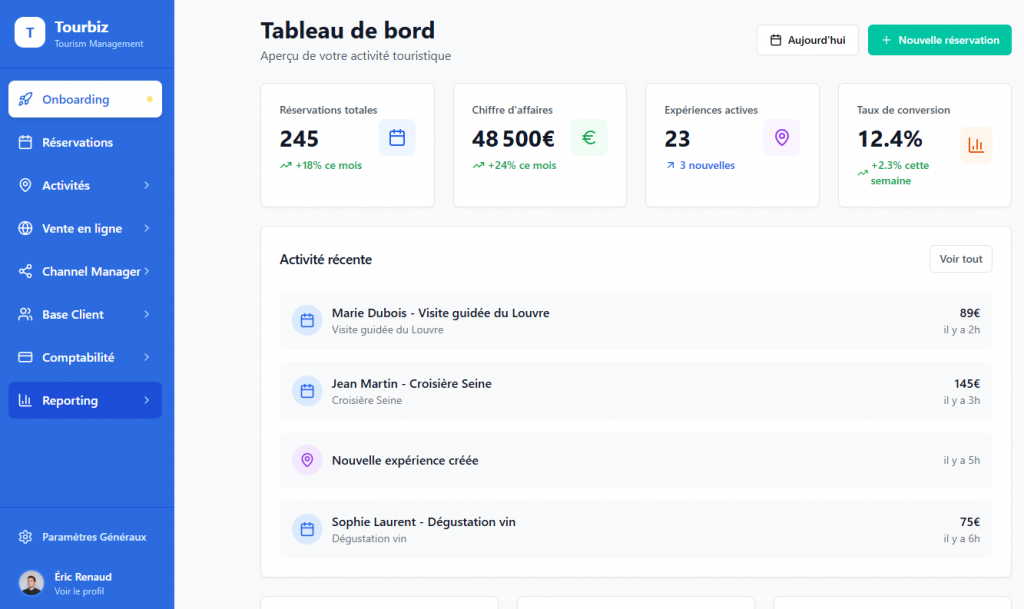
However, our solution gives you access to a clear, structured, and exportable view of your activity — essential information when it comes to building a solid funding file.
Reliable data for your business plans and aid files
Thanks to its integrated accounting and reporting modules, Tourbiz centralizes all your financial and operational data:
- Revenue by activity, period, or sales channel;
- Margins, variable costs, and detailed charges;
- Booking volumes and occupancy rates;
- Sales trends by product, OTA, or market.
All this data is exportable with one click (Excel, PDF, or API), greatly facilitating the preparation of business plans, forecast studies, or detailed supporting documents often required in grant applications.
Save time and improve readability
Tourbiz is not limited to producing numbers: it allows you to organize and present them in a readable way, without complex spreadsheets.
You can:
- Automatically generate your activity reports;
- Compare multiple fiscal years or periods;
- Support your requests with precise and verifiable indicators.
Result: a considerable time saving, always up-to-date data, and better-argued files.
A lever to structure your financial management
Even without a specific tool for grants, Tourbiz strengthens the credibility of your management. By centralizing sales, payments, costs, and margins, you have a solid foundation to demonstrate:
- The predictable impact of aids on your development. For tourism professionals who want to professionalize their management and save time, it’s a tool that makes a difference.
- The economic viability of your projects;
- The traceability of your expenses;