

What is a margin for a travel agency and how to calculate it?
The margin is the heart of a travel agency’s business model. It is the difference between what you charge the client and what you pay your suppliers. Calculating it correctly ensures the viability of your structure.
Definition of commercial margin and net margin
The commercial margin corresponds to the difference between the selling price of a tourist product (a stay, an activity, a plane ticket) and its purchase cost. It is what remains before deducting your fixed costs such as salaries, marketing, or technology.
The net margin, on the other hand, is the actual profit after these charges. It is an indicator of overall profitability, and the one that managers monitor the most.
Difference between commission, fees, and margin
Be careful not to confuse these concepts:
- Commission: percentage paid by a supplier (e.g., hotel or tour operator) for each booking.
- Fees: service charges added by the agency, often presented to the client.
- Margin: final amount remaining after deducting all direct costs related to the sale.
Formula for calculating a travel agency’s margin
The simple formula:
Margin = (Selling price excluding tax – Purchase cost excluding tax) / Selling price excluding tax × 100
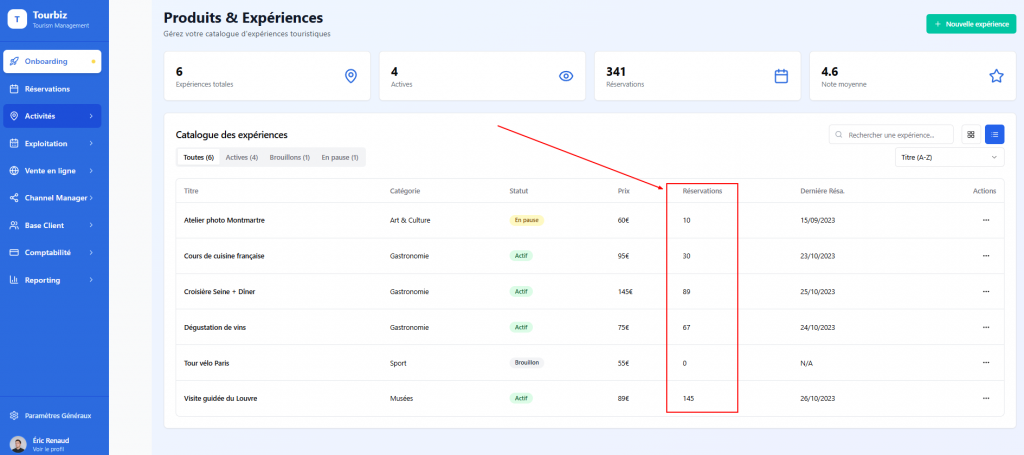
This formula gives your margin rate, a key indicator to monitor month by month. Automated tracking via a management tool like Tourbiz highlights the most profitable products and allows you to adjust your prices accordingly.
Numerical examples according to the type of agency
- B2C Agency (direct sales): stay sold for €2,000, purchased for €1,600 → margin of 20%.
- B2B Agency: circuit sold to a coach operator for €1,000, purchased for €850 → margin of 15%.
- OTA (online platform): activity at €100, commission of 20% from the supplier → margin of €20.
These discrepancies are explained by business models: volume, technological integration, and dependence on suppliers.
What is the average margin percentage in the tourism sector?
There is no “standard margin” in tourism, but rather ranges depending on the type of activity and cost structure. The important thing is to know where you stand compared to your peers.
Average margins by segment
- Air ticketing: average margin of 2 to 5% (high competition, low commissions).
- Accommodation: between 10 and 18%, depending on supplier agreements and promotions.
- Organized circuits and stays: from 15 to 25%, or even more for high-end products.
- MICE (seminars, incentives): between 10 and 20% depending on logistical complexity.
Discrepancies by business model
- Physical Agency: margin often higher (personalized client relationship, higher fixed costs).
- Online Agency: lower margin but higher volume thanks to automation and natural referencing. Discover how to improve your presence via platforms in our OTA guide.
Factors influencing the margin
- Sales volume: the more stable it is, the more you can negotiate your commissions.
- Seasonality: margins often drop off-season, hence the importance of offering targeted deals or local activities.
- Partnerships: a strong supplier network increases your negotiating power.
- Customer loyalty: a regular customer costs less to convert than a new one.
Benchmarks and trends for 2024
In 2024, OTAs have consolidated their margins around 18%, while specialized agencies (activities, niche destinations) have exceeded 25%. The 2025 trend confirms this movement, particularly thanks to automation and the rise of high-value experiential products.
Agencies capable of combining personalization and technological optimization will, unsurprisingly, have the strongest margins in the market.
Why do some travel agencies achieve a higher margin than others?
Not all agencies start with the same tools. The most profitable have understood how to transform their model: choosing the right positioning, strengthening their ties with suppliers, and betting on technology.
Winning positioning strategies
An agency that specializes attracts a specific audience, less sensitive to price and more willing to pay for expertise or a unique experience. The most effective approaches:
- The niche: thematic circuits, cultural trips, sustainable tourism…
- The high-end: high perceived value, superior margins, increased loyalty.
- The tailor-made: total personalization, flexible pricing, and recognition of expertise.
Negotiating power with suppliers
Margins are also determined by negotiation. An agency that consolidates its volumes or establishes direct partnerships with providers obtains better purchasing conditions. This particularly applies to activity platforms and local DMCs, where sales volume is a major lever.
To develop these collaborations, see our comprehensive resource on supplier GetYourGuide guide: a model that shows how to forge advantageous agreements and track your performance.
Impact of customer experience and technology
The agencies with the highest margins are those that use technology to understand, anticipate, and serve better. CRM, automation, data analysis: all of this reduces costs and increases satisfaction.
At the same time, investing in customer experience creates a leverage effect: a satisfied customer returns, recommends, and buys at a higher price. It is the best margin multiplier.
Practical cases of successful agencies
- An adventure travel agency doubled its margin by repositioning itself in the high-end market and automating its customer follow-up.
- A MICE tour operator negotiated exclusive commissions with its partner hotels after three years of increasing volume.
- An independent travel planner tripled its revenue by partnering with certified activity platforms.
How to optimize your margin without degrading customer experience?
Increasing your margins does not mean cutting back on quality or satisfaction. It is more about adjusting your model so that every euro invested or earned has a maximum impact.
Adjusting your rates and commission policy
Recalibrating your prices is primarily about finding the balance between competitiveness and perceived value. The most advanced agencies use dynamic pricing to adjust their rates in real-time, depending on demand, season, or availability.
This flexibility allows:
- to increase the margin during peak booking times,
- to maintain volumes in low season,
- and to avoid value-destructive promotions.
Automating operational and financial management
Time is margin. The most profitable agencies have eliminated manual tasks without added value thanks to integrated SaaS tools: automatic invoicing, bank reconciliations, centralized management of quotes and bookings.
Result: fewer errors, more visibility, and decisions made based on reliable data.
Diversifying your revenue
Margins also increase by diversifying revenue streams. Here are a few quick levers to activate:
- adding cross-sold products (insurance, transfers, local experiences),
- implementing a tailored loyalty program,
- developing subscription or concierge offers.
Establishing performance indicators
Tracking your margins without measuring is like moving forward without a compass. The essential KPIs to activate today:
- Gross margin rate by product or type of trip,
- Customer acquisition cost: how much do you spend for each new customer?
- Repurchase rate: do your loyalty efforts pay off?
A dynamic dashboard will allow you to link this data to your actions, identify anomalies, and act before profitability erodes.
How can Tourbiz help track and improve your travel agency’s margin?
Tracking the profitability of each tourist product, integrating your suppliers, and automating accounting: this is the winning trio for a profitable agency. Tourbiz centralizes all of this in a single tool.
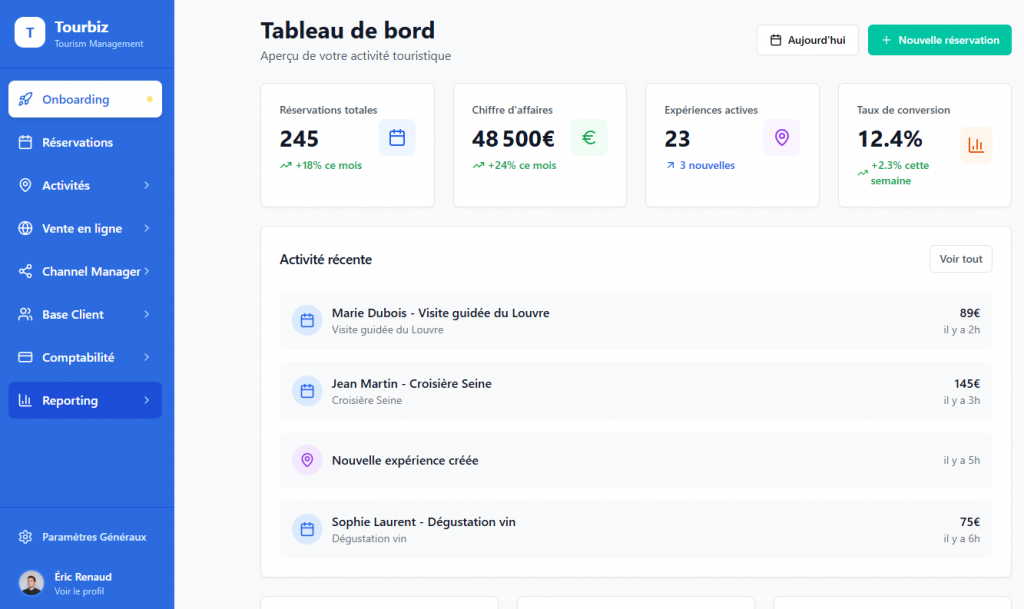
A clear and actionable financial dashboard
Tourbiz’s financial management module allows you to track your margins by product, by channel, or by period. You visualize in real-time:
- the gross and net margin rate on each file,
- the most profitable products,
- the actual customer acquisition cost, integrated with your marketing expenses.
This immediate transparency helps you anticipate rather than suffer your results. Coupled with sales management (tourism sales tracking), your financial vision becomes a true performance dashboard.
Native integration with your suppliers
Tourbiz directly connects your supplier catalogs: GetYourGuide, Viator, Funbooker, or even local DMCs (via our Marketplace and Offline Agents features). Every time a booking is made through these platforms, the data is synchronized and your margin calculated automatically.
Advantage? Less re-entry, fewer errors, and a consolidated view of the performance of your partnerships.
Complete automation of invoicing and reconciliations
No more Excel spreadsheets or hunting for lost invoices. Tourbiz automates:
- the issuance and sending of client invoices,
- the reconciliation of purchases/sales with suppliers,
- the reporting of payments in your accounting tool.
Result: you save time, secure your margins, and improve your cash flow predictably.
Concrete example: connect GetYourGuide via Tourbiz to boost the margin
A common case: a local agency offers excursions but lacks visibility and fluidity in its billing. By connecting its GetYourGuide account to Tourbiz, it:
- automatically imports its bookings in real time,
- sees the supplier cost and the associated margin appear without manual entry,
- can adjust its prices to maximize profitability according to trends.
Discover how this connection works in our GetYourGuide and Viator guide, designed to help agencies better leverage their integrations and boost their margin without technical complexity.
With Tourbiz, margin tracking becomes a strategic lever: you no longer manage your sales — you drive your profitability.