

What is a pricing policy in tourism in 2025 ?
In 2025, a pricing policy in tourism is no longer just a simple cost calculation. It is a comprehensive strategy that seeks to balance profitability, competitiveness, and customer satisfaction in a post-pandemic context where inflation and demand fluctuations are redefining the rules of the game.
It relies on the ability of a tourism business to continuously adjust its prices, according to the season, the market, the origin of travelers, or even the distribution channels.
Three main approaches dominate today :
- Dynamic pricing: instant price adjustment based on demand, competitors, and occupancy rates. Discover how it works in our guide on dynamic pricing.
- Differentiated pricing: prices varying according to the profile or purchasing power of the customer, the time of booking, or the chosen channel.
- Personalized pricing: based on customer data and behavioral preferences to maximize perceived value.
The stakeholders involved are numerous :
- Travel agencies that build their margins on flexible packages.
- Tour operators who integrate multiple partners and adjust prices according to the issuing markets.
- Accommodation providers and activity providers who must follow the evolution of local and international demand.
In summary, adopting a modern pricing policy means deciding to manage your prices as a strategic lever, not as a constraint.
Why is a good pricing policy essential for profitability and competitiveness in tourism?
A pricing policy does not just influence your revenue. It defines the perception of value of your brand and the experience you offer. A price that is too low can devalue your offer; a price that is too high can hinder conversion. Finding the right balance transforms price into a signal of trust.
The pricing strategy directly influences the occupancy rate. A price adjusted in real-time helps maximize bookings during off-peak periods without undercutting during peak times. To understand this balance, explore our guide on how to attract customers in the low season.
Companies that succeed today combine technology and market intelligence. Some concrete examples :
- Urban hotels adjust their prices according to event attendance and online search data.
- Excursion agencies adjust their prices based on weather, availability, and competitor announcements.
- Premium tours use pricing personalization to enhance perceived value and retain their international clientele.
In 2025, a high-performing pricing policy is not an option. It is a survival condition in a market where margins are tightening and travelers are better informed than ever.
What factors should be analyzed to define prices in tourism ?
Establishing the right prices in tourism in 2025 requires more than a simple accounting calculation. It is a strategic analysis process that combines internal data, market signals, and customer behaviors. Every pricing decision must be based on precise and up-to-date indicators.
The main factors to observe :
- Fixed and variable costs: rent, salaries, commissions, energy, transportation… Identifying your break-even thresholds remains fundamental.
- Seasonality: adjusting prices according to demand during different times of the year, school holidays, and local events.
- Buying behaviors: anticipating last-minute bookings, early reservations, or weekend peaks.
- Competition: monitoring competitors’ prices on marketplaces and booking platforms.
- Customer trends: sustainability, local experiences, cancellation flexibility… value criteria that influence willingness to pay.
In 2025, the role of OTA platforms and price comparison tools is decisive : they redefine the notion of perceived value. To delve deeper into this topic, consult our guide on OTAs and discover how to adjust your prices in response to these players.
In summary, defining the right price means continuously analyzing a moving equation between your costs, your goals, and market signals.
How to implement a high-performing and agile pricing strategy ?
Once the factors are well identified, it’s time for implementation. A high-performing pricing strategy must be agile, connected, and measurable. In 2025, tourism players adopt a four-step approach to manage their prices as true growth levers.
1. Diagnosis and segmentation
Start by assessing your customer segments and the perceived value of each offer. Identify the most profitable products, high-potential markets, and the most effective sales channels.
2. Implementation of tracking tools
Revenue management software and centralized management platforms (PMS, channel managers) become essential allies. They facilitate real-time adjustments based on demand and competition. To choose your tool wisely, consult our guide on channel managers.
3. Choice of pricing method
- Value-based: charge according to the value perceived by the customer rather than the simple cost.
- Demand-based: maximize revenue by increasing prices during demand peaks.
- Data-based: use booking history, search trends, and competitive data to guide adjustments.
4. Strategic alignment
Price is never isolated : it must integrate into your marketing and distribution strategy. Consistency of messages, harmonization of prices across your channels, and transparent communication enhance your brand’s credibility.
An agile strategy is one that evolves every week, integrating data, technology, and the psychology of the modern traveler.
How to optimize your pricing policy with Tourbiz ?
Tourbiz is your digital co-pilot for managing your prices without wasting a minute. The platform does not just centralize your bookings : it allows you to manage your prices across all your channels from a single dashboard.
Where other tools require juggling between interfaces, Tourbiz automates adjustments and synchronizes your data in real-time. The result : more consistency, fewer overbookings, and a pricing strategy always aligned with the market.
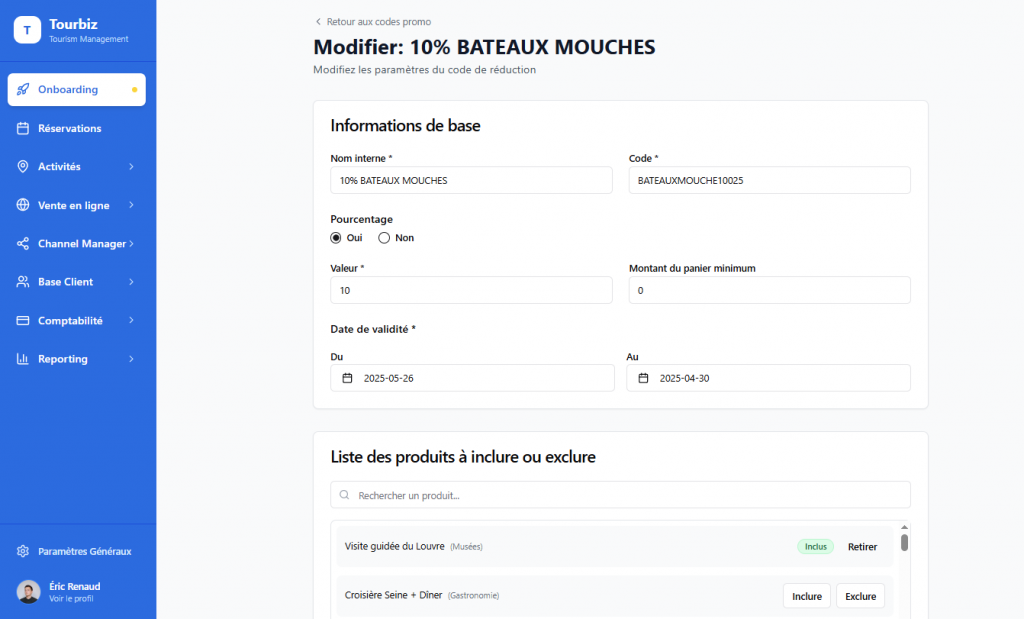
The pricing management features in Tourbiz
- Unified dashboard: view your prices at a glance by channel, product, and period.
- Comparison tools: track your prices against the competition to maintain an advantage over OTAs.
- Smart alerts: be notified if your prices become too high or too low compared to the market.
- Automatic pricing scenarios: instantly modify your prices based on occupancy rates, season, or sales history.
Automation through integrations
Tourbiz integrates directly with your sales platforms, avoiding price discrepancies between your different channels. Native connections with Viator, Funbooker, or GetYourGuide ensure instant price updates and availability.
By continuously synchronizing your prices, Tourbiz helps you maximize your margins and avoid human errors. An essential step for smooth and profitable pricing management in 2025.
Concrete example : connecting Tourbiz to GetYourGuide
Imagine a tour agency that publishes its excursions on multiple platforms. Thanks to the direct integration between Tourbiz and GetYourGuide, every price change in your back office is automatically reflected on the platform.
No more price discrepancies or lengthy manual updates. You remain competitive while maintaining control over your pricing grid. To learn more about this connection, visit our supplier GetYourGuide guide.
In summary, Tourbiz transforms your pricing policy into an automated performance lever: less management, more precision, and a responsiveness that your competitors will envy.