

What is slow travel and where does this movement come from?
Slow travel, or “slow journey”, is not a fleeting trend. It is a manifesto for traveling differently. It opposes the frenzy of timed tours and the “see as much as possible in the least amount of time” mentality. Here, we talk about experience, not performance.
Origins of the concept: from slow food to slow life
The movement has its roots in the 1980s in Italy with the birth of “slow food”, in reaction to the dominance of fast food. From this philosophy emerged a holistic approach: “slow life”, which values quality, proximity, and awareness of one’s choices – including when traveling.
Foundational principles: immersion, sustainability, authenticity
Slow travel is based on three pillars:
- Immersion: taking the time to know the locals and the places.
- Sustainability: minimizing one’s ecological and economic footprint.
- Authenticity: prioritizing local experiences over standardized attractions.
For tourism stakeholders, offering a “slow” journey means rethinking the entire experience chain: from choosing local partners to communicating values. It also requires a smooth and centralized management of offers, facilitated by modern digital tools.
To go further, discover our article on the channel manager which explains how to centralize your availability without losing flexibility.
Differences with traditional tourism
Where mass tourism maximizes volumes, slow travel values connection. One does not “check off” destinations; one becomes attached to them. This is the case in many Asian destinations, as many actors in tourism in Thailand propose today. This approach attracts a more demanding but also more loyal clientele, seduced by authenticity and transparency.
Why is slow travel increasingly appealing to travelers in 2025?
Evolution of post-pandemic mindsets: search for meaning and impact
Since the pandemic, the way of traveling has profoundly changed. Tourists aspire to more conscious stays, more aligned with their values. The idea of “traveling less, but better” is taking hold, marking the end of purely consumerist tourism.
Rise of responsible tourism and personal well-being
2025 sees the confirmation of the fusion between two quests: that of respecting the planet and that of mental well-being. Travel becomes a means of reconnecting with oneself and others. Eco-friendly accommodations, nature retreats, and local experiences are gaining popularity.
Influence of new generations and digital nomads
Young travelers and remote workers are the natural ambassadors of slow travel. They extend their stays, work on the go, integrate into local communities, and prioritize destinations where life is good over just “seeing”.
- Millennials: attracted to authentic experiences and sustainable values.
- Digital nomads: seeking balance between productivity and cultural immersion.
For professionals, adapting their offerings to these new expectations is a major opportunity. This involves better online visibility and more targeted communication.
Discover how to find clients in tourism through concrete “slow” marketing actions.
What are the major trends in slow travel to watch for in 2025?
Rural tourism and local micro-adventures
The “slow” traveler avoids urban saturation. They prefer the countryside, mountains, or small islands inhabited by fewer than 5,000 souls. Rural tourism is reborn in 2025, driven by a desire to return to the land and reconnect with the tangible.
Micro-adventures — short stays close to home — become a gateway to this philosophy. They appeal to those who want to disconnect without necessarily crossing the planet.
Eco-designed accommodations and community experiences
Eco-lodges, energy-autonomous tiny houses, and permaculture farms are becoming the new symbols of slow travel. Travelers want to sleep “usefully”, in places that have a story, a local anchorage, and that directly support the surrounding community.
- Eco-design: passive buildings, bio-sourced materials, short food circuits.
- Human encounters: participatory workshops, artisanal workshops, shared meals.
Soft mobility: train, bike, walking…
Goodbye to repeated internal flights. In 2025, travelers favor low-carbon transport means: train, bike, walking, or electric van. Scenic train routes and cultural carpooling platforms are gaining ground.
Tech and sustainability: connected but responsible platforms
Technology is no longer the enemy of slow travel; quite the opposite. Ethical planning apps or trail mapping promote a smooth experience while respecting the visited territories.
For professionals, relying on sustainable technological ecosystems is strategic. It is better to collaborate with responsible digital partners connected to virtuous OTAs. Check out our article on OTAs to effectively structure your distribution channels while maintaining the “slow” spirit.
How can tourism stakeholders integrate slow travel into their offerings?
Adapting circuits and local partnerships
Integrating slow travel means first rethinking your routes. Offer fewer stops, but more emotions. Select committed local partners: guides, producers, collaborative workshops. The key? Co-construct experiences rooted in the reality of the territory rather than simple tourist products.
Highlighting ethical storytelling and transparency
Slow travelers buy a story before buying a stay. They expect to understand where their money goes, who they support, and what footprint their passage leaves. Telling accurately, owning one’s choices, valuing the people involved: these are powerful loyalty levers.
Using data to understand and anticipate “slow” expectations
Data, when used intelligently, becomes a tool for observing behaviors and continuous improvement. Analyzing requests, lengths of stay, and customer feedback allows for adjusting offerings without losing the authenticity of the “slow” concept.
- Observation: identifying periods of “soft” demand.
- Personalization: offering experiences staggered over time.
- Anticipation: adjusting pricing strategy based on responsible flows.
Tools like tourism CRMs and integrated analysis solutions simplify this management. Discover how good tourism sales tracking can transform your data into optimization levers for a more sustainable offering.
How can Tourbiz help professionals value slow travel?
Slow travel is not just a philosophy: it is also a viable business strategy. Travelers seek offers aligned with their convictions. But for tourism professionals, these offers must remain visible, connected, and easy to manage. This is where Tourbiz comes into play.
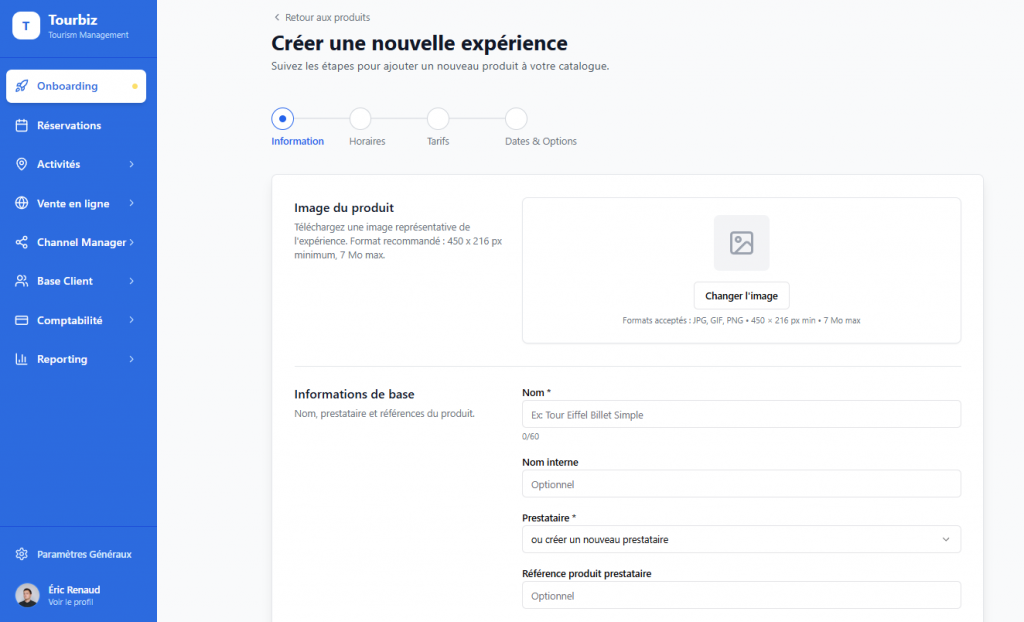
Centralization of local and eco-responsible offers
Tourbiz allows agencies, offices, and independent guides to group their experiences on a single platform. You can manage your “slow” circuits, accommodations, and local activities without wasting time between different Excel sheets or emails.
- Simplified multi-distribution of offers to your partners and responsible OTAs.
- Increased visibility thanks to optimized SEO sheets and automatic scheduling synchronization.
- Smooth local management to value artisans, producers, and sustainable initiatives.
In practice, the solution promotes better highlighting of territories and authentic actors, while avoiding the stress of double-booking.
To go further, consult our guide on tourism reservation management which details how to centralize your bookings without sacrificing proximity.
Integration with platforms like GetYourGuide or Booking Experiences
Slow travel is not improvised: it becomes visible where travelers seek inspiration. Tourbiz easily integrates with OTAs like GetYourGuide, Viator, or Booking Experiences, automatically distributing your responsible offers.
- Native connection with the APIs of major marketplaces.
- Automatic updates of availability and rates.
- Selective distribution on the most relevant platforms for your market.
This interconnection streamlines distribution while maintaining control over your identity and values. Looking to sell on GetYourGuide? Discover how to connect to the platform with Tourbiz.
Automation of management while maintaining a human and sustainable approach
The heart of slow travel is the human relationship. Tourbiz understands this: the tool automates repetitive tasks while preserving the human dimension of your activity. Less administration, more time to welcome your travelers, exchange, and personalize.
- Intelligent automation: emails, reminders, confirmations, secure payments.
- Ethical reporting: your data serves to optimize your flows without exploiting travelers.
Thus, Tourbiz establishes itself as a lever of balance between performance and conscience, technology and authenticity. A solution designed to make tourism smoother… and more human.