

GetYourGuide and Viator: two different philosophies
Ten years ago, Viator reigned supreme. Backed by TripAdvisor, it embodied the power of first-generation OTAs: vast catalogs, detailed listings, a volume logic.
Then GetYourGuide arrived, with a breath of fresh air: a smooth interface, immersive visuals, a more direct tone, and a simple promise — book, go, enjoy.
Two platforms, two DNAs:
- Viator is the classic heavyweight. It speaks to a more mature clientele: families, groups, American or Canadian tourists. It reassures with its brand, its processes, its anchoring in the TripAdvisor ecosystem. Selling on Viator is the choice of operators who bet on stability and international visibility but accept a certain administrative heaviness.

- GetYourGuide, on the other hand, has the charm of the challenger. Born in Berlin, shaped by European start-up culture, it targets a connected, urban, mobile generation.
It emphasizes simplicity and speed: instant bookings, intuitive management, storytelling centered on experience.
Its product listings resemble more showcases than catalogs: large format photos, catchy titles, conversational tone.
Where Viator inspires institutional trust, GetYourGuide embodies curiosity and spontaneity.
One caters to those who plan their stay in advance, the other to those who improvise their trip from their smartphone while walking through the streets of a foreign city.
Key differences at a glance
GetYourGuide and Viator look similar on paper: same commission model, same mission to connect operators and travelers.
But in reality, their philosophies, audiences, and tools differ significantly. Here’s an overview of the main distinctions.
| Criterion | GetYourGuide | Viator |
|---|---|---|
| Visibility | Very strong in Europe, particularly in major capitals and cultural destinations. | Clear dominance in North America and long-haul destinations. |
| Average commission | About 20 to 25%. | Slightly higher, between 20 and 30%, depending on the type of activity. |
| Supplier interface | Ultra-intuitive, designed for small structures and independent guides. | Comprehensive dashboard but more technical, with more B2B options. |
| Type of clientele | Connected, urban travelers, often Millennials or young couples. | Families, seniors, groups, North American clientele. |
| Payment management | GetYourGuide collects the customer payment and transfers the operator’s share after the service. | Viator operates through a more traditional billing system. |
| Mobile app | Modern design, remarkable fluidity, instant notifications. | Robust application but less ergonomic. |
| Customer service | Direct chat, responsive support. | TripAdvisor support: comprehensive but often slower. |
| Integration with Tourbiz | Native synchronization via API. | Native synchronization via API. |
Behind this table lie two logics.
GetYourGuide aims to be close to the ground: quick to grasp, fluid to use, focused on visual performance and simplicity of execution.
Viator, on the other hand, plays the card of network and depth: a global reach, massive referencing, but a slightly more demanding environment to configure.
Many operators choose not to choose: they exploit both. That’s what our clients do, and by the way, Tourbiz allows you to do that very well!
Which OTA best suits your business?
The choice between GetYourGuide and Viator is not just a question of commission or design.
It’s primarily a question of identity: what type of experience do you offer, who are you addressing, and how do your clients book?
The two platforms do not quite operate in the same timeframe. Viator targets travelers who plan, GetYourGuide targets those who improvise. One reassures, the other inspires.
For small structures and independent guides
If you are starting out, GetYourGuide is often the ideal entry point.
- Its interface is simple, intuitive, and designed for operators who manage their activity themselves.
- The registration process is quick, and publishing your offers is done in a few clear steps.
- The support team is accessible, the tone direct, the visual environment attractive.
It’s a perfect space to test your products, adjust your prices, and learn to understand online demand.
You can also check our complete guide for GetYourGuide suppliers to better understand how to optimize your presence and climb the rankings.
For established structures and ‘mass market’ products
If you operate on larger volumes — cruises, cultural visits, museums, regular excursions — Viator becomes an essential partner.
- Its connection to TripAdvisor gives you instant visibility to a massive American audience.
- The management system is denser, but it allows for greater finesse in configuration.
- High perceived value activities (culture, heritage, gastronomy) find a particular echo there.
Viator operates as a channel for international expansion. It requires a bit more administrative rigor, but it can transform a local activity into a global product.
And why not both?
Many operators today choose to combine the two OTAs.
- GetYourGuide for impulsive sales and European clientele.
- Viator for global referencing and North American clientele.
This multi-platform approach requires a bit of organization, but it offers a perfect balance between volume and diversity.
To go further, our complete guide on OTAs explains how to build a balanced strategy: how to choose, test, and above all, how to remain in control of your distribution.
In summary, there is no right or wrong choice between Viator and GetYourGuide — only the one that matches your pace, your audience, and your way of telling your experience.
And if you master both well, that’s where the real growth lever begins.
How Tourbiz facilitates the management of your OTAs
Publishing on Viator or GetYourGuide is one thing. Managing both — in addition to your website, Google Things To Do, your direct sales, and your emails — is another.
This is often where disorder sets in: misaligned stocks, different rates, a slot booked twice, and suddenly, the ‘digital’ experience becomes a source of stress.
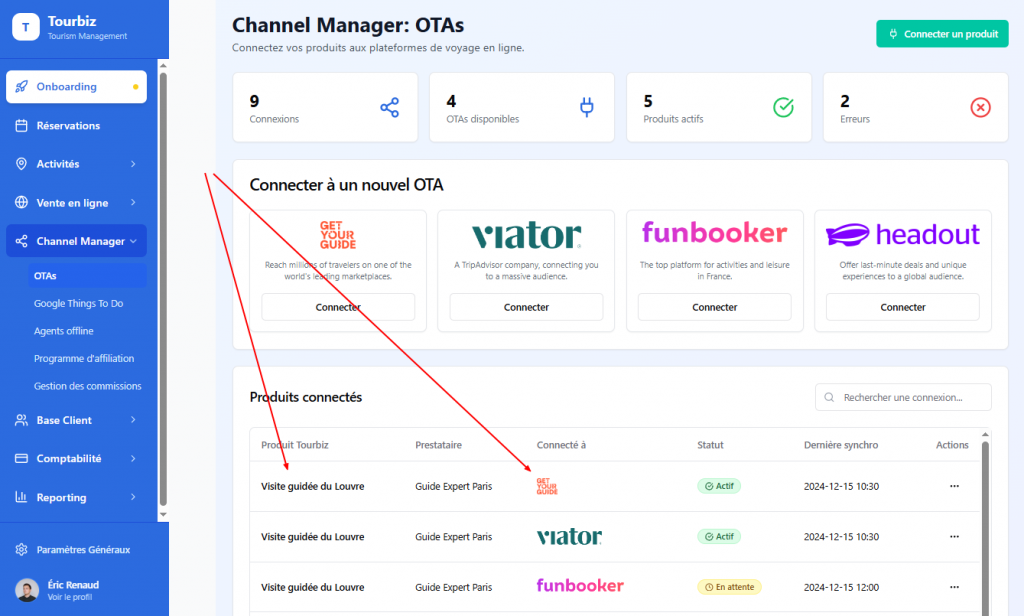
It is precisely to avoid this scenario that Tourbiz was designed: a global management tool that connects all your sales platforms and synchronizes each booking, each price, each available slot — in real time.
On the integration side, we obviously include Get Your Guide and Viator, which are the giants of the sector, but also other OTAs like Funbooker (no fees on Tourbiz via your Funbooker sales!) and Headout.
Tourbiz aims for centralized, fluid, and automatic management
From a single dashboard, you manage your sales on GetYourGuide, Viator, Google Things To Do, your website, and your physical ticketing.
Each booking automatically blocks slots elsewhere. Each price update is instantly reflected across all your channels.
You keep control, without ever retyping the same information twice.
Tourbiz acts as an invisible conductor: everything is in rhythm, without manual effort, without delay.
And if you want to understand how this mechanism works in depth, our channel manager guide details the synchronization logics that make this fluidity possible.
Tourbiz helps you choose your channels, not suffer from them
Beyond the technical aspect, Tourbiz gives you a strategic vision.
A clear dashboard shows you:
- which OTAs bring you the most margin,
- which offers perform according to the season,
- and how your direct sales evolve compared to your intermediary sales.
This visibility changes everything: it allows you to invest where you actually gain customers — not just bookings.
And if you’re looking to go even further in this approach to commercial autonomy, check out our complete article on how to find clients in tourism.