

Advantages & Disadvantages of using WhatsApp as a booking channel
Before diving in headfirst, one must be clear-headed: WhatsApp is an excellent contact tool, but not necessarily the best for managing a large-scale tourism activity.
| Advantages | Disadvantages |
|---|---|
| Immediate proximity: customers love the feeling of talking “to a real human.” | Disorganization: when messages flood in, it becomes difficult to keep track (loss of information, duplicates). |
| Massive adoption: 2 billion users worldwide, no entry barriers. | No integrated calendar: you have to juggle between your notes and your actual availability. |
| Richness of exchanges: photos, documents, geolocation, everything can go through WhatsApp. | No OTA synchronization: impossible to align your WhatsApp sales with Viator, GYG, Funbooker. |
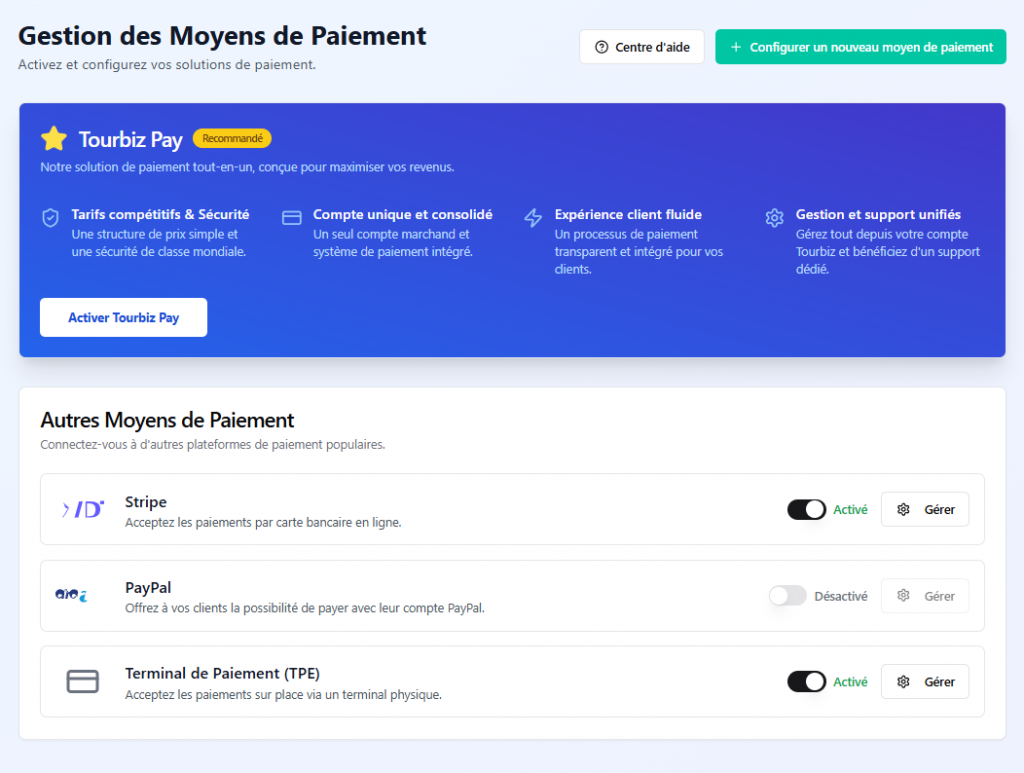
| Ideal for small structures: perfect for starting without software budget. | No integrated payment: you have to tinker with external links (Stripe, PayPal, or other systems compatible with our integrated payment methods). |
| Strong personalization: you can pamper each client, send a voice message, respond live. | Huge mental load: the client expects a nearly immediate response, even in the evening or on weekends. |
If we could summarize this table in one sentence, we could say without error that WhatsApp is a fantastic commercial entry point, but it’s a bad back-office if you use it alone. To maintain human contact without sacrificing organization, it must be intelligently integrated with your other tools.
Best practices for using WhatsApp as a booking channel
Managing bookings via WhatsApp can be an asset, but only if the tool is used with discipline. Otherwise, you quickly slip to the dark side: lost requests, frustrated clients, days swallowed by notifications. Here’s how to avoid chaos.
Make the tool professional
Forget the personal account: WhatsApp Business is essential. You display your hours, practical information, and key offers. In seconds, the client understands that they are talking to an organized structure, not a random mobile number.
Prepare the first contact
The worst? Radio silence. Set up a simple welcome message: “Thank you for your message! We will get back to you within two hours.” Add a few quick responses for recurring questions (prices, hours, departure location). You show responsiveness without being glued to your phone.
Organize the flow
From three or four simultaneous conversations, WhatsApp becomes unmanageable if you don’t categorize your messages. Labels (prospect, confirmed, awaiting payment) transform a chaotic inbox into a clear pipeline.
Secure the payment
Nothing worse than a “send me a transfer” or “pay in cash upon arrival.” To inspire confidence, offer a secure payment link. Whether via Stripe, PayPal, or a module generated by your software, the client feels safe and you, protected.
Protect your time
If you let your clients believe they can write to you at 11 PM and get an immediate response, you will never have peaceful evenings again. Set your hours, display them, and stick to them. Being professional doesn’t mean being available 24/7, it means being reliable within a clear framework.
Used this way, WhatsApp remains what it should be: a human, simple, and effective channel, without becoming too time-consuming.
Case study: our client Clara
Let’s take the example of Clara (fictitious name), who organizes guided walks in Lisbon.
At first, everything went through WhatsApp. Clients contacted her directly, she sent practical information, and it worked quite well. WhatsApp gave an image of proximity: “We talk directly with the guide”. Result: many bookings… but also a lot of chaos.
Very quickly, Clara found herself with:
- lost messages in the flow of conversations,
- duplicate bookings because she hadn’t blocked her slots elsewhere,
- scattered payments (cash, transfer, PayPal), which she had difficulty tracking.
The trigger came after a costly mistake: two families had booked the same tour for the same slot. She had to refund one and received a negative review.
So, Clara decided to keep WhatsApp… but to professionalize it:
- using WhatsApp Business with automated messages to save time,
- classifying conversations with clear labels (prospects / confirmed / paid),
- sending secure payment links instead of juggling multiple methods.
And it works. As a result, clients continue to appreciate the proximity of WhatsApp, but its management has become structured and reliable.
But Clara went even further, and integrated Tourbiz into her tool stack. You will see how in the next section.
How does Tourbiz interface with WhatsApp?
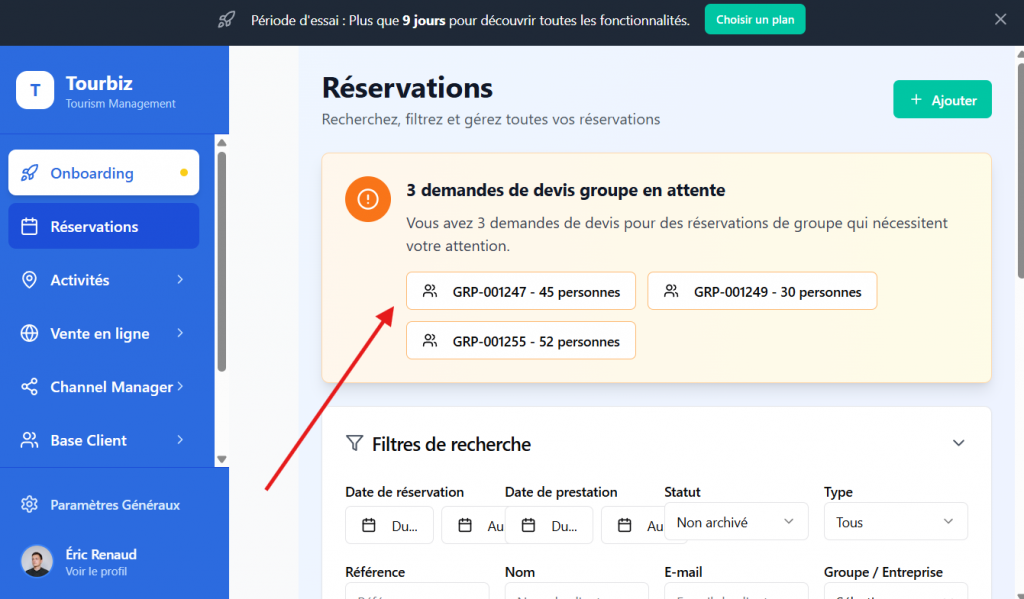
Today, Tourbiz does not integrate WhatsApp as a “standalone” booking channel. And ultimately, it’s not necessarily needed. The application remains a human contact tool, but Tourbiz allows transforming these exchanges into structured bookings.
How does it work?
- You create an order link in Tourbiz
→ the product, the slot, and the price are already defined. - You send this link to the client on WhatsApp
→ a clear, reassuring message that redirects to a secure online payment. - The client books and pays directly
→ their registration arrives automatically in Tourbiz, just like an OTA sale or a booking via your site.
Thus:
- You keep the proximity of WhatsApp, without losing track of bookings.
- No more confusion: everything that is booked automatically enters your Tourbiz back-office.
- Payments are secure, and your stocks are updated instantly.
Another concrete example:
A cruise operator in Lyon still receives many requests via WhatsApp, especially from foreign clients who find this channel simpler than the phone. Before Tourbiz, he had to note everything by hand, chase after transfers, and cross his fingers that the slots wouldn’t overlap.
Since he started sending Tourbiz order links via WhatsApp, the workflow is smooth:
- the client books in two clicks,
- the spot is blocked immediately,
- and the team sees the booking appear in their centralized planning.
In short: Tourbiz bridges the “human and direct” side of WhatsApp and the rigor of management software. You maintain the proximity that travelers love, but you never lose a booking along the way.