

What is dynamic pricing?
Dynamic pricing is the art of adjusting prices based on demand, context, and timing. Unlike a fixed price grid, this method allows for real-time price adjustments to optimize both occupancy and profitability.
Concrete examples:
- Airlines adjust their prices according to the occupancy rate of a flight, the day of the week, or the proximity to the departure date.
- Hotels modify their rates based on events in the city (a trade show, a concert, a local festival).
- Cruises and excursions offer lower rates to fill empty slots and increase their prices when demand surges.
The difference is simple:
- With a fixed pricing model, you set a price once and for all, risking losing customers in the low season or leaving money on the table during peak times.
- With dynamically pricing, you adjust your prices to the reality of the market in real-time: you fill seats when demand is low and maximize your margins when it is high.
👉 In other words, dynamic pricing is not a technique reserved for industry giants: it is a competitive lever accessible to any tourism operator who wants to manage their revenue intelligently.
Why adopt dynamic pricing in tourism?
Tourism is inherently a fluctuating market. Weather, school holidays, local events, or even a simple transport strike can cause demand to vary overnight. In this context, a fixed price is a blunt weapon.
Responding to demand fluctuations
A simple example: a cruise on the Seine on a Tuesday in November does not have the same perceived value as a Saturday night in mid-June. With fixed pricing, you lose sales in the first case… and let margins slip in the second. Dynamic pricing allows you to fill empty seats without discounting the entire season.
Maximizing revenue
Every seat, every unsold ticket is a lost opportunity. Adjusting your prices dynamically means:
- slightly lowering your rates to fill an empty slot,
- increasing when demand surges (school holidays, weekends, festivals).
This is not a logic of ‘permanent sales’, but a way to exploit each context to the maximum.
Staying competitive against OTAs
OTAs like GetYourGuide or Viator already practice a logic close to dynamic pricing, favoring flexible and well-calibrated offers. If you don’t play this card, you risk being relegated behind your competitors in search results. However, if you adjust your prices skillfully, you gain visibility… and conversions.
Dynamic pricing is therefore primarily a win-win strategy: more customers during low-demand slots, more margin during peak times, and a consolidated position against market giants.
Implementing a dynamic pricing strategy in 4 steps
Dynamic pricing is not a haphazard improvisation. It is a structured method based on precise variables and well-calibrated automation.
1. Identify your key variables
Each activity has its levers of variation:
- the season (summer vs winter),
- the day of the week (weekend vs weekday),
- the time (low morning vs busy evening),
- the customer type (families, groups, corporate).
These parameters determine when and how your prices should move.
2. Define your pricing rules
Example:
- -10% on Tuesdays and Thursdays outside school holidays,
- +15% on weekends from June to September,
- special rates during major events (trade shows, festivals, local celebrations).
These rules lay the foundation for your dynamic grid.
3. Automate adjustments
Doing all this manually is impossible. You need to rely on a tool capable of updating your prices in real-time across your various channels (website, OTA, ticketing). This is the role of modern SaaS software and Channel Managers.
4. Test, analyze, refine
Dynamic pricing is alive. Monitor your performance, measure the impact on your sales, and adjust your rules. What works in November may not be optimal in July.
The secret is to find the balance between flexibility and clarity: too many adjustments confuse the customer, too few make you lose potential.
Essential tools for managing dynamic pricing
Implementing a dynamic pricing strategy only makes sense if it is supported by the right technology. Without a tool, adjusting your prices based on demand and reflecting them across all your channels is mission impossible.
Channel Managers and PMS
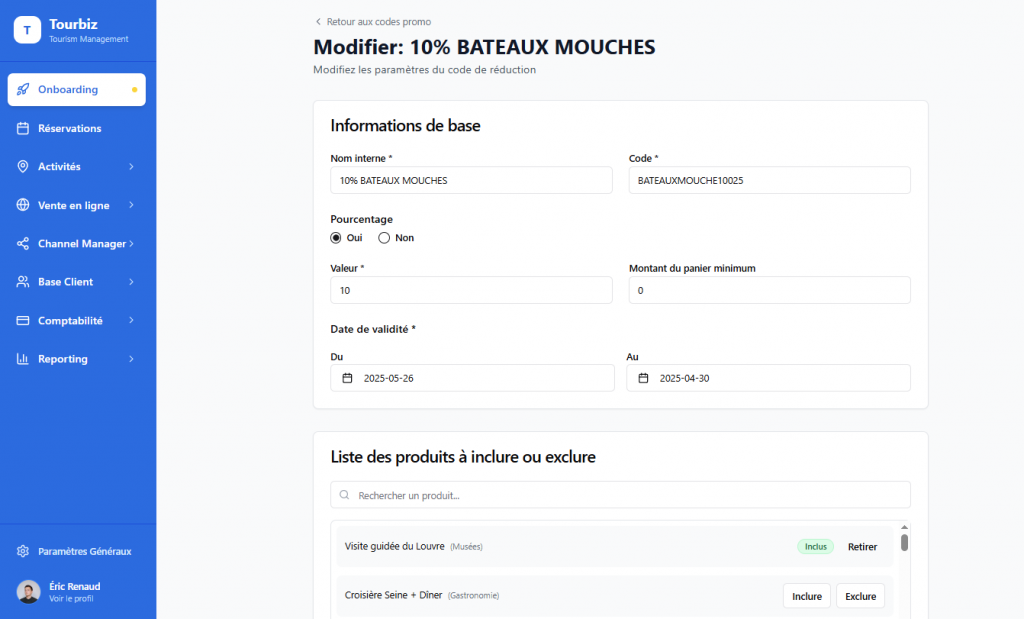
Modern Channel Managers (and some Property Management Systems) now integrate dynamic pricing modules. They automatically apply your rules and update prices across all your channels — website, ticketing, OTAs like GetYourGuide or Viator.
Dedicated SaaS solutions
Some revenue management software goes even further: they analyze demand in real-time, scrutinize competition, and adjust your prices to the minute. A luxury often reserved for hotels and airlines, but which is becoming more accessible in the world of activities and excursions.
And for your tourism activity? Well, you have Tourbiz, but we’ll come back to that a bit later in this article.
Data-driven management
Whatever tool you choose, it must come with a clear dashboard: price history, impact on occupancy rates, comparison between channels. Without measurement, there is no effective strategy.
In short: to succeed in dynamic pricing, you must forget makeshift spreadsheets and equip yourself with tools capable of reacting faster than demand itself.
Dynamic pricing with Tourbiz: we explain everything
At Tourbiz, we know that dynamically adjusting prices is not reserved for giants in aviation or hospitality. It is a practice that every tourism operator, whether managing a boat, a guided tour, or a local activity, can easily implement — provided they have the right tools.
How does it work in practice?
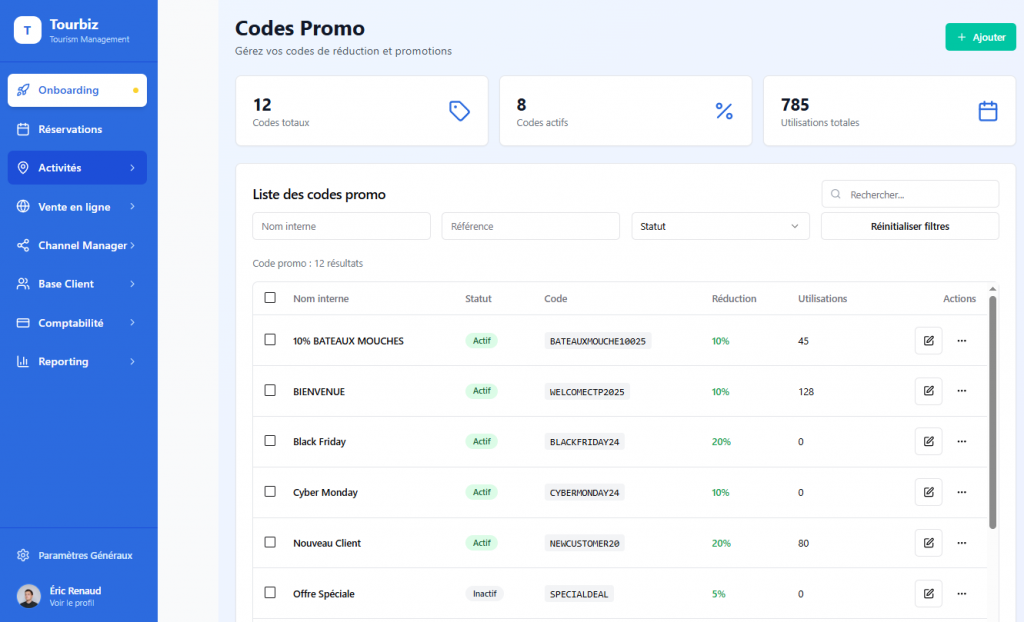
- You define your rules: for example -10% in low season, +20% on high season weekends, special rates during local events.
- Tourbiz automatically applies these rules across all your channels: website, online ticketing, OTAs like GetYourGuide, Viator, or Funbooker.
- Prices update in real-time: no risk of discrepancies between what the customer sees on a platform and what is available in your back office.
Example of use
A Parisian cruise operator previously used a fixed pricing grid: €60 per passenger all year round. Result: half-empty boats in November and lost sales in July, failing to optimize demand peaks.
With Tourbiz, he implemented:
- a reduced rate of €45 on weekdays during the off-season to attract local clientele,
- a gradual increase up to €75 on summer weekends,
- an automatic adjustment during the Music Festival and on July 14.
Result: occupancy rate increased by 20% in the low season, and margin increased by 15% during peak summer — without any manual manipulation.
Direct benefits for you
- Less stress: you set your rules once, Tourbiz applies them.
- More consistency: your prices are aligned across all your channels at all times.
- A real competitive lever: you compete on equal terms with OTAs and major industry players.
Dynamic pricing, integrated with Tourbiz, promises to turn every variation in demand into an opportunity, not a loss.