

Introduction
In tourism, the multiplication of sales channels is both an opportunity and a headache. A hotel, a cruise company, or an activity operator must simultaneously manage its website, direct sales, phone calls, not to mention major platforms like Booking.com, GetYourGuide, Viator, Airbnb Experiences, or TripAdvisor. The result: availability updates everywhere, rates to harmonize, and a constant risk of errors.
This is where the Channel Manager comes in, which became an essential component of any tourism distribution strategy in 2025. A true control tower, it connects your products in real-time to all your sales channels and frees you from time-consuming and risky manual management. Without it, it’s difficult to remain competitive in a market where speed and reliability make the difference.
What is a Channel Manager?
A Channel Manager is software that centralizes and synchronizes the availability, rates, and reservations of an establishment or a tourism operator across all its sales channels. Specifically, it serves as an interface between your internal system (website, PMS, or booking software) and external platforms (OTAs, distributors, online travel agencies).
Clear definition
Its role is simple: to avoid double entries, reduce the risks of double booking, and ensure that every update (new rate, fully booked slot, promotion) is instantly reflected everywhere.
Origin and evolution
Historically, Channel Managers were born in the hotel industry, at the time when Booking.com, Expedia, or Hotels.com disrupted distribution in the 2000s. Hoteliers suddenly needed a tool capable of updating room inventories everywhere at once.
Since then, their use has expanded to the entire tourism ecosystem:
- A Parisian museum that sells its tickets both on its own site, on GetYourGuide, and through local distributors.
- A cruise operator that markets its evening departures on Viator, TripAdvisor Experiences, and its own booking site.
- A bike rental company that manages its availability between its physical stand, phone reservations, and online platforms.
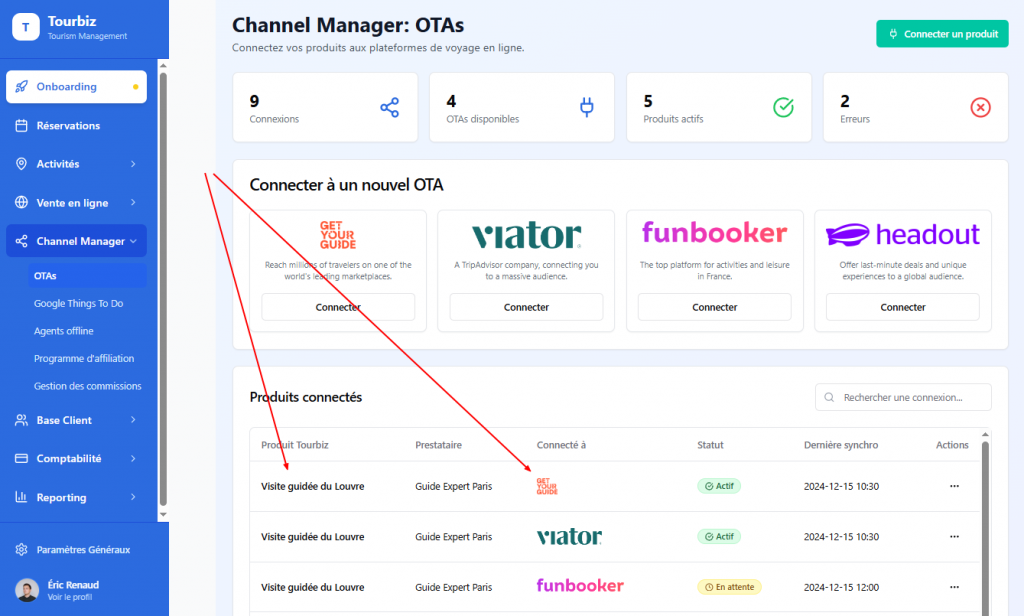
In each of these cases, the Channel Manager acts as a central hub that disseminates information in real-time and prevents two customers from booking the same product at the same time.
An evolution towards more intelligence
In 2025, a Channel Manager no longer just synchronizes inventories. It also offers advanced features:
- automatic price adjustment according to demand (yield management),
- statistical sales analysis to identify the most effective channels,
- marketing integrations (promotions, gift codes, OTA campaigns).
In short, it has evolved from an ‘anti-error’ tool to a strategic lever to maximize sales.
Why is a Channel Manager essential in 2025?
In 2025, tourism distribution has become a maze. Travelers book through a multitude of channels, and they expect a simple, fast, and seamless experience. For a professional, managing this complexity without a Channel Manager is a risky bet.
- Explosion of OTAs and sales platforms: Booking.com, Expedia, GetYourGuide, Viator, Airbnb Experiences, Headout… The list grows every year. Being present on these channels is vital to capture demand, but multiplying entry points mechanically increases the risks of duplicates and disorganization. Find all our OTA integrations here!
- Impatient and demanding customers: Today, a traveler wants to book in seconds, receive instant confirmation, and have the certainty that their spot is guaranteed. An incorrectly displayed availability or a late confirmation can be enough to trigger a cancellation… and a lasting negative review.
- Growing complexity in management: Professionals no longer juggle just inventories. They must manage:
- multiple pricing grids (adults, children, groups, promotions),
- multiple time slots,
- varied cancellation conditions,
- sometimes even personalized quotes.
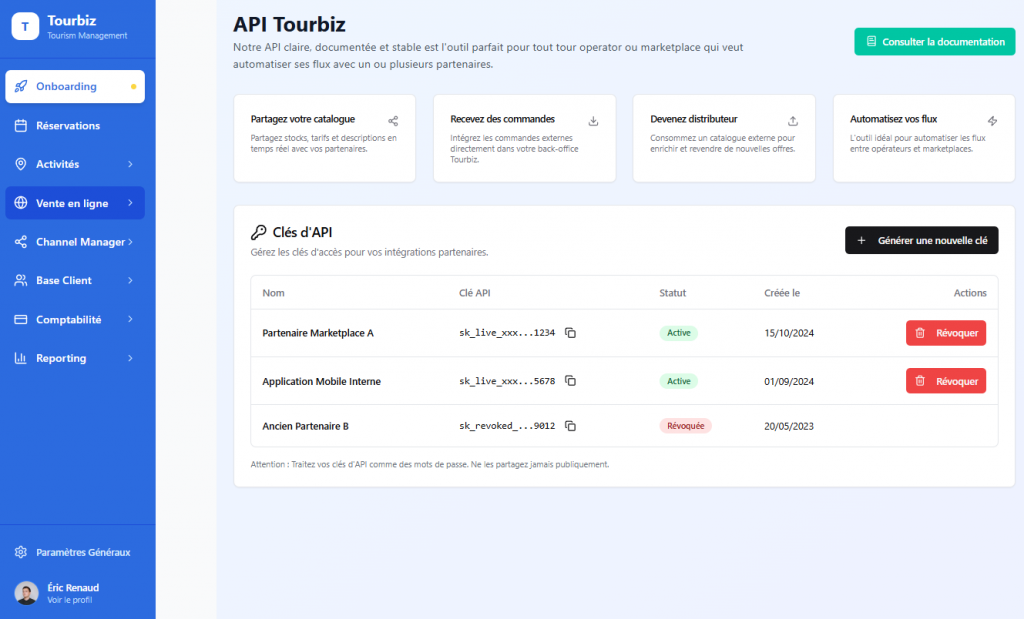
As you can see below, we integrate several OTAs natively through our channel manager. But if you want to connect to other platforms, you can also use our Tourbiz API and Zapier features!
Each of these variables is an opportunity for error when handled manually. This is precisely where the Channel Manager comes in: it acts as a conductor, harmonizing all data to secure your sales and make distribution smooth. To learn more about Tourbiz, visit our page channel manager feature!
What criteria to choose your Channel Manager in 2025?
In 2025, the real issue is no longer whether you need a Channel Manager, but rather choosing the right tool. The market is full of options, and certain criteria should guide your decision.
The first is ease of use. A Channel Manager should save time, not be a cumbersome tool. The interface should remain intuitive so that your teams can use it without heavy training.
Next is the level of integration with OTAs. The best tools connect directly to major sales platforms (Booking, GetYourGuide, Viator, Expedia…), with real-time updates. A delay of a few minutes can already generate a double booking.
The quality of support is another key element. An available, responsive service with real response time commitments (SLA) makes all the difference during a peak activity or a technical incident.
Finally, the cost question should not be limited to the displayed price. Some software operates on a subscription basis, others on a commission per booking. The real comparison is made on the return on investment:
- how many errors avoided,
- how many additional sales,
- how many hours saved each week.
In short, choosing a Channel Manager is a strategic choice: it directly impacts your profitability and customer satisfaction.
The key features of a modern Channel Manager
In 2025, a Channel Manager is no longer limited to synchronizing inventories. It must be a true sales management cockpit. Here’s an overview of the essential features that tourism professionals expect:
| Key feature | Why is it important in 2025? |
|---|---|
| Real-time synchronization | Avoid double bookings and offer instant confirmation. |
| Multi-channel management | Centralize web sales, OTAs, phone, and counter in a single tool. |
| Dynamic pricing | Adjust prices according to season, demand, or promotions. |
| PMS/CRM integration | Streamline internal management and customer relations. |
| Reports and analytics | Identify the most effective channels and optimize your distribution mix. |
| Marketing automation | Promo codes, OTA campaigns, gift voucher management. |
| Strong support and SLA | Ensure reliability and quick assistance, especially during peak season. |
Comparison of some Channel Managers on the market
Below, we have prepared a small summary table of the strengths and weaknesses of the most well-known channel managers in France:
| Solution | Strengths | Limitations in 2025 | Suitable for… |
|---|---|---|---|
| Bokun (Tripadvisor) | Large ecosystem, smooth integration with TripAdvisor/Viator, many features. | Additional commission, complexity for small structures. | Operators aiming for international and volume. |
| Regiondo | Simple interface, good support in Europe, integrated ticket and reservation management. | Less flexible on advanced integrations, cost that rises with volume. | Tourism SMEs and local leisure. |
| Ventrata | Strong on real-time ticketing and physical channels (kiosks, terminals). | Heavy tool for small structures, more technical adoption. | Large operators, parks, and tourist transport. |
| Tourbiz | Channel Manager integrated into the complete booking software, real-time synchronization with Viator, GetYourGuide, Headout, Funbooker. Simplicity and cost suited for small players. | Newer than the industry giants, growing ecosystem. | Small and medium operators looking for an all-in-one solution (booking + distribution). |
Tourbiz and its vision of the Channel Manager
At Tourbiz, we see the Channel Manager as much more than just a technical tool: it is the beating heart of tourism distribution. Designed directly in contact with small and medium structures, it addresses a key issue: how to remain competitive against large players, without complexity or prohibitive costs.
Unlike historical market solutions, which have often been designed for large operators, Tourbiz has chosen a different approach:
- Simplicity above all: the interface has been designed to be usable from day one, without heavy training.
- Native integration: the Channel Manager is directly linked to the Tourbiz booking software, which avoids juggling between multiple tools.
- Optimal connectivity: Viator, GetYourGuide, Headout, Funbooker… the main OTAs are synchronized in real-time.
- Adapted pricing: instead of commissions that eat into your margins, Tourbiz offers a clear and affordable model, designed for the realities of small structures.
To give you a bit more concrete, here’s the example of a well-known Parisian client on sidecars who joined us six months ago:
Our sidecar tour operator in Paris worked with several OTAs — Viator, GetYourGuide, and Headout — while also accepting direct bookings by phone and through its own site.
Until now, each channel was managed separately:
- Excel for availability,
- confirmation emails sent manually,
- random updates on platforms.
The result: in high season, it happened that two customers booked the same slot for a single vehicle, forcing the operator to refuse a ride at the last moment.
With Tourbiz, all reservations are now centralized in a unique calendar synchronized in real-time. As soon as a slot is booked on Viator, it immediately disappears from GetYourGuide and the operator’s site. Confirmations are automatically sent to customers, and availability is permanently visible across all channels.
In just a few weeks, the operator has:
- eliminated the double bookings that were damaging its reputation;
- gained 2 hours per day of administrative work;
- increased 15% its sales simply by expanding its distribution channels without fear of overbooking.
Turning visitors into bookings is easier with a booking widget embedded right on your site.
In 2025, Tourbiz’s vision is clear: to democratize the Channel Manager, making it accessible, reliable, and directly connected to all the daily needs of tourism professionals.
![Sell on Funbooker: become a funpro partner and list your activities [2026]](https://tourbiz.fr/wp-content/uploads/2026/07/Prestataire-dactivites-de-loisirs-gerant-ses-reservations-en-ligne-300x225.jpg)
![Sell on BilletRéduc: become an advertiser and list your events [2026]](https://tourbiz.fr/wp-content/uploads/2025/09/Reporting.png)
![Sell on Ceetiz: become a partner and list your activities [2026]](https://tourbiz.fr/wp-content/uploads/2026/07/Ouvrir-une-agence-de-voyage-conseiller-en-agence-de-tourisme-1-300x232.jpg)