
When is the “low season” in tourism?
The low season does not have a universal calendar. It varies according to destinations, climates, and even types of activities.
- In major European capitals (Paris, Rome, London), the low season often corresponds to the winter months, from January to March, when the flow of international tourists dwindles and only business travelers or a few enthusiasts brave the cold.
- In seaside resorts, the lull occurs as soon as the beaches empty. On the Côte d’Azur, September marks the end of the crowds, and from October to April, bookings drop significantly.
- In the mountains, it’s the opposite: the low season sneaks in between two peaks, once the resorts close (April-May, then September-November).
- For local activity operators (museums, parks, urban excursions), the calendar follows that of school holidays: maximum attendance in July-August and at Christmas, marked lows in November, January, and March.
👉 In other words, the low season is a fluid concept. It is not a mandatory passage at fixed dates: it is a natural cycle, to be anticipated according to one’s sector and clientele.
Understanding the stakes of the low season
The low season is not just about a few empty seats on a boat or a canceled visit due to lack of participants. It is a systemic phenomenon, almost a real-life stress test for all tourism activities.
On one hand, demand evaporates. Depending on the destinations, bookings can drop by 30 to 70%. A Seine cruise that was fully booked in July struggles to fill a third of its boat in November. The result: cash flow tightens, and every sale counts double.
On the other hand, teams become exhausted. How to keep motivation when the phone stops ringing and schedules empty? Some operators juggle between reduced hours, partial unemployment, and the fear of losing talent along the way.
Distribution channels also slow down. Even OTAs, usually boosted by international traffic, go into slow mode. But this is precisely where a Channel Manager makes sense: adjusting prices in real-time, staying visible when others let their guard down, and snagging sales that no one expected.
Finally, there is hidden opportunity. The low season is the time to catch your breath. You test new indoor offers, turn to local clientele, and solidify partnerships. In short, you prepare for what’s next.
Understanding the low season: adapt your offer!
The low season often means half-empty boats, deserted museums, and guided tours canceled due to lack of participants. But it is also an opportunity to reinvent your offer to attract a different clientele.
Create specific experiences
When the weather cools down, you can offer indoor alternatives: local cooking workshops, private museum tours, wine tastings, or exclusive events. These activities attract both curious travelers and local clientele seeking discoveries.
Design attractive packages
Combining several services into a single offer adds value while justifying a competitive price. Example: city stroll + typical lunch or cultural visit + transport included. In the low season, the customer looks for the good deal that simplifies their stay.
Focus on local clientele
We tend to forget, but local clientele is an underutilized resource. Offering preferential rates for residents, organizing events dedicated to local families, or working with schools can fill part of the seasonal lull.
👉 The key is to stop thinking “fewer tourists = fewer sales” and switch to opportunity mode: diversify, test, adjust. Offers launched in the low season often serve as a laboratory… and some become lasting successes.
A good time to optimize your distribution channels
The low season is not the time to play ghost. If your customers are not coming to you, you need to go find them where they still hang out: on OTAs, on Google, on your networks.
Do not disappear from OTAs
Many operators scale back during the off-season, and that’s a mistake. Being present on Viator, GetYourGuide, or Funbooker, even with fewer slots, means continuing to exist on the radar. And in a market where the algorithm rewards consistency, cutting your offers means stepping down several rungs as soon as business picks up.
Play with prices intelligently
The low season does not necessarily call for massive promotions, but for fine flexibility:
- testing dynamic pricing according to the days of the week,
- adding paid options to compensate for the base price,
- rewarding early bookings.
It’s less about “discounting” than knowing where to position your offer to remain competitive without devaluing it.
Centralize to maintain control
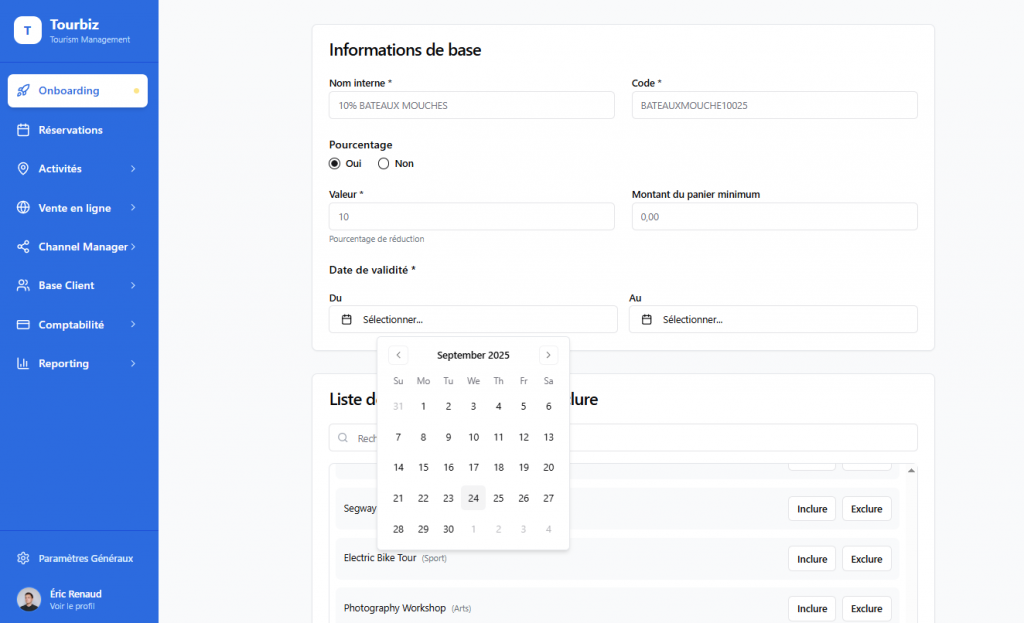
Multiplying channels without a tool exposes you to panic: a slot sold on GetYourGuide but not closed on your site, a forgotten promo on Viator… and the infamous double booking that ruins your customer reviews. This is exactly where a tool like Tourbiz changes the game: everything is centralized, your stocks update automatically, and you maintain a clear vision, even when demand is sparse.
Take advantage of the low season to prepare for the high!
The low season is also a pause. Fewer clients to manage, less flow to absorb… and therefore available time. The structures that really stand out are those that use this time to strengthen themselves.
- Train the teams: When the agenda is less saturated, it’s the perfect time to organize training: customer reception, foreign languages, digital skills. Every hour invested in January translates into better service in July.
- Update your processes and tools: What seems impossible to do in the middle of high season becomes realistic during the low period:
- reviewing your booking funnel,
- testing a new management tool (CRM, Channel Manager, ticketing),
- analyzing last year’s statistics to understand where you lost revenue.
- Prepare new offers: The low season is a laboratory: you can test new packages, forge partnerships with local players, or launch a pilot activity at lower risk. What works can be amplified as soon as business resumes.
In summary: the low season is not a dead time, but a time for investment. Those who use it to reorganize, train, and innovate arrive in the high season sharper, more efficient, and more profitable.