
Google Things To Do: What is it and what is it for?
Google Things To Do is a service that allows you to display your ticket and activity offers directly in search results and on Google Maps.
The logic is simple:
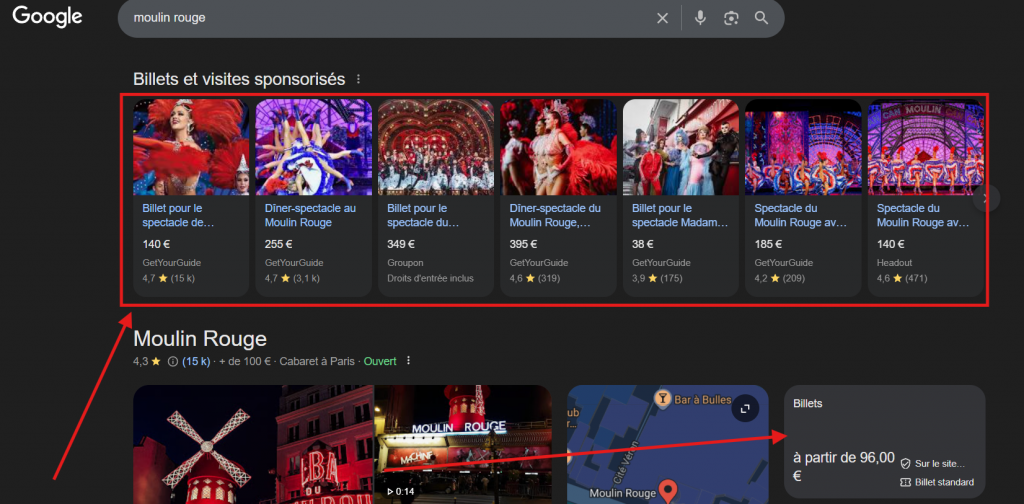
- A traveler searches for an activity (“guided tour Paris”, “Seine cruise”),
- Google displays boxes at the top of the page with available tickets,
- The user can compare options: official site, OTA (GetYourGuide, Viator…), local distributors.
The difference with Google Ads is significant: here, you do not pay to be displayed, but you must be connected via an official partner. Google Things To Do thus acts as an integrated marketplace: it highlights your products at the exact moment the customer is ready to buy.
Concrete example: typing “Louvre ticket” triggers a dedicated box where you find the official offer from the museum, but also those distributed by OTAs. Without a connection, you leave these strategic spots to your competitors.
To go further, discover our Google Things To Do feature.
Why use Google Things To Do for your activity?
For a tourism professional, Google Things To Do is a visibility accelerator and a reducer of dependence on OTAs. That’s why it can be crucial to want to integrate it.
Global visibility at the key moment
Unlike a website that has to fight to exist in organic results, your offers appear directly in the Google ecosystem. The user who types “ticket Musée d’Orsay” or “Seine cruise Paris” is already in a buying intent: you are placed before their eyes at the most decisive moment.
Reduce dependence on OTAs
Until now, many operators had no choice: to be visible, they had to go through Viator, GetYourGuide, or other distributors. The result: a significant share of sales went to commissions. With Things To Do, you can offer a direct channel alongside OTAs and maintain control over your customer relationship.
Improve conversion
Things To Do listings allow you to display prices, photos, and clear conditions directly in Google Search or Maps. By reducing the number of clicks before purchase, you increase your chances of converting. Less friction, more bookings.
In short: Google Things To Do is not a gadget, but a major evolution in tourism distribution. Those who connect gain visibility, independence, and revenue. Those who delay leave the field open to OTAs.
How to connect your activity to Google Things To Do?
Google Things To Do is not a magic button that you activate in two clicks. To appear in the results, you must meet certain conditions and, above all, go through an official integrator.
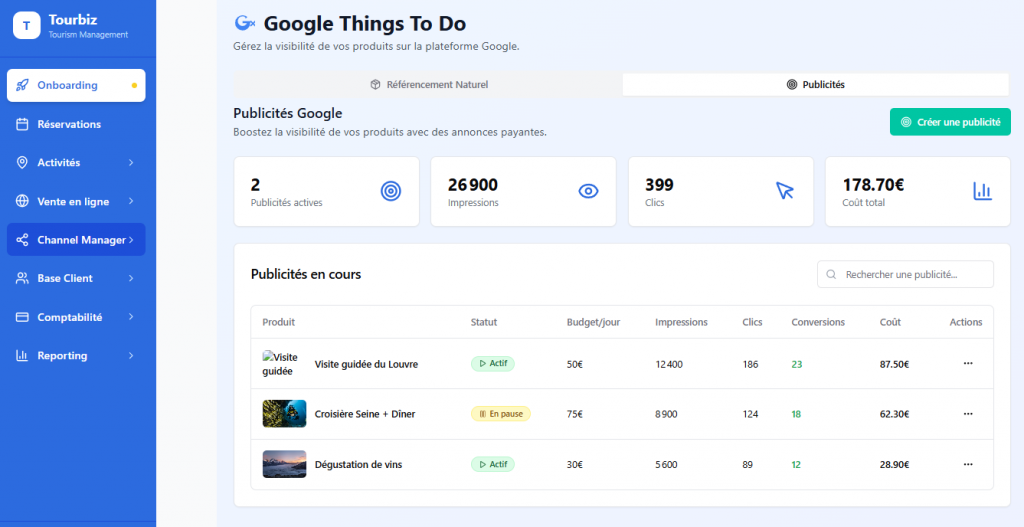
Case 1: You configure TTD yourself
If you want to manage it yourself: go to Google’s action center. The Action Center is the space where Google centralizes the management of experiences and tickets. If you already have a Google Business account, you can link it; otherwise, you create a dedicated one.
First of all, check the eligibility of your products.
Things To Do is designed for activities that require a reservation or a ticket: museums, attractions, guided tours, cruises, excursions.
For example: a restaurant, a shop, or a hotel alone cannot appear directly.
Then, follow these few steps:
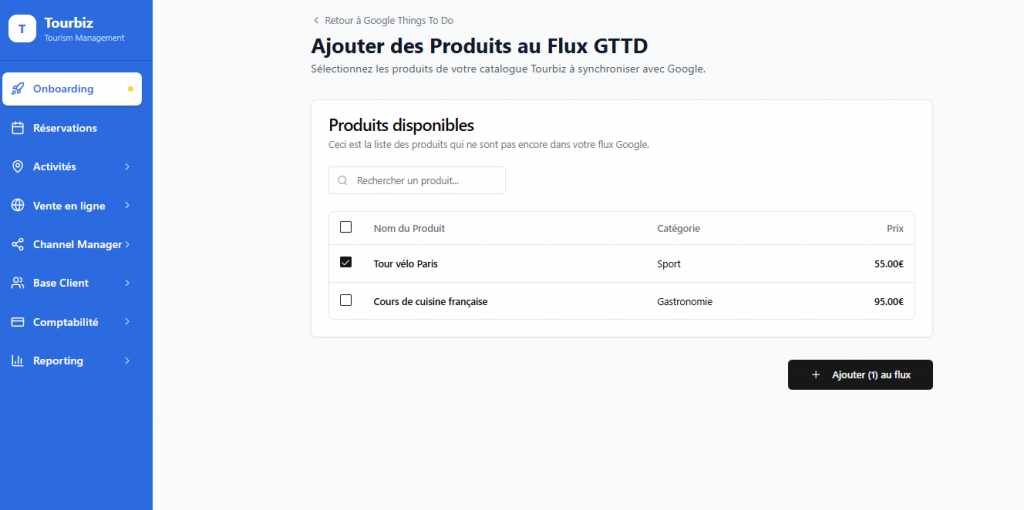
1. Add your products to your feed
This is where rigor comes into play: each product must comply with Google Things To Do guidelines. This includes:
- a clear and descriptive title (“Skip-the-line ticket Musée d’Orsay”),
- a concise description with essential information (duration, location, hours),
- an exact and updated price,
- at least one professional quality photo.
2. Check your data
Google applies strict controls to ensure that your listings are consistent and reliable. Pricing, translation, or schedule errors are quickly detected and can block publication.
3. Publish and wait for validation
Once your products are submitted, Google checks them before they appear in Search and Maps. The delay is variable, but the more complete your listings are, the faster the validation.
Case 2: You go through an integration partner
Google does not work directly with every tourism operator. To display your offers, you must connect your booking system to Things To Do via a certified technology partner. These integrators serve as intermediaries between your inventory and the Google platform.
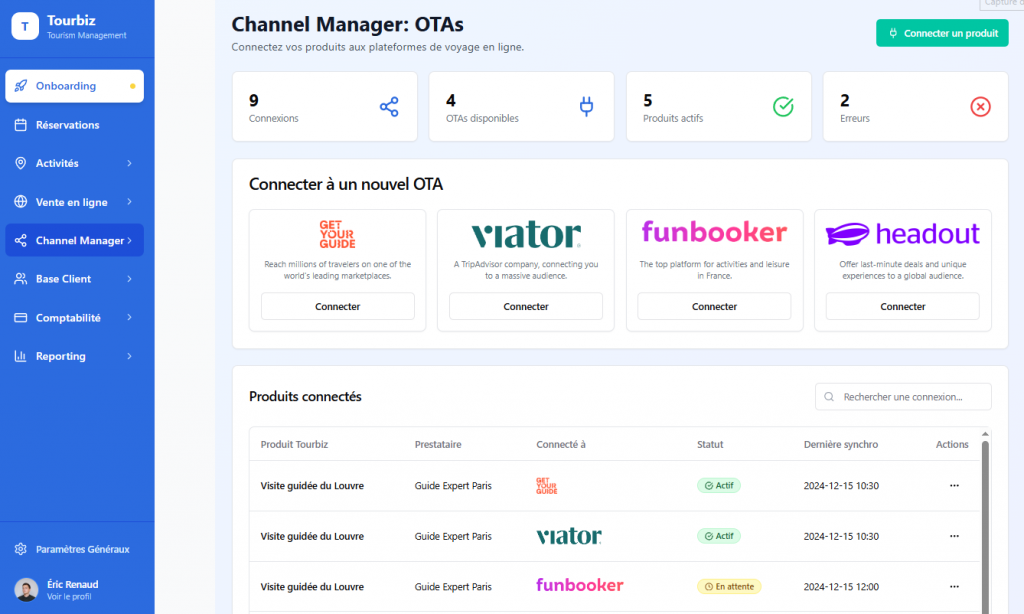
This is where a tool like Tourbiz simplifies things. As a channel manager software, it automatically connects your products to Google Things To Do. The result: your offers appear alongside OTAs, but as a direct channel, with your prices and conditions. You gain visibility without solely relying on Viator or GetYourGuide.
In practice, connecting to Things To Do through Tourbiz ensures that your offers are visible in the right place, at the right time, without additional technical effort.
Google Things To Do with Tourbiz
Connecting to Google Things To Do may seem reserved for giants, but Tourbiz makes it a powerful tool for any operator. The integration is native, simple, and designed for one thing: to put your direct sales back at the center of the game.
Clear and immediate advantages
- Effortless connection: your products — cruises, tours, museums, local activities — are automatically transmitted to Google. No line of code, no technical headache: what you create in Tourbiz can be broadcast on Things To Do.
- The “official site” in front: your offers appear alongside those of OTAs, but under the reassuring mention Official site. For the traveler, it’s obvious: clicking on your site guarantees the direct channel.
- Unified stocks and prices: you manage everything from the Tourbiz back office. An adjusted price or a closed availability is updated in real-time on Google, Viator, GetYourGuide, and your website.
- More margin, less dependence: every direct booking via Google Things To Do goes to you, without additional commission. That’s more sales and a percentage of margin saved.
Concrete example with a client case:
A Parisian cruise operator used to sell exclusively through Viator and GetYourGuide. The boats filled up, of course, but at a high price: each ticket sold was cut by 20% in commission.
Since connecting his catalog to Google Things To Do via Tourbiz, his offers now appear live in Google Search and Maps, under Official site. In three months, more than a third of his sales generated by Google have gone direct. Result: thousands of euros saved in commissions, without additional effort.
And above all, a regained relationship with his clients: direct emails, post-booking contacts, reviews left in his name — and not that of an OTA.
With Tourbiz, Google Things To Do stops being an experimental gadget and becomes a profitable, simple, and controlled direct channel.