
What is meant by “sales tracking” in the tourism sector?
Sales tracking in tourism is not just about counting your bookings. It is a continuous analysis work that helps understand how, when, and why your customers purchase your services. In other words: sales tracking is the compass of your commercial performance.
For a tourism operator, a Travel Planner, an agency, or an independent guide, tracking sales means:
- Identifying the best-performing products (and those to adjust)
- Measuring the effectiveness of each distribution channel
- Understanding customer behavior according to the season or the type of experience offered
The tourism sector has its particularities: strong seasonality, bookings from many channels (OTA, website, local agencies, messaging…), and a customer experience that must remain smooth from the first click to the end of the stay.
Good to know: are you starting your Tour Operator activity? Discover our guide to create your travel agency!
The key indicators to track vary according to the size and nature of the activity, but the most common include:
- Total revenue and revenue by channel
- The conversion rate of inquiries into firm bookings
- The average basket and occupancy rate
- The customer acquisition cost
A well-thought-out dashboard allows you to obtain this data at a glance. And to better understand how to leverage seasonality, discover our tips for managing clients in low season.
Why is sales tracking crucial for the performance of your activity?
Without regular tracking of your sales, you are navigating blind. Tracking is not limited to “doing the accounts”: it allows you to understand commercial dynamics and manage your activity proactively.
Here are the main benefits of rigorous tracking:
- Understand your revenue sources: knowing which services, tours, or offers generate the most profitability.
- Identify the most effective channels: GetYourGuide, Viator, or TripAdvisor do not all contribute in the same way to your revenue.
- Optimize prices and margins: tracking your sales data helps you adjust your pricing strategy in real-time.
- Anticipate demand variations: by spotting booking trends, you can better allocate your human and logistical resources.
The most successful tourism companies do not just observe their results: they leverage their commercial data to adjust their offers even before the market evolves.
How to structure an effective sales tracking process in tourism?
Good sales tracking is not a matter of chance. It relies on a method and rigorous organization. In other words: your data must be centralized, readable, and actionable.
Here are the pillars of a high-performing process:
- Define a clear dashboard: adapt your indicators to your business model. The priorities of a guided tour operator are not those of an accommodation provider.
- Centralize sales data: gather all your sources — website, OTA, direct sales, messaging — in one tool to avoid duplicates or blind spots.
- Automate reporting: schedule the sending of a weekly or monthly report to track your performance effortlessly.
- Set up alerts: configure activity thresholds (occupancy rate, gross margin, booking volume) to receive an alert as soon as an indicator deviates.
A well-structured process is not only for analysis: it becomes your best decision-making tool on a daily basis. And if managing your booking flows seems time-consuming, discover our tips for managing tourist bookings to streamline everything.
What tools to use for optimal sales tracking?
To track your sales effectively, you need tools capable of gathering, analyzing, and interconnecting your data. Depending on the size of your structure, your needs will not be the same.
- Tourism CRMs: they facilitate tracking prospects, bookings, and repeat customers. Ideal for agencies and DMCs.
- ERPs or integrated platforms: designed for multi-site or multi-product operators, they centralize sales, stocks, teams, and finances.
- OTA connectors: useful for automatically synchronizing your bookings from GetYourGuide, Viator, Expedia, or Google Things to Do.
- Automation and analysis tools: Google Data Studio or Power BI can help you visualize your KPIs in real-time.
The choice depends on your priority: time savings, simplification, or strategic management. To better understand how to interconnect your solutions, consult our guide on connecting Viator and optimize your data flows between platforms.
How to manage your tourist sales directly from Tourbiz?
Tourbiz has been designed so that sales tracking is no longer a headache, but a real performance lever. Thanks to its integrated module, each tourism operator can visualize in real-time the evolution of their revenue and the performance of their sales channels, without juggling between multiple platforms.
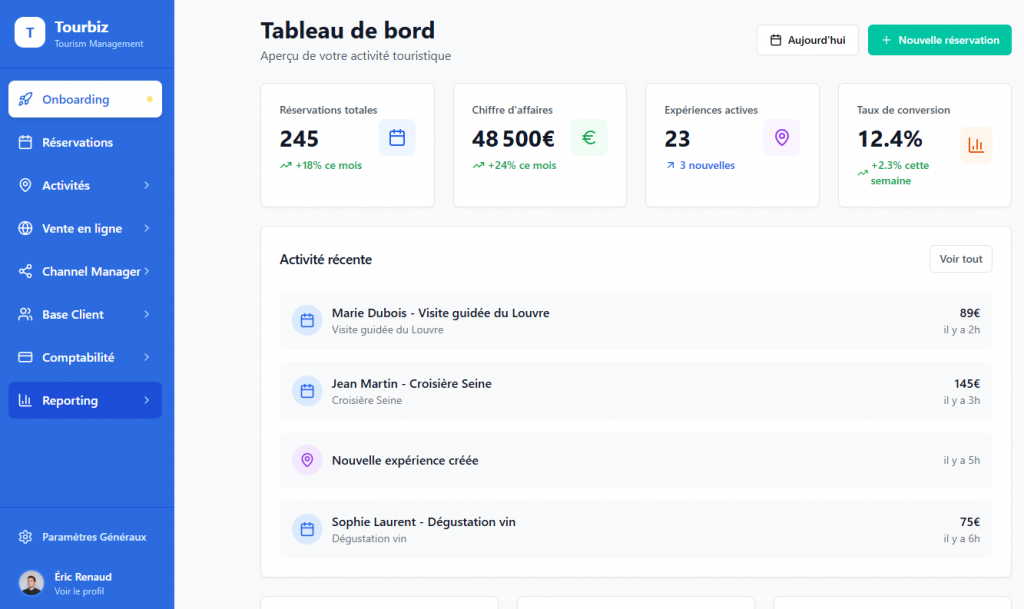
Specifically, sales tracking in Tourbiz is based on four pillars:
- Direct connection to booking platforms: easily integrate your GetYourGuide, Viator, or Expedia accounts. Data automatically feeds into your dashboard.
- Automatic import of bookings: each validated sale is synchronized, eliminating data entry errors and saving you valuable time.
- Real-time reports and analyses: check your performance statistics by channel, type of activity, or period, without complex manipulation.
- Smart alerts: Tourbiz notifies you when your indicators exceed a critical threshold or when a booking trend emerges.
The biggest advantage? Everything is centralized. You can compare at a glance your OTA sales with your direct sales, identify the most profitable experiences, and adjust your prices based on observed trends.
To fully leverage these integrations, find our detailed tutorial on the connection to GetYourGuide and discover how to synchronize your sales automatically in just a few clicks.