
What is electronic invoicing (and why is it changing everything)?
We’ve been talking about it for a while, but few really know what it is.
The electronic invoicing is not just sending a PDF by email.
It is much more than a simple attachment: it is a structured data, readable by both humans and machines.
In short: the invoice becomes an interoperable data flow, designed to be read automatically by accounting software, ERPs, and soon, the tax systems themselves.
The new standard: Factur-X, UBL, CII
Three formats are recognized by the DGFiP:
- Factur-X: a clever hybrid between a readable PDF and a hidden XML file inside.
👉 It is the most popular format (and the one adopted by Tourbiz). - UBL and CII: 100% structured formats, more technical, intended for large volumes and integrated systems.
These formats ensure compliance, traceability, and automatic integration into management tools.
PDP vs PA: what change for electronic invoicing?
If you’ve ever typed “PDP electronic invoicing” into Google, you’re not alone.
It is still the most searched term on the subject. However, since 2024, the official terminology has changed: goodbye PDP, hello PA.
But then, what does this simple acronym change hide?
PDP, the old world
The PDP, or Partner Dematerialization Platform, referred to the intermediaries authorized to transmit your electronic invoices to the Public Invoicing Portal (PPF).
These platforms ensured the transit, control, validation of data, and their transmission to the administration.
The problem is that the PPF, the central hub of the State, did not survive the reform. Too rigid, too slow, too costly.
PA, the new era
Now it’s time for the PA, for Approved Platform.
In essence, nothing really changes: the PAs play the same role as the old PDPs.
They receive, control, route, and transmit tax data to the DGFiP.
But in form, everything changes:
- The PAs are fully private, approved by the State according to a strict protocol;
- They can work directly with each other, without going through a central portal;
- And they become the single entry point for issuing and receiving electronic invoices.
Why keep “PDP” in this article?
Because administrative vocabulary has inertia: thousands of professionals continue to search for “PDP electronic invoicing”. By keeping the term, you find the information you are looking for while discovering the updated vocabulary.
👉 In other words, “PDP” and “PA” refer to the same thing, but “PA” is the only term now recognized by the tax administration.
⚠️ End of the PPF: a turning point to understand
The Public Invoicing Portal (PPF), formerly Chorus Pro, will no longer manage your invoices from the reform.
It becomes a national directory and a collector of tax data, nothing more.
From now on, everything goes through an Approved Platform (PA) — or through an Operator of Dematerialization (OD) connected to a PA. And it is these private actors who will guarantee the compliance of your accounting flows.
If you are already using a management or ticketing software like Tourbiz, good news: it will speak the language of the PAs — without you having to reinvent your invoicing process.
What does this change for tourism professionals?
In parks, museums, agencies, or river companies, we often juggle multiple systems: ticketing, CRM, accounting, marketplace, CE partners…
Tomorrow, these flows will all need to speak the same language.
With electronic invoicing, each B2B sale becomes an automated flow, without double entry, without errors, without unnecessary reminders.
Accounting reconciliations will be done in a few clicks.
And for managers, financial data will be cleaner, more usable, and faster to consolidate.
The new deadlines for electronic invoicing in France for 2026 and 2027
The reform of electronic invoicing is advancing at a rapid pace.
And while successive delays have sown doubt, the schedule is now set and definitive.
Two dates to remember — engraved in the marble of the DGFiP: September 1, 2026 and September 1, 2027.
📅 September 1, 2026 — First step: receive
From this date, all French companies, regardless of their size, must be able to receive electronic invoices.
This means that your accounting, your ERP, or your management software (including Tourbiz) must be connected to an Approved Platform (PA).
Large companies and ETIs will also need to start issuing their invoices in structured electronic format.
This is the learning phase: we receive, we adapt, we automate data reading, we adjust flows.
📅 September 1, 2027 — Second step: issue
One year later, the rest of the economy will join in.
SMEs, TPEs, micro-enterprises, independent tourism professionals, and leisure service providers: it’s your turn.
From this date, issuing invoices in electronic format becomes mandatory.
And this directly concerns all actors in tourism:
- ticketing, agencies and offices,
- activity providers, museums, leisure centers,
- cruise operators, parks, or event companies.
In practice, your B2B invoices (partners, CE, operators, local authorities, etc.) must be issued in Factur-X, UBL, or CII format, via an approved PA.
Why this reform?
Beyond the constraints, there is a strong logic:
- Modernize B2B exchanges and secure payments.
- Automate VAT collection (no more manual declarations and data entry errors).
- Reduce fraud through real-time monitoring of flows.
- Simplify the life of businesses, especially those juggling hundreds of invoices per month.
The idea is to transform the invoice into living data: more than a document, a structured, usable flow interconnected with your tools.
🧭 The 3 steps to comply (ticketing special)
For tourism actors, electronic invoicing may seem like a complex process.
But in practice, it boils down to three simple and essential steps.
And if you use a business software like Tourbiz, you already have a head start.
The 3 steps to follow in practice
✅ Register your business in the official directory.
✅ Connect your software to an Approved Platform.
✅ Issue your invoices in Factur-X format.Here are the details.
1️⃣ Register in the central directory
First of all, your business must appear in the official electronic invoicing directory:
👉 https://facturation.chorus-pro.gouv.fr/annuaire/#/
This registration associates your SIREN/SIRET with an electronic invoicing address, called “registration address”.
This address will allow your B2B partners to send you their invoices via their Approved Platform (PA).
💡 In short: without this registration, no electronic invoice can be delivered to you.
2️⃣ Choose your Approved Platform (PA)
This is the crux of the matter.
Your PA is the technical gateway between your invoicing system and the national network.
You have two options:
- Use a PA directly, like Sage, Cegid, Pennylane, or other publishers approved by the DGFiP;
- Go through an Operator of Dematerialization (OD) integrated into your business software, which relays your invoices to one or more PAs.
💬 Concrete example:
Tourbiz, business software dedicated to tourism and leisure, is already connected to several Approved Platforms.
This saves you from having to choose an additional provider: everything is done from your usual environment.
3️⃣ Issue your invoices in the correct format
The famous Factur-X format is becoming the standard for SMEs and tourism actors.
Why? Because it combines the best of both worlds:
- a readable PDF for humans;
- a structured XML for accounting software.
Tourbiz already adopts this format. Each invoice issued from the platform complies with Factur-X standards and can be transmitted directly to the client’s PA, without manual handling.
The new mandatory mentions on your electronic invoices
The electronic invoice is not just a new format — it also redefines the information that an invoice must contain.
As a reminder, the DGFiP’s goal is to make each transaction perfectly identifiable, interpretable, and automatically usable.
In other words, every line, every field matters.
The classic mentions… that remain
Nothing changes on the fundamentals:
- the date of issue,
- the invoice number,
- the amount excluding tax, VAT, including tax,
- the contact details of the client and the supplier,
- the description of the service.
These mentions remain, but they must now be structured, meaning readable by accounting systems.
The new mentions specific to electronic invoicing
From 2026–2027, several fields become mandatory on electronic invoices:
- SIRET of the issuer and the recipient: to precisely identify the companies in the central directory.
- Type of operation: sale of goods, provision of services, or mixed.
- VAT category: normal rate, reduced, exempt, or self-liquidated.
- Electronic invoicing address: the address from the Chorus Pro directory (that of your PA).
- Unique transaction identifier: generated automatically by the system.
- Structured compliant format: Factur-X, UBL, or CII.
This information is no longer simply “displayed”: it is coded in the data and read automatically by management tools.
Why are these mentions now essential?
These new fields allow the administration to:
- check in real-time the consistency between sales and VAT declarations;
- track inter-company transactions without waiting for the end of the quarter;
- simplify controls and pre-filling of tax declarations.
In return, businesses gain transparency and reduce errors — no more juggling with double entries or lost invoices.
In ticketing or leisure activities, these mentions will be crucial for:
- manage differentiated VAT rates (5.5%, 10%, 20% depending on the case);
- track deposits, credits, or multi-site sales;
- streamline exchanges with agencies, works councils, and B2B partners.
Tourbiz being already compatible with the Factur-X format, we automatically integrate these fields when generating your invoices — you remain compliant without changing your habits.
How to choose your Approved Platform (PA)?
As explained in the introduction, the Approved Platform (PA) is somewhat the invisible pivot of the reform: without it, no invoice circulates.
It is the one that receives, verifies, formats, routes, and archives the tax data on behalf of companies.
But not all PAs are equal — and choosing yours well can make the difference between smooth compliance and an administrative nightmare.
1. Check your current software
First question to ask yourself:
Will your management or accounting software integrate a PA?
Most major publishers (Sage, Cegid, Pennylane, QuickBooks, etc.) already announce native connections with one or more approved platforms.
Business solutions like Tourbiz — designed for tourism professionals — follow the same path: they communicate directly with several PAs, without additional gateways.
💡 If your tool is already compatible with the Factur-X format, you are halfway to compliance.
2. Understand how a PA works
An Approved Platform is not just a simple host:
- it controls the validity and compliance of each invoice;
- it ensures its routing to the recipient’s PA;
- it transmits essential data to the DGFiP (e-reporting VAT);
- it keeps a history of flows for consultation and proof.
The approval granted by the DGFiP is based on very strict criteria: security, availability, traceability, and interoperability.
👉 The official list of approved PAs will be published before 2026 on the government website (DGFiP / impots.gouv.fr).
3. Or go through a Dematerialization Operator (OD)
You can also entrust the technical management to a Dematerialization Operator (OD), integrated into your business software.
The OD acts as an intermediary: it formats your invoices, verifies them, and then sends them to one or more partner PAs.
This is often the most flexible solution for SMEs and tourism players, as it avoids the multiplication of interfaces and simplifies configuration.
4. The right criteria for choosing
The choice of your PA depends on several factors:
- The volume of invoices (a few dozen or several thousand per month?)
- Your software ecosystem (ERP, ticketing, CRM, accounting)
- Your budget (some PAs charge per transaction, others by subscription)
- Your specific needs: archiving, automation, accounting export, status tracking.
To summarize…
✅ Start by checking if your software is already connected to a PA.
✅ If not, anticipate the connection by 2025.
✅ Prefer solutions that allow you to choose your PA — like Tourbiz.
Thus, you remain free, compliant, and ready for the switch on September 1, 2026.
The specifics of electronic invoicing for ticketing and the tourism & leisure sector
The reform of electronic invoicing does not affect everyone in the same way.
And in tourism, it is a real balancing act between B2C and B2B.
Tickets sold to the general public? Not much affected.
But inter-company sales — agencies, works councils, local authorities, tour operators, partner service providers — will be directly impacted.
Let’s look at this in detail.
If you work in B2C, there is no direct obligation
Most players in tourism operate on massive volumes of B2C transactions:
online bookings, ticket sales, museum entries, dinner cruises, outdoor activities…
These operations are not subject to mandatory electronic invoicing.
But be careful: these flows remain subject to VAT and may sometimes need to be aggregated in the automatic reporting that the Approved Platforms will send to the administration.
In other words, even if you do not issue electronic invoices for your visitors, your B2C sales data could be partially reported via your accounting tool.
If you work in B2B, the obligation applies
This is where the reform makes complete sense.
From 2027, all your invoices addressed to other companies must be issued in structured electronic format.
Examples:
- sales to works councils or local authorities;
- invoices to partner travel agencies;
- services for corporate events or groups.
💡 These invoices, like all those concerned by the transition to electronic invoicing, must therefore go through an Approved Platform and comply with the Factur-X, UBL, or CII format.
Some particular cases to anticipate
The tourism sector multiplies fiscal subtleties:
- Deposits and balances to be invoiced separately;
- Credits and refunds of reservations;
- VAT on margin for agencies and organized tours;
- Reduced rates (5.5% or 10% for culture, transport, or catering);
- Multi-site or multi-legal entity sales.
All elements that need to be correctly configured in your software before the switch.
The right reflex to have
Define now, in your management or ticketing solution, the nature of each operation (service, good, applicable VAT, special conditions).
This preparatory work will save you from receiving non-compliant invoices in 2026.
Tourbiz, for its part, already integrates these specific cases:
- Multi-activity and multi-site management,
- Configuration of VAT rates specific to tourism,
- Automatic issuance of compliant B2B invoices,
- Direct export to your accounting or your Approved Platform.
The role of Tourbiz in this transition
In a context where every player in tourism must juggle between regulation, accounting, and customer experience, Tourbiz does not just follow the reform — it anticipates it.
The new version of the software has been designed to make electronic invoicing simple, fluid, and automatic, without sacrificing ergonomics or the business logic of sector professionals.
Tourbiz, already compatible with Factur-X
From today, all invoices issued via Tourbiz can be generated in Factur-X format, the standard adopted by the DGFiP.
This hybrid format — readable PDF + structured XML — allows for a balance between human visibility and technical compliance.
Result:
- your clients see a clear and readable invoice;
- your accounting partners receive a file perfectly usable by their systems.
Direct connection with several Approved Platforms (PA)
Tourbiz is currently working on native connection with several market PAs, to allow each client to freely choose their provider.
The goal: for your invoices to be transmitted automatically, regardless of your accounting ecosystem.
This interoperability guarantees you total freedom: you remain in control of your tools, without dependence on a single platform.
The concrete benefits for Tourbiz users
- Compliant invoices from issuance: each invoice meets the structure required by the DGFiP.
- Automatic transmission to the client’s PA: zero manual export, zero email sending.
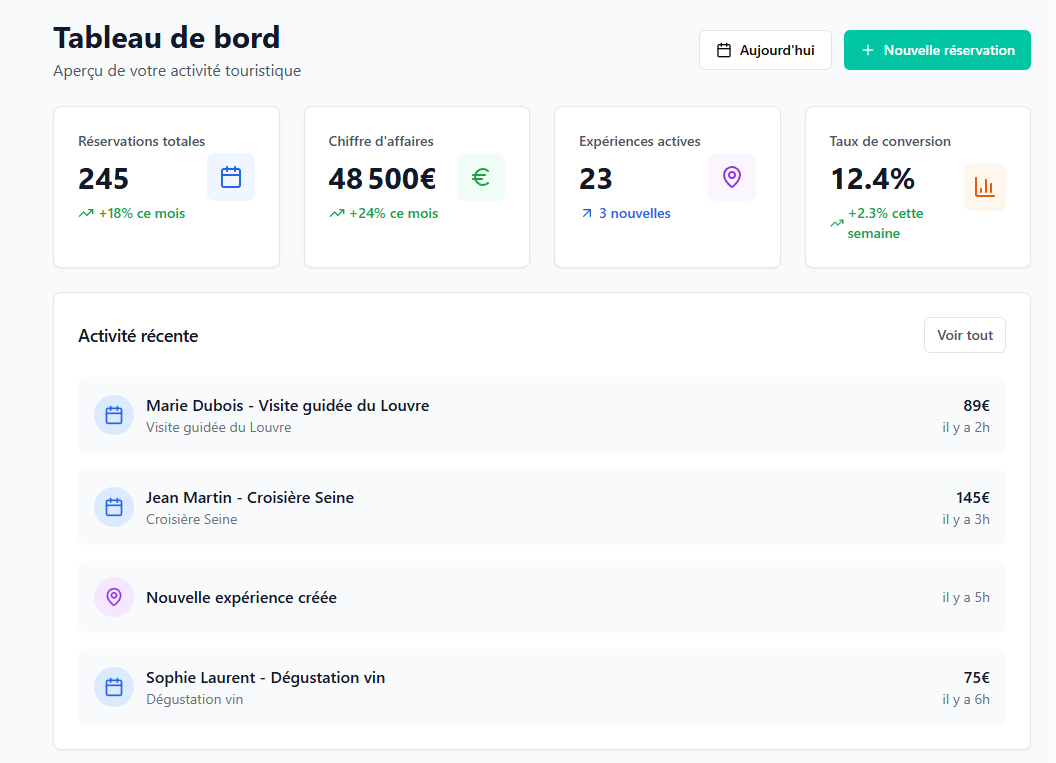
- Real-time tracking: invoice status (issued, transmitted, accepted, rejected) accessible from your interface.
- Reduction of data entry errors: thanks to the automatic generation of tax and VAT data.
- Time savings in accounting: your entries synchronize directly with your accounting software.
A global view of compliance
Tourbiz supports tourism players towards a more reliable, more connected, and more modern management. You continue to sell, manage, and invoice as before — but better, faster, and 100% compliant.